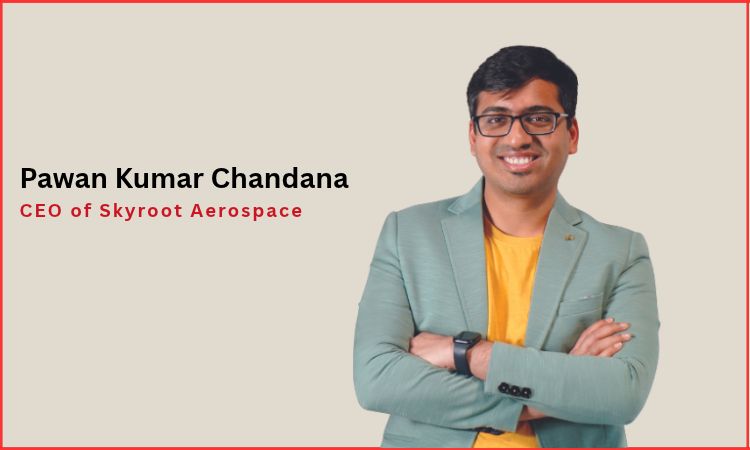
Pawan Kumar Chandana is the co-founder and CEO of Skyroot Aerospace, the Hyderabad company that put an Indian private rocket into orbit in July 2026. If you’re after a complete Pawan Kumar Chandana biography, this guide covers his age, education, career, net worth and the Skyroot Aerospace success story in one place.
A decade ago, the idea of a private Indian company building rockets sounded like a long shot. Today the Indian space startup industry is crowded with founders attempting exactly that, and Chandana, a former ISRO engineer, is one of the people who made it feel possible. Below, we trace how a mechanical engineer from Hyderabad became the Skyroot Aerospace CEO, what he has achieved so far, and what still has to go right.
Pawan Kumar Chandana Biography: Quick Facts
| Particulars | Details |
| Full name | Pawan Kumar Chandana |
| Known for | Co-founder and CEO of Skyroot Aerospace |
| Birth year | 1991, per media reports |
| Age | About 34 to 35 in 2026 |
| Birthplace | Hyderabad, India |
| Education | B.Tech and M.Tech dual degree, IIT Kharagpur (2012) |
| Earlier career | Nearly six years at ISRO’s Vikram Sarabhai Space Centre |
| Company founded | Skyroot Aerospace, 2018, with Naga Bharath Daka |
| Net worth | Not publicly verified |
| Recent recognition | TIME100 Next 2026 |
Early Life and Pawan Kumar Chandana Age
Pawan Kumar Chandana was born in 1991 in Hyderabad, according to media reports, which puts Pawan Kumar Chandana’s age at roughly 34 or 35 in 2026. His exact date of birth isn’t consistently confirmed in authoritative public sources, so the birth year is best treated as approximate.
Published profiles mention that maths wasn’t his strongest subject at school. The detail gets repeated because it’s a good reminder that early marks don’t decide where someone ends up. What he did have was a pull toward engineering and rockets, and that curiosity carried him through a demanding academic path and later into India’s space sector.
Instead of chasing a conventional corporate job, he set his sights on contributing to the country’s space programme. Leaving it to build his own company came years afterwards, and it became the turning point of his career.
Pawan Kumar Chandana Education: IIT Kharagpur and Rocket Science
Pawan Kumar Chandana’s education took serious shape at IIT Kharagpur, where he finished a dual degree in Mechanical Engineering and Thermal Science and Engineering in 2012. That B.Tech and M.Tech combination suited rocket work well.
Mechanical engineering covers design, materials and structures. Thermal science deals with heat transfer and combustion, both central to propulsion. A rocket has to survive crushing pressure, extreme temperatures and violent vibration, so these subjects aren’t academic extras. They sit at the heart of launch vehicle engineering.
The degree gave him a technical base, and it also showed him how much precision, testing and reliability matter when an aerospace system has only one chance to work. That mindset shaped Pawan Kumar Chandana’s career at ISRO and, later, at Skyroot.
Pawan Kumar Chandana Career: Six Years at ISRO
After graduating in 2012, Pawan Kumar Chandana joined the Indian Space Research Organisation and worked at the Vikram Sarabhai Space Centre, one of India’s main launch vehicle centres. He stayed nearly six years. According to India Today, his work touched programmes such as the GSLV Mk III and the Small Satellite Launch Vehicle (SSLV).
That experience counted for a lot. Building a rocket is about far more than designing an engine. Propulsion, structures, avionics, guidance, materials, testing and launch operations all have to work together. Six years inside a national programme taught him how complicated reliable launch vehicles are, and why a strong engineering culture matters.
Still, his ambitions went further. He wanted to find out whether private enterprise could build launch vehicles in India and offer commercial customers another route to orbit. In 2018 he left ISRO and teamed up with fellow former ISRO engineer Naga Bharath Daka to found Skyroot Aerospace. The timing helped. Small satellites were becoming more useful, operators struggled to find suitable launch slots, and government reforms along with IN-SPACe were opening the door for private companies.
Skyroot Aerospace Success Story: From Vikram-S to Vikram-1
Founded in 2018 and based in Hyderabad, Skyroot Aerospace builds launch vehicles for commercial satellite missions. Chandana is co-founder and the Skyroot Aerospace CEO, while Daka is co-founder and COO. The company works on propulsion systems, composite structures and avionics, and has invested in its own manufacturing and testing capability.
Its rockets carry the Vikram name, a tribute to Vikram Sarabhai, widely seen as the father of India’s space programme. The pitch is simple. Small-satellite operators often wait for larger missions or share launch capacity, so Skyroot offers dedicated launches built around their orbit and schedule.
The first big moment came in November 2022, when Vikram-S flew on the Prarambh mission and showed what India’s private space sector could do. Then, on 18 July 2026, Vikram-1 reached low Earth orbit and placed multiple payloads there. For the Skyroot Aerospace success story, that’s the headline: proof that an Indian private company can develop and fly an orbital rocket.
A first orbital flight isn’t the finish line, though. Customers want repeat launches, predictable schedules and dependable manufacturing. As Skyroot Aerospace CEO, Chandana’s real job now is turning one great mission into a service people can count on.
Pawan Kumar Chandana Net Worth
Pawan Kumar Chandana’s net worth hasn’t been reliably established in public information, so any precise figure you come across online is a guess.
What is known is the company’s valuation. In May 2026, Reuters reported that Skyroot reached about $1.1 billion after a $60 million round led by GIC and Sherpalo Ventures, with BlackRock taking part. Total funding stood at around $160 million at that point.
That number belongs to the company, not to him. A founder’s personal wealth depends on his equity stake, other assets, liabilities and what he can actually sell. A valuation also isn’t revenue or profit. Until his holdings are disclosed, the honest answer on Pawan Kumar Chandana’s net worth is simple: not publicly verified.
Awards and the Indian Space Startup Industry
Recognition has followed the launches. In October 2026 Chandana was named to TIME100 Next 2026. Earlier honours listed in his profiles include Forbes 30 Under 30 Asia, the Economic Times 40 Under Forty list and a Young Alumni Achiever Award linked to IIT Kharagpur. Skyroot itself picked up the National Startup Award in 2020 and a National Award for Technology Startups in 2022.
Beyond the trophies, his story shows how the Indian space startup industry is changing. Small satellites for communication, Earth observation and research keep multiplying, and operators want more launch options. A stronger private launch sector can create work for engineers, component makers, satellite companies and research institutions, and it can pull investment into materials, propulsion and manufacturing.
Skyroot’s next phase will test all of this: more production capacity, a steady supply chain, paying customers and repeat launches. How that goes will say a lot about whether the Indian space startup industry can compete globally.
What Aspiring Founders Can Learn from Pawan Kumar Chandana
- Deep knowledge can become a business. His engineering background helped him spot a gap in how small satellites get launched.
- A career switch can open doors. Leaving ISRO meant uncertainty, but it also meant a different vision for rocket development.
- Deep-tech takes patience. Testing, specialised teams and long-term funding come before any reliable service.
- A rocket isn’t a business model. Costs, customers and dependable delivery matter just as much.
- A milestone is a beginning. Repeat launches are what build a lasting company.
Conclusion
This Pawan Kumar Chandana biography follows one engineer from IIT Kharagpur and ISRO to the top of Skyroot Aerospace. His career shows how specialised training, a bold career switch and a growing Indian space startup industry can come together. The next test is consistent launches and real commercial partnerships. If Skyroot delivers, his story will be remembered as the start of something bigger for private space in India.
Frequently Asked Questions
1. Who is Pawan Kumar Chandana?
An Indian aerospace engineer, co-founder and Skyroot Aerospace CEO, building rockets for commercial satellite launches.
2. What is Pawan Kumar Chandana’s age?
Media reports give his birth year as 1991, so he is about 34 to 35 in 2026.
3. What is Pawan Kumar Chandana’s education?
A dual degree in Mechanical Engineering and Thermal Science and Engineering from IIT Kharagpur, completed in 2012.
4. What is Pawan Kumar Chandana’s net worth?
It isn’t publicly verified. The $1.1 billion figure is Skyroot’s valuation, not his personal wealth.
5. What is Skyroot Aerospace known for?
Vikram-S flew in 2022, and Vikram-1 reached low Earth orbit in July 2026.