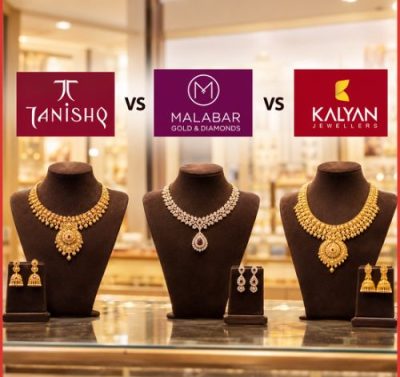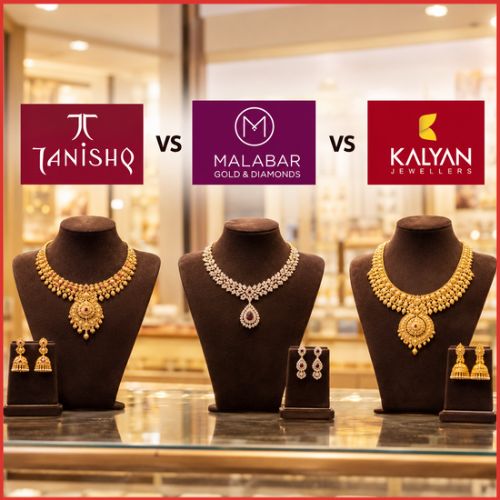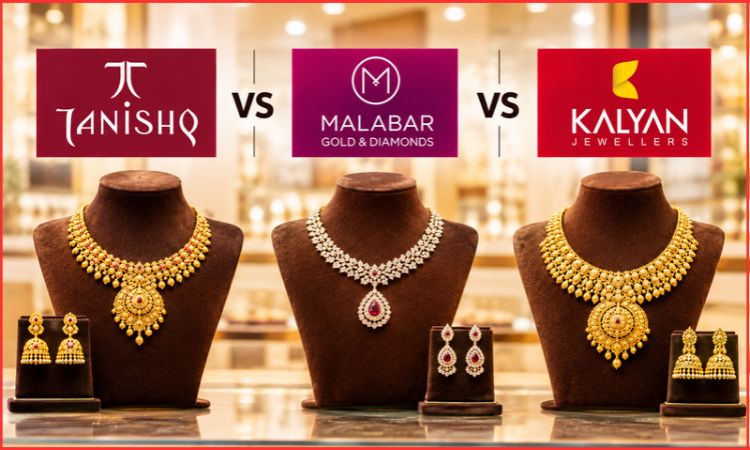
Gold is the one purchase Indian families make for love, luck and safekeeping all at once. That’s why jewellery has quietly become one of the most closely watched consumer businesses in the country, and why three names, Tanishq, Malabar Gold & Diamonds and Kalyan Jewellers, come up in almost every boardroom conversation about it.
They sell the same metal but run very different companies. Tanishq sells trust and design under the Tata umbrella. Malabar sells scale across 14 countries. Kalyan sells familiarity, with a franchise-led model that lets it open showrooms fast. This Tanishq vs Malabar Gold vs Kalyan Jewellers comparison looks at how each one makes money, how big each really is and who each suits. If you’re sizing up the best jewellery brands in India, as a buyer or as an investor, the answer isn’t a single name, because the leading gold jewellery brands in India each win on a different test.
Tanishq vs Malabar Gold vs Kalyan Jewellers
| Parameter | Tanishq (Titan) | Malabar Gold & Diamonds | Kalyan Jewellers |
| Parent company | Titan Company, Tata Group | Malabar Group | Kalyan Jewellers India Ltd (listed) |
| Headquarters | Bengaluru (Titan) | Kozhikode, Kerala | Thrissur, Kerala |
| Started | 1994; retail identity from 1996 | 1993 | 1993 |
| Positioning | Premium, design-led | Traditional and global, wide range | Traditional, regional, wedding-led |
| Latest financial figure | Jewellery division: ₹18,195 crore in Q4 FY26 (one quarter, excl. bullion) | About ₹63,000 crore global turnover (June 2025); FY26 target ₹78,000 crore | ₹35,743 crore revenue and ₹1,350 crore profit after tax in FY26 |
| Recent growth | Q4 FY26 jewellery revenue up 50% | FY26 target implies roughly 24% growth | FY26 revenue up 43%; Q1 FY27 up about 45% |
| Stores | 1,194 jewellery stores in India (Mar 2026), all Titan formats | 445+ showrooms in 14 countries | 342 Kalyan showrooms in India plus 124 Candere stores (FY26) |
| Operating model | Company-owned and franchise stores; sister brands Mia, Zoya, CaratLane | Owned showrooms plus own manufacturing, sourcing and wholesale | Franchise-owned, company-operated (FOCO) |
| Flagship lines | Rivaah, Mia, Zoya, Tanishq Diamonds | Bridal, gold, diamond, platinum, gemstone; Nuwa, Aanika, Nayraa | Muhurat, Nimah, Mudhra, Candere |
| Overseas presence | Gulf, North America, Singapore; Damas (UAE) stake | Strongest of the three | Middle East and USA |
| Key strength | Brand trust and design | Variety and global reach | Regional appeal, capital-light expansion |
| Watch-out | Premium pricing | Turnover isn’t comparable with listed revenue | No published national market share |
The Jewellery Retail Industry in India 2026
Any fair Indian jewellery market comparison starts with the size of the market. India’s jewellery trade is worth well over ₹6 lakh crore a year by most estimates, and one forecast expects the domestic market to reach about USD 145 billion by FY28. The share going to organised players keeps rising: Kalyan’s investor presentation puts it at roughly 40% in 2025, up from 5% in 2000, though other estimates sit nearer 30% to 40%. Weddings drive about 60% of demand, and the South accounts for around 40% of sales.
Gold prices flatter the numbers right now. Titan said higher gold rates alone added nearly ₹20,000 crore to its FY26 revenue, so some of the growth across the leading gold jewellery brands in India is price, not volume. The jewellery retail industry in India 2026 is also still fragmented. Titan, the largest player, estimates its own share at about 8.5%.
Tanishq Business Model: Built on Trust
Titan’s jewellery arm entered a market where most buyers simply took a local jeweller’s word on purity. The Tanishq business model was built to remove that doubt: hallmarked gold, the Karatmeter (introduced in 1997) to test purity in the store, fixed standards and a Tata name behind it all. Premium pricing follows from that promise. Tanishq competes on design and assurance, not on the lowest making charge.
It also runs a portfolio rather than one brand. Rivaah covers bridal, Mia targets lightweight everyday wear, Zoya sits at the luxury end and Tanishq Diamonds handles gifting and celebrations, while CaratLane reaches younger online buyers. That part of the Tanishq business model lets Titan serve several income groups without diluting the flagship.
The numbers show the model scales. In Q4 FY26 the jewellery division earned about ₹18,195 crore, up 50%, with Tanishq, Mia and Zoya contributing ₹16,047 crore. Titan ended March 2026 with 1,194 jewellery stores in India and, through a 67% stake in Damas Jewellery, added 123 stores in the Gulf. The catch is price. Some pieces cost more than comparable ones elsewhere, so compare making charges and exchange terms before buying.
Malabar Gold and Diamonds Revenue and Reach
Malabar began in Kerala in 1993 and now looks more like a global retailer than a regional jeweller. It sells everything from heavy bridal sets to everyday chains, and it keeps adding lines. 2026 brought the Nuwa natural diamond, Aanika diamond and Nayraa gemstone collections, along with MS Dhoni as brand ambassador.
On Malabar Gold and Diamonds revenue, one caution applies. The group reports global retail turnover, not audited listed-company revenue, so it can’t be set directly against Titan or Kalyan. It reported ₹51,218 crore in April 2024 and about ₹63,000 crore in June 2025, then set a ₹78,000 crore target for FY26 backed by a ₹5,000 crore investment plan. A confirmed FY26 figure wasn’t available at the time of writing, so none is quoted here. The company lists more than 445 showrooms across 14 countries.
The model behind Malabar Gold and Diamonds revenue leans on vertical integration, with its own manufacturing, sourcing and wholesale operations, and on Indian customers abroad. Its “One India One Gold Rate” scheme and emphasis on responsible sourcing are aimed at the same thing as Tanishq’s purity checks: making a high-ticket purchase feel safe.
Kalyan Jewellers Market Share and the FOCO Model
T.S. Kalyanaraman founded Kalyan in Kerala in 1993. It built its name on traditional and wedding jewellery, with Muhurat for bridal, Nimah for handcrafted heritage pieces and Mudhra for traditional designs, and it runs the digital brand Candere.
The Kalyan Jewellers market share question has no clean answer, because the company doesn’t publish a national figure. The growth is clear, though. FY26 consolidated revenue was ₹35,743 crore, up 43%, with profit after tax of ₹1,350 crore, up 86%, and Q1 FY27 revenue rose about 45% to ₹10,589 crore. Management credits share gains in newer markets where organised penetration is low. Set against a ₹6 to ₹7 lakh crore market, a rough sum puts Kalyan at 5% to 6% at most. That’s a back-of-envelope estimate, not an official number, and it’s a ceiling because the revenue includes overseas sales and Candere.
The engine behind Kalyan Jewellers market share gains is the franchise-owned, company-operated (FOCO) model. Partners fund the showroom while Kalyan manages operations and brand standards. It’s capital-light, and it’s how Kalyan reached 342 Kalyan showrooms in India and 124 Candere stores by the end of FY26.
Designing for the Customer: Who Each Brand Is Really Talking To
Tanishq designs for the urban, brand-aware buyer who wants jewellery that fits a life and not just a wedding. Mia’s lightweight pieces are aimed at working women, Rivaah breaks bridal down by regional wedding traditions, and Zoya takes the premium end. Its advertising follows the same logic. It tells stories about relationships and changing social values instead of just showing gold.
Malabar designs for breadth. Heavy bridal sets serve families, lighter gold and diamond pieces serve daily wear, and lines like Nayraa bring colour for gemstone lovers. The Indian diaspora is a core audience, so its designs have to travel, yet it still localises. Nayraa, for instance, was launched through a gemstone festival across four southern states.
Kalyan designs for the wedding-led, regionally rooted family. Collections follow local taste, with Muhurat for bridal and Mudhra for traditional patterns, and its campaigns lean on celebrity faces and family moments told in several languages. Candere is its answer for younger shoppers who buy online and want something more contemporary.
The Strategies Behind Their Rise as Top Jewellery Brands in India
The three companies differ, but the playbook behind the leading gold jewellery brands in India has a lot in common.
Trust before sales. Hallmarking, in-store purity checks, a single gold rate and responsible sourcing all do the same job. They tell a first-time buyer that a high-ticket purchase is safe, which is how organised retail keeps pulling customers away from the neighbourhood jeweller.
Widen the range beyond weddings. Lightweight everyday pieces, studded jewellery, natural diamonds and gemstones bring in buyers who aren’t shopping for a wedding. Titan has pointed to strong studded demand and higher ticket sizes, and Malabar’s 2026 launches follow the same direction.
Go local to go national. Kalyan has grown by entering newer markets where organised penetration is low, Tanishq builds collections around regional wedding customs, and Malabar adapts launches state by state. Larger, experience-led showrooms support this. A CBRE report found that large stores above 8,000 sq ft accounted for half of jewellery leasing in 2025.
Mix physical and digital. CaratLane, Candere and Malabar’s online store let customers browse at home and still visit a showroom to buy.
Expand without carrying all the cost. Kalyan does it through franchise partners. Titan does it through acquisitions such as Damas in the Gulf. Malabar does it through its own manufacturing and sourcing, which gives it control over supply as it opens new countries.
Indian Jewellery Market Comparison: Price, Trust and Reach
On price there’s no permanent winner. The final bill combines gold value, making charges, stone costs and GST, and making charges move with design, weight and offers. Tanishq tends to price at a premium, while Malabar and Kalyan cover a wider range of budgets. The only fair test is a written quotation from all three for the same purity, weight and design.
On trust, all three of the best jewellery brands in India are established organised retailers, but buyers should still check the BIS hallmark, HUID details, any diamond certificate and written exchange terms. Among the leading gold jewellery brands in India, Malabar is the most international on reach, Titan has the biggest domestic network across its formats and Kalyan is expanding fastest through franchises. Store counts aren’t like-for-like, since Titan’s includes Mia and CaratLane and Malabar’s includes overseas showrooms.
Which Is the Best Jewellery Brand in India?
There’s no single winner among the best jewellery brands in India. Tanishq suits those who want premium, contemporary design and the Tata name, and its scale makes it the biggest player in the jewellery retail industry in India 2026. Malabar suits buyers who want variety and an international retailer, and its Malabar Gold and Diamonds revenue shows how far it has come from a regional start. Kalyan suits traditional and regional bridal shopping, and its Kalyan Jewellers market share gains show organised retail winning ground in newer markets.
For founders and investors, the bigger point in this Indian jewellery market comparison is that all three are riding the same shift from habit-based buying to branded, hallmarked, experience-led retail. They’re just getting there with different models: premium design, global scale and franchise-led expansion.
Frequently Asked Questions
1. Which is better, Tanishq or Malabar Gold?
It depends on the buyer. Tanishq is stronger on premium branding and contemporary design, while Malabar offers wider variety and a bigger international presence.
2. Is Kalyan Jewellers better than Tanishq?
They’re good at different things. Kalyan leads on traditional and regional bridal designs, while Tanishq focuses on premium, modern jewellery.
3. What is the Tanishq business model?
It combines company-owned and franchise stores with a national supply chain, strong design and purity assurance under the Titan and Tata umbrella. It competes on trust, not on the lowest making charge.
4. What is Kalyan Jewellers market share in India?
Kalyan doesn’t publish a single national figure. Its FY26 revenue was ₹35,743 crore, and the company points to share gains in newer markets. Titan estimates about 8.5% of the overall market for itself.
5. Which brand has the lowest making charges?
None permanently. Charges vary by design, weight and offers, so get written quotations for the same purity and design from all three.