Android users have far more choice in smartwatches than they did a few years ago. Google has refined the Pixel Watch, Samsung continues to add health and AI features to its Galaxy Watch range, while brands such as Garmin and Amazfit are still strong options for people who care more about fitness or battery life than having every Wear OS app on their wrist.
That variety is useful, but it also makes choosing the right watch harder. The best Android smartwatches in 2026 do not all solve the same problem. Some work best as an extension of a phone, others are built around running and training, while a few simply offer good everyday features without asking buyers to spend flagship money.
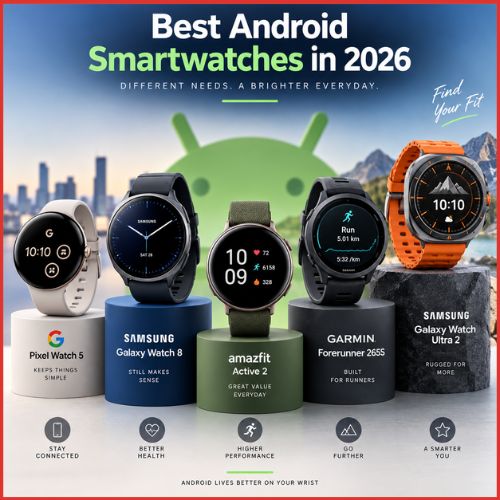
5. Google Pixel Watch 5 Keeps Things Simple
For someone buying an Android smartwatch for the first time, the Google Pixel Watch 5 is one of the easiest places to start.
Its biggest strength is that it feels straightforward. The round design is compact, the interface is easy to understand and it works with modern Android phones without forcing buyers into one particular smartphone brand. Google has also continued improving the connection between Wear OS, Fitbit health tracking and its wider software ecosystem.
That makes the Pixel Watch 5 a sensible everyday choice for users who want notifications, activity tracking, sleep data, apps and basic smart features without spending hours adjusting settings.
The design remains recognisably modern rather than traditional. Buyers looking for something that resembles a classic mechanical watch may find other options more appealing, but the clean appearance suits the software-first experience.
It is also a good example of how much Wear OS has matured. Android smartwatch buyers no longer need to accept awkward software simply because they want strong integration with their phones.
4. Galaxy Watch 8 Still Makes Sense After the Watch 9
Buying the newest model is not always the smartest move.
Samsung has already released the Galaxy Watch 9, but the Samsung Galaxy Watch 8 remains interesting precisely because it is now an older-generation product. Discounts can make it considerably cheaper while many of its core features still feel current.
The Watch 8 introduced Google Gemini support on the wrist and also added Samsung’s antioxidant index, which uses sensor data to provide information related to carotenoid levels.
Samsung’s wider health platform remains one of its strongest selling points. Sleep tracking, ECG-related functions and other health tools give Galaxy users plenty of data to work with.
There is one catch: the experience is better with a Samsung phone.
The watch can work with other Android devices, but some functions are tied more closely to the Galaxy ecosystem. Features such as camera control and parts of Samsung Health Monitor are more useful, or sometimes only available, when paired with compatible Galaxy hardware.
For existing Samsung owners, though, picking up a discounted Watch 8 instead of automatically paying more for the latest generation could make plenty of sense.
3. Amazfit Active 2 Covers the Basics for Less
Not everybody needs a premium smartwatch.
The Amazfit Active 2 sits at the cheaper end of the market and focuses on providing the features most people actually use. It tracks basic activity, offers smartwatch functions and comes with a design that can work in both casual and slightly smarter settings.
One practical touch is the availability of different strap styles. A sportier strap suits exercise, while a more traditional-looking option can make the same watch easier to wear during the rest of the day.
The compromises become clearer when comparing it with Garmin, Samsung or Google devices. GPS and deeper fitness tracking are not its strongest areas, and the Zepp Health software experience may not feel as refined as Wear OS.
Still, price changes the calculation.
A buyer spending around $130 is not expecting the same training tools or app ecosystem offered by a watch costing several times more. For someone who wants notifications, daily activity data and a decent-looking device without a major investment, the Active 2 remains an approachable option.
2. Garmin Forerunner 265S Is Built for Runners
The Garmin Forerunner 265S is a different kind of smartwatch.
It is less interested in replacing a phone on your wrist and far more interested in what happens during training. That makes it particularly suitable for runners who care about pace, recovery, workout planning and performance data.
Garmin’s strength has always been the depth of its fitness tools. The Forerunner 265S carries that approach into a relatively compact watch with training plans, heart-rate variability information, sleep coaching and other recovery metrics.
Physical buttons are also more valuable than they may sound.
Touchscreens are convenient when sitting at a desk, but tapping tiny controls while running hard, sweating or wearing gloves can become annoying very quickly. Garmin keeps real buttons alongside its display, giving athletes a more dependable way to control workouts.
For somebody who runs occasionally and mainly wants phone notifications, it may be more watch than necessary. For regular runners, marathon trainees or users who enjoy detailed performance data, it makes much more sense.
1. Galaxy Watch Ultra 2 Is the Rugged Option
At the opposite end of the market sits the Samsung Galaxy Watch Ultra 2.
This is the watch aimed at buyers who want a tougher device for outdoor activity, endurance training and situations where an ordinary smartwatch may feel too delicate.
The Ultra 2 combines multi-day battery life with a bright AMOLED display that can reach 5,000 nits. Dual-band GPS improves positioning in more difficult environments, while the case is designed to handle demanding outdoor use and is certified for diving.
It is also significantly more expensive than mainstream Galaxy Watches.
That means the Ultra 2 is difficult to justify for somebody whose exercise routine consists mainly of walking, gym sessions and the occasional weekend run. Its value becomes clearer for hikers, triathletes, outdoor travellers or anyone who regularly puts a watch through rough conditions.
The interesting part is that Samsung still keeps the familiar Wear OS experience underneath the rugged hardware. Users do not have to choose between outdoor capability and conventional smartwatch functions.
The Right Android Watch Depends on What Matters Most
There is no single best Android smartwatch for every buyer in 2026, and that is probably a good thing.
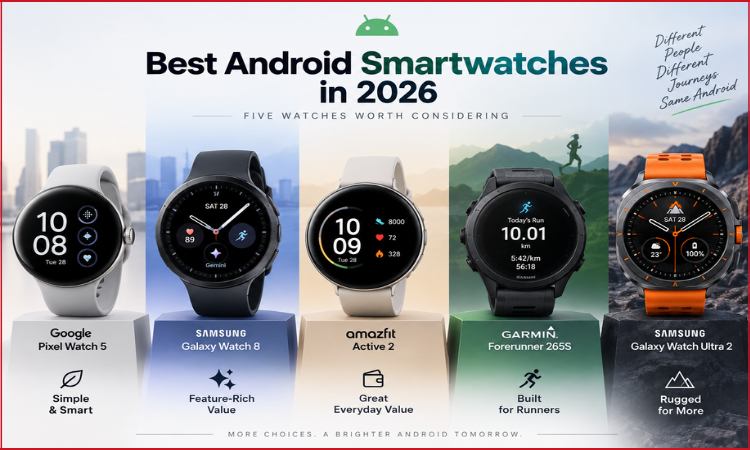
The Pixel Watch 5 is the easiest option for someone who wants a polished all-round Android experience. Samsung’s Galaxy Watch 8 offers strong value when discounted, especially for Galaxy phone owners. Amazfit keeps costs under control, while Garmin remains the better fit for serious runners. The Galaxy Watch Ultra 2 handles the premium rugged end of the market.
Before choosing, buyers should think about what they will actually use every day. Battery life, fitness depth, phone compatibility, comfort and software matter more than simply buying the newest model.
A smartwatch spends hours on the wrist, often through workouts and sleep as well as normal daily use. The right one is therefore not necessarily the device with the longest specification sheet. It is the one whose strengths match the way its owner actually lives.
Source