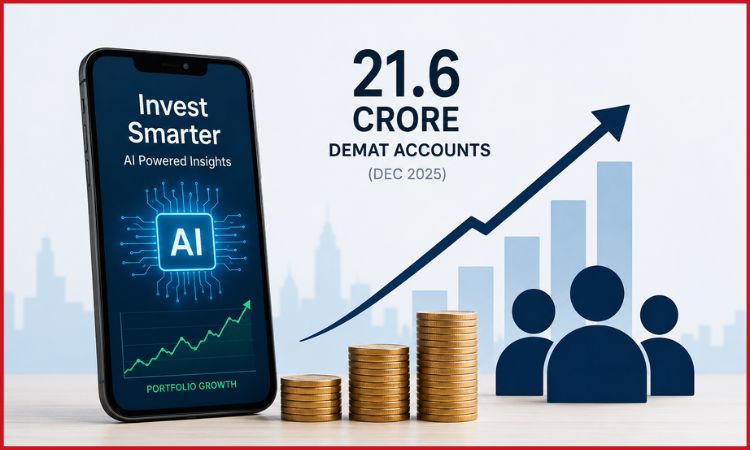
At the end of December 2025, the overall tally of demat accounts stood at 21.6 crore. That number was put out recently by SEBI.
Nearly three out of four new accounts are now opened by young investors, with most of the action coming from people under 30. Many of them have never walked into a brokerage office, spoken to a wealth manager, or paid for a research report. What they have done is open an app.
That shift, from branch to browser, from advisor to algorithm, is at the heart of one of the more consequential changes underway in Indian finance. And it is AI, more than any single policy or market rally, that is powering it.
Says Ankit Sarawagi, CFO at Verloop.io: “A few years ago, detailed portfolio analysis, strategy testing, or market research were largely limited to investors who could afford expensive advisory support. That gap has narrowed considerably.
AI has significantly widened access to financial insight for retail investors in India. Today, an investor sitting outside the larger financial centres can access tools that help analyse portfolios, backtest strategies, and interpret market trends with far greater ease than before.”
The geography of that change matters. India’s investment culture has historically been concentrated in a handful of cities, with access to quality advice a function of where one lived and what they earned. AI-driven platforms have begun to redraw that map, nearly three-fourths of individual F&O traders in FY24 now hailing from beyond the top-30 cities. The democratisation is real, even if its outcomes are not always positive.
The information gap that used to define retail investing
For decades, the structural disadvantage facing the retail investor in India was not one of interest or intent. It was information. Most of the profits in equity derivatives were generated by larger entities that used trading algorithms, with 97 per cent of FPI profits and 96 per cent of proprietary trader profits coming from algorithmic trading, SEBI noted in its landmark study on F&O participation. Against that backdrop, the individual investor was navigating markets with fundamentally inferior tools.
Dr. Syed Hasan, Vice Dean at the School of Business and Area Chair of Finance at Woxsen University, frames it plainly: “Historically, financial markets have seen asymmetry of the information flow, leading to significant disadvantage to retail investors when compared to their institutional counterparts. With the advent of AI-based platforms, which perform the data analysis task of a wealth advisor on the click of a button, retail investors are now able to make well-informed decisions.”
That information asymmetry carried a measurable cost. Individual traders incurred net losses of Rs 1,05,603 crore in the futures and options segment during FY2024-25, with the average per-person loss at Rs 1.1 lakh. The losses were not simply a function of market risk. They were, in large part, a function of disadvantage — retail participants entering the market without the research depth, risk frameworks, or real-time data that institutional players took for granted.
Dr. Sunil Kumar Roy, Professor and Dean at the School of Business, Manav Rachna University, points to the behavioural dimension. “Earlier, investment advisory was largely based on a human-centric approach, but the rise of fintech and robo-advisory services has given individual investors access to advanced investment planning tools using deep learning and big data. Young investors are often influenced by emotional biases like herding behaviour and Fear of Missing Out. AI-driven platforms help provide objective insights that reduce impulsive investment decisions influenced by peer pressure or social media trends.”
Platforms closing the distance
The tools doing this work are increasingly visible in India’s fintech stack. Jarvis Invest, a SEBI-registered AI advisory platform, uses a proprietary risk management system that takes into consideration more than 1.2 crore local and global data points and monitors client investments 24×7, providing a personalised portfolio to each individual investor as per their risk appetite — something described as nearly impossible for a human-driven advisory service offering model portfolios.
Dr. Hasan points to Jarvis Invest and Zerodha’s Streak as examples of this shift made concrete. “Jarvis Invest, a SEBI-registered company, offers round-the-clock portfolio monitoring, personalised risk profiling, and autonomous portfolio rebalancing. Zerodha’s Streak platform assists retail clients in developing strategies in real time. Once thought to be beyond the capabilities of the average investor, sentiment analysis may now be completed with a single click.”
Using AI to manage portfolios
What Streak has done for strategy-building, robo-advisory more broadly is doing for portfolio management. The Indian robo-advisory market was valued at USD 512.31 million in 2025 and is projected to reach USD 6,993.86 million by 2034, growing at a CAGR of 33.03 per cent.
Driving that growth is precisely the demographic that has been showing up in demat account data: younger investors in smaller cities who want access to structured investment frameworks without the costs traditionally attached to them. As of November 2025, the average fee for robo-advisory services in India is approximately 0.5 per cent of assets under management, compared to 1-2 per cent for traditional advisors.
Access to information, access to interpretation
Sarawagi draws a distinction that gets to the nub of what AI has actually changed. “The larger shift is not just access to information, but access to interpretation. AI has reduced the friction involved in understanding financial products and market behaviour, which has made investing more participative for a wider set of users. While experience and judgment still matter, the distance between a well-informed retail investor and a high-net-worth investor is meaningfully smaller than it used to be.”
That compression is showing up in the data on how Indians are actually investing. Monthly SIP contributions rose to Rs 31,002 crore in December 2025, up from Rs 29,445 crore in November, marking a 5 per cent increase month-on-month and a 17 per cent rise year-on-year.
For the full year, SIPs alone contributed approximately Rs 3 trillion, with the investor base expanding by 3.36 crore during 2025. These are not figures driven by existing HNI investors deepening their positions. They reflect new, smaller-ticket participants entering systematically, many of them through platforms that use AI to simplify the onboarding and portfolio construction process.
Total mutual fund folios rose to 26.12 crore in December 2025, with retail mutual fund folios across equity, hybrid, and solution-oriented schemes climbing to 20.28 crore. The structural shift toward retail participation in equity markets — long discussed, often premature as a claim — is now supported by hard numbers across multiple data series.
The structural change, and what it still cannot fix
Dr. Hasan is careful to frame what AI has achieved in precise terms: “The use of AI in financial markets has caused a structural change for the Indian investor, who may now obtain strategic insights without the assistance of an institutional research desk or wealth manager.”
That structural change, though, is not uniform in its benefits. The SEBI data on F&O losses is a reminder that access to tools is not the same as the wisdom to use them. The most active traders are under 30 years of age and earn less than Rs 5 lakh a year, with many having started trading post the COVID-19 pandemic, driven by easy access through mobile apps and online influencers.
The paradox is genuine: the same digital infrastructure that enables AI-powered, disciplined investing also enables frictionless access to high-risk speculation. The tools are available. The judgment is still being formed.
Dr. Roy puts it this way: “The use of AI-based digital advisory services is especially growing among Gen Z investors in India. AI-driven platforms help provide objective insights that reduce impulsive investment decisions influenced by peer pressure or social media trends.”
For Sarawagi, the honest accounting of where AI ends and human judgment begins is the more important conversation. “AI can improve speed, analysis, and accessibility, but trust in financial decision-making is still built through context, accountability, and a deeper understanding of individual goals.”