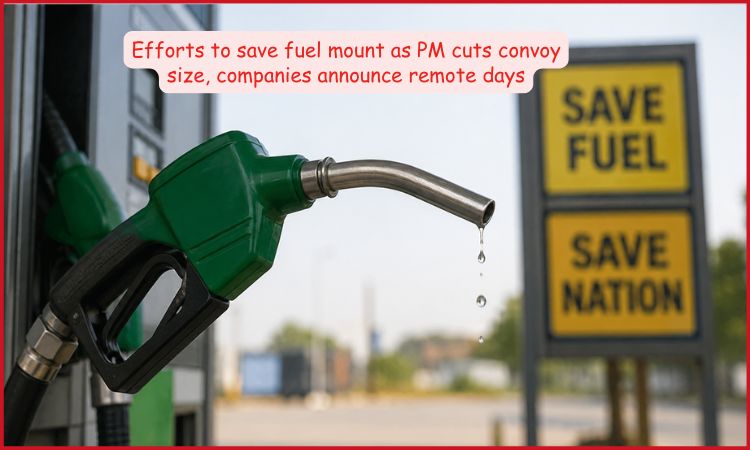
From trimming convoys to rolling out mandatory WFH, India is mobilising across sectors to ease pressure on its import bill.
“Patriotism is not only about the willingness to sacrifice one’s life on the border. In these times, it is about living responsibly and fulfilling our duties to the nation in our daily lives,” Prime Minister Narendra Modi said at a public address in Secunderabad last week. The remark has since sparked a cascading response across government and industry as India braces for the economic fallout of the West Asia conflict.
PM leads by example, reduces convoy size
Modi has reduced the size of his own convoy and directed the Special Protection Group to minimise the fleet. He has also asked for electric vehicles to be included wherever feasible, without any new purchases.  The move follows what sources described as a deliberate signal: “PM Modi leads from the front and shows the way to save fuel and cut down expenses.” 
The effect has been swift. Defence Minister Rajnath Singh and Union Health Minister J.P. Nadda cut the number of vehicles in their convoys by nearly 50 per cent. In Uttar Pradesh, Chief Minister Yogi Adityanath directed an immediate 50 per cent reduction in the fleet used by ministers and government officials, and encouraged public representatives to use public transport at least once a week.
In Maharashtra, the Devendra Fadnavis government mandated prior approval for ministers seeking to use government aircraft to curb non-essential air travel, while Gujarat governor Acharya Devvrat announced he would use trains and state transport buses instead of helicopters for travel within the state.
Industry follows suit, Shaadi.com announces one remote day
Corporate India has not been far behind. Shaadi.com CEO Anupam Mittal announced a mandatory weekly work-from-home day for employees, saying that allowing 500 employees to work remotely once a week could save nearly 30,000 litres of petrol every year. Posting on X, Mittal wrote: “Kabhi socha nahin, but 1 day remote for 500 employees means 30k liters of petrol saved a year. Wed r now WFH.”
Nasscom, meanwhile, said the Indian technology industry continues to function on “well-established hybrid work models”, with firms calibrating work-from-home and in-office arrangements based on role requirements and customer needs. The body added that companies have adopted “prudent energy management measures” across campuses in response to the evolving geopolitical situation. 
Employee union NITES has gone further, urging the Labour Ministry to issue a formal advisory. “Employees in metropolitan cities spend several hours daily travelling despite performing work that can effectively be delivered remotely,” NITES said. “This not only impacts physical and mental health, but also results in avoidable fuel usage and environmental burden.”
The numbers behind the push
Government data shows India imports over 85 per cent of its crude oil requirements, making the economy highly vulnerable to disruptions in global energy markets. West Asia supplies approximately 80 to 90 per cent of India’s crude oil and a large proportion of its LPG imports, with more than 50 per cent of these energy imports transiting the Strait of Hormuz.
For the past two years, India Inc had steadily pushed employees back to office campuses after pandemic-era remote work arrangements, with companies across sectors arguing that physical offices were essential for productivity. Modi’s remarks have now reframed what an employee flexibility debate was into a question of fuel conservation and national interest.