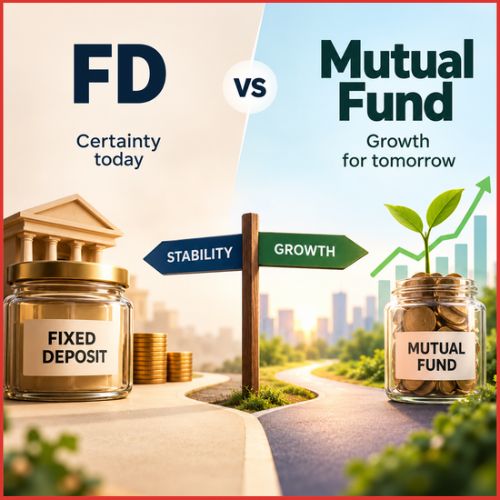
A fixed deposit promises certainty. A mutual fund offers the possibility of greater growth. The right choice depends on which one your money actually needs.
For an investor with ₹1 lakh, the difference between an FD and a mutual fund can seem obvious. But there’s a problem with the usual comparison: a fixed return and a market-linked return are not directly comparable.
An FD pays interest according to the terms agreed with the bank. A mutual fund invests in securities whose value can fluctuate, and SEBI makes it clear that mutual-fund returns are not guaranteed.
So, which is better in 2026? The answer depends less on the highest advertised return and more on when the money will be needed, how much risk the investor can tolerate, and what the money is expected to accomplish.
FD vs Mutual Fund at a Glance
| Factor | Fixed Deposit | Mutual Fund |
|---|---|---|
| Return | Predetermined interest rate | Market-linked |
| Return guarantee | Greater predictability, subject to terms | No guaranteed return |
| Value fluctuation | No daily market-linked NAV | NAV can rise or fall |
| Risk | Relatively lower, but not zero | Depends on fund category |
| Liquidity | Depends on FD terms | Generally redeemable, subject to scheme rules |
| Inflation risk | Can erode purchasing power | Long-term growth may potentially outpace inflation |
| Suitable for | Capital stability and predictable goals | Suitable long-term growth objectives |
| Investment method | Usually lump sum | Lump sum or SIP |
| Taxation | Interest generally taxable | Depends on fund type and applicable tax rules |
| Deposit protection | Eligible bank deposits covered by DICGC within applicable limits | Not a deposit and not covered by DICGC |
| Main trade-off | Lower volatility vs potentially lower real growth | Higher growth potential vs market volatility |
The simplest way to remember the difference: an FD offers certainty, while a mutual fund offers growth potential. Neither one automatically wins.
What Is a Fixed Deposit?
A fixed deposit allows an investor to place a lump sum with a bank for a specified period at a predetermined rate of interest. The appeal is straightforward — the investor knows the applicable interest rate when the deposit is booked, and the maturity value can generally be calculated in advance.
RBI rules also require banks to disclose applicable premature-withdrawal conditions. Depending on the deposit and bank, withdrawing early can mean that interest is paid at a lower applicable rate or that a penalty is imposed. That makes an FD particularly useful when predictability matters.
However, “FD is risk-free” is too broad a statement. Eligible bank deposits are currently insured by DICGC up to ₹5 lakh per depositor per bank, covering principal and interest within the applicable rules. Deposits held at different branches of the same bank are aggregated for the insurance limit. So an investor should consider both the interest rate and the bank’s deposit-insurance framework.
What Is a Mutual Fund?
A mutual fund pools money from investors and invests it in securities according to the scheme’s stated objective. That can include equity funds, which primarily invest in shares; debt funds, which primarily invest in debt and money-market instruments; and hybrid funds, which combine asset classes.
This distinction matters because “mutual fund” does not describe one level of risk. An equity mutual fund can experience substantial short-term volatility. Debt funds have their own risks, including credit and interest-rate risk. SEBI states that mutual-fund investments are subject to market risks, that NAV can move up or down, and that past performance does not indicate future performance.
This is why an investor should compare a specific fund category with an FD, rather than treating every mutual fund as the same product.
FD vs Mutual Fund: Which Is Safer?
For someone asking “Is FD safer than a mutual fund?”, the answer generally depends on what “safe” means.
An FD offers greater predictability because its agreed interest rate does not fluctuate with the stock market. A mutual fund’s NAV can change daily, and for equity funds that movement can be substantial. But an FD has risks too — its biggest long-term problem may not be a falling account balance. It may be that the return fails to keep pace with inflation after tax.
That creates an important distinction: nominal safety is not the same as real wealth preservation. An FD can therefore be appropriate for capital stability while still being less suitable for a long-term wealth-creation objective.
Which Gives Higher Returns: FD or Mutual Fund?
This is the most searched, and often the most poorly explained, part of the comparison.
A bank may quote an FD rate such as 6% or 7%. A mutual-fund comparison may show historical annualised returns of 10%, 12%, or more. These numbers should not be placed side by side as though both are promises. The FD rate is a contractual interest rate under the deposit terms. The mutual-fund figure is a historical or hypothetical investment return.
A useful reference point is the Nifty 50 Total Return Index, which includes dividends and is often used as a broad equity-market benchmark. As of February 27, 2026, the Nifty 50 TR Index showed annualised returns of 14.64% over three years, 12.94% over five years, and 15.09% over ten years. These are index returns, not returns guaranteed by mutual funds. The same data also showed annualised volatility of 12.07%, 13.57%, and 16.07% over those respective periods.
| Period to Feb. 27, 2026 | Nifty 50 TR annualised return | Annualised volatility |
|---|---|---|
| 3 years | 14.64% | 12.07% |
| 5 years | 12.94% | 13.57% |
| 10 years | 15.09% | 16.07% |
| Since inception | 12.74% | 22.53% |
What does this show? Higher historical equity returns have come alongside meaningful volatility. It does not mean an investor should expect 15% from an equity mutual fund every year. SEBI explicitly warns that past performance is not a guarantee of future results.
What Are FD Rates in 2026?
FD rates change with monetary conditions and bank-specific policies. As a broad RBI market snapshot on July 28, 2026, term-deposit rates for maturities above one year were reported in a range of approximately 6.00% to 6.75% across the banking system. This is an indicative market range, not a recommendation or a claim that every bank offers these rates.
That distinction matters when searching for the best short-term FD in 2026. The highest headline rate is not necessarily the best FD. An investor should also check the tenure, premature-withdrawal rules, interest payout structure, tax impact, and bank and deposit-insurance considerations before choosing one.
FD vs Mutual Fund: An Illustrative ₹1 Lakh Scenario
Consider ₹1 lakh invested for 10 years. This is a scenario, not a forecast.
| Assumed annual return | Approximate value after 10 years |
|---|---|
| 6% | ₹1.79 lakh |
| 7% | ₹1.97 lakh |
| 10% | ₹2.59 lakh |
| 12% | ₹3.11 lakh |
| 14% | ₹3.71 lakh |
The calculation uses annual compounding and ignores taxes, fees, and changes in return. The purpose is not to suggest that a mutual fund will return 10%, 12%, or 14%. It illustrates the power of compounding, and the reason higher-return scenarios also come with greater uncertainty.
A guaranteed or predetermined return and a hypothetical market return should therefore never be treated as equivalent promises.
Why Inflation Changes the FD vs Mutual Fund Calculation
Suppose an FD earns 7% while inflation averages 5%. The money increases by 7% in nominal terms, but purchasing power grows more slowly. As a simplified measure, the real return roughly equals the investment return minus inflation — so a 7% nominal return against 5% inflation implies roughly 2%, before considering taxes and other factors.
This is why an FD can be perfectly sensible for a short-term financial goal but less compelling as the sole vehicle for long-term wealth creation. The longer the horizon, the more important inflation becomes.
FD vs Mutual Fund for 5 Years, 10 Years, and Beyond
The investment horizon can substantially affect the decision.
| Goal horizon | General approach |
|---|---|
| Less than 1 year | Capital stability and liquidity generally matter most |
| 1–3 years | Lower-volatility options may be appropriate for many goals |
| Around 5 years | Goal, risk tolerance, and asset type should determine the choice |
| 7–10+ years | Suitable investors may consider diversified equity mutual funds for growth |
| Emergency fund | Liquidity and capital stability should generally take priority |
There is no fixed rule saying that five years automatically means “mutual fund” or one year automatically means “FD.” The purpose of the money matters just as much.
SIP vs FD: Which Is Better?
Searches for “equity SIP vs FD returns” often compare them as though SIP and FD are competing financial products. They are not. A SIP is a method of investing, usually by putting a fixed amount periodically into a mutual-fund scheme. The actual comparison, then, is periodic investment in a market-linked mutual fund versus money placed in a fixed-rate deposit.
A SIP does not guarantee positive returns. It can, however, create investment discipline and make long-term investing easier to maintain. An FD offers greater certainty but does not provide the same exposure to market-linked growth.
For someone investing for a long-term objective and willing to tolerate volatility, an equity-fund SIP may be appropriate. Someone building savings for a near-term obligation may value the stability of an FD more.
What Happens During a Market Crash?
This is where the difference becomes very visible. Suppose an investor puts ₹1 lakh into an equity mutual fund and the market declines. The fund’s NAV may also fall — the investment could temporarily be worth ₹80,000, ₹70,000, or less, depending on the severity of the decline and the fund’s holdings.
An FD does not behave that way. Its value is not marked down because the stock market has fallen. That stability is valuable for money that cannot afford market volatility.
However, long-term investors should distinguish between temporary volatility and permanent loss. Selling a quality investment during a market panic can turn a temporary decline into a permanent loss. The opposite is also true: not every mutual fund is suitable for every long-term investor simply because the horizon is long.
FD vs Mutual Fund Taxation in 2026
Tax can change the final outcome significantly. FD interest is generally taxable according to the applicable income-tax rules and the individual’s tax position. Mutual-fund taxation depends on factors such as the fund category, acquisition date, holding period, and applicable capital-gains provisions.
India’s tax framework also underwent a major structural change in 2026. The Income Tax Department states that the Income-tax Act, 2025 came into effect on April 1, 2026, replacing the Income-tax Act, 1961, with transitional provisions for earlier tax years. For that reason, an evergreen article should avoid presenting one permanent mutual-fund tax rate or one permanent FD tax rate. Investors should evaluate the post-tax return, not simply the advertised return.
Is FD Better Than Mutual Fund for Beginners?
For a beginner who is uncomfortable seeing an investment fall temporarily, an FD may be easier to understand and manage. A beginner with a long investment horizon, adequate emergency savings, and a willingness to tolerate market fluctuations may instead consider diversified mutual funds appropriate to their risk profile.
The key is not age alone. It’s the relationship between the goal, the time horizon, the risk tolerance, and the liquidity requirement. That framework is more useful than simply asking which product is “best.”
When an FD May Make More Sense
An FD may be suitable when:
- The money is required for a known near-term goal.
- Predictable returns are important.
- The investor has low tolerance for market fluctuations.
- Capital stability is a priority.
- The money forms part of a conservative savings allocation.
When a Mutual Fund May Make More Sense
A mutual fund may be suitable when:
- The investment horizon is relatively long.
- The investor can tolerate temporary losses.
- Long-term growth is the priority.
- The investor wants diversified exposure to market securities.
- A suitable mutual-fund category has been selected after considering the investor’s risk profile.
The word “suitable” matters here. A high-risk equity fund is not automatically appropriate merely because the investor wants higher returns.
Can an Investor Use Both FD and Mutual Funds?
Yes, and for many financial plans, that may be more practical than choosing only one.
Consider an investor with three objectives. Emergency savings need liquidity and stability. A down payment in three years has a defined deadline and limited tolerance for a market decline immediately before the goal. Retirement in 20 years has a much longer horizon and potentially greater capacity to tolerate volatility.
It would be difficult for one product to perform all three jobs equally well. This is where asset allocation becomes more important than product rivalry. The money should be assigned a job first. The investment should follow.
Common Mistakes When Choosing FD or Mutual Fund
- Comparing a guaranteed FD rate with an assumed equity-fund return.
- Calling an FD completely risk-free without considering deposit-insurance limits.
- Treating every mutual fund as equally risky.
- Ignoring inflation when assessing FD returns.
- Looking only at historical mutual-fund performance.
- Investing emergency money in volatile equity funds.
- Choosing an FD solely because it has the highest advertised interest rate.
- Ignoring taxation and comparing only pre-tax returns.
- Treating SIP as a separate investment product rather than a method of investing.
FD vs Mutual Fund: Which Is Better for Different Goals?
| Financial objective | More suitable starting point |
|---|---|
| Emergency savings | FD or another suitable liquid, low-risk option |
| Short-term purchase | FD or another option matched to the time horizon |
| Predictable maturity value | FD |
| Long-term wealth creation | Suitable diversified mutual funds may be considered |
| Regular long-term investing | Mutual-fund SIP may be suitable |
| Very low tolerance for losses | FD may be more appropriate |
| Higher long-term growth potential | Market-linked investments, with corresponding risk |
These are general educational guidelines, not personalised investment advice.
Final Verdict: FD or Mutual Fund?
The FD vs mutual fund debate is often presented as a competition between two products. It is better understood as a certainty-versus-growth decision.
An FD offers a more predictable outcome and can be useful for near-term goals, conservative savings, and investors with low tolerance for volatility. Mutual funds offer market-linked exposure — suitable equity-oriented funds can provide greater long-term growth potential, but the investor must accept uncertainty and the possibility of losses.
The strongest approach, then, isn’t to choose the investment with the highest return. It’s to choose the investment that matches the job the money needs to perform. For a near-term obligation, certainty can be more valuable than growth potential. For a long-term objective, accepting measured market risk may be more productive than sacrificing growth to avoid every fluctuation.
An FD protects certainty. A suitable mutual fund can pursue growth. A sound financial plan decides where each belongs.
Frequently Asked Questions
Is FD better than a mutual fund in 2026?
An FD may be better for investors prioritising predictable returns and capital stability. Suitable mutual funds may be better for investors seeking long-term growth potential and willing to accept market risk. Neither is universally better.
Which gives higher returns, FD or mutual fund?
Mutual funds can potentially deliver higher long-term returns, particularly equity funds, but those returns are not guaranteed. An FD offers a predetermined interest rate. The two should therefore not be compared as though their returns carry the same level of risk.
Is FD safer than an equity mutual fund?
An FD generally has lower market volatility and greater return predictability. However, eligible bank deposits are insured only within DICGC’s applicable ₹5 lakh limit per depositor per bank.
Is SIP better than FD for long-term investment?
A SIP can be useful for regularly investing in a market-linked mutual fund, but it does not guarantee returns. For a long-term investor who can tolerate volatility, an equity SIP may offer greater growth potential than an FD.
What is the best short-term FD in 2026?
There is no single best FD for everyone. Investors should compare the current interest rate, tenure, premature-withdrawal conditions, tax impact, and bank-level considerations before choosing one. RBI’s July 2026 snapshot showed term-deposit rates above one year broadly around 6.00%–6.75%, but rates vary by bank and tenure.
Can mutual funds lose money?
Yes. Mutual-fund NAVs can fall because of movements in the underlying securities. Equity funds can experience substantial short-term losses. SEBI states that mutual-fund investments are subject to market risk and that there is no assurance that investment objectives will be achieved.
Is FD interest taxable in India?
FD interest is generally taxable under the applicable income-tax rules based on the investor’s circumstances. Investors should consider the post-tax return rather than the stated interest rate alone.
Which is better for an emergency fund: FD or mutual fund?
An emergency fund generally prioritises liquidity and capital stability. An FD or another suitable low-risk and accessible option may therefore be more appropriate than a volatile equity mutual fund.