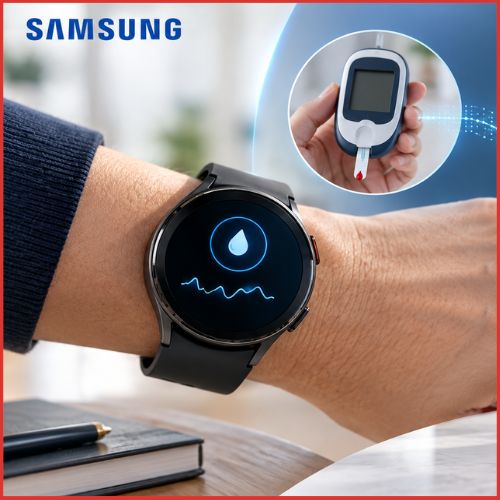
Samsung’s long-running effort to bring blood sugar monitoring to wearable devices has surfaced again through a newly published European patent. The filing describes a system in which a wearable could learn from a conventional glucose reading and then use biometric information collected from the wrist to estimate glucose values later.
It sounds like a major step towards Galaxy Watch blood sugar monitoring, but there is an important distinction. Samsung has not announced a Galaxy Watch that can independently measure glucose, nor has it confirmed that this particular patent will appear in a future commercial device.
What the filing does show is how the company is thinking about one of the most difficult health features still missing from mainstream smartwatches.
Samsung’s Patent Starts With an External Glucose Reading
The patent was published in Europe on September 9 under publication number EP4803002A1.
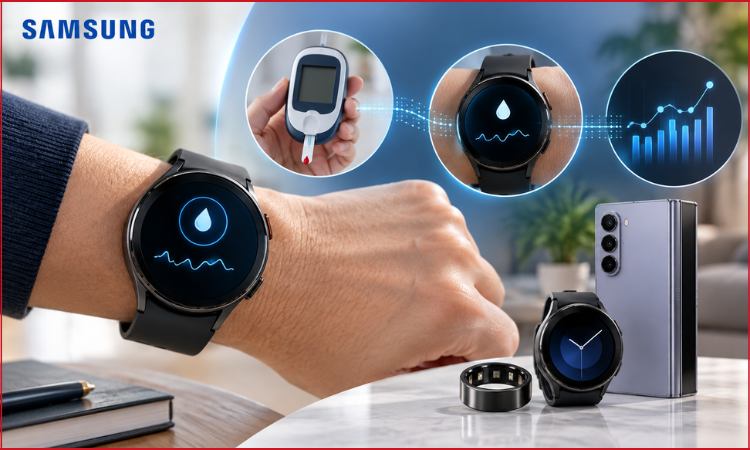
Its approach does not begin with a Galaxy Watch magically reading glucose from the wrist. Instead, the system first relies on a glucose value measured by an external device.
Around the same time, sensors inside the wearable collect biometric information from the person wearing it.
The system can then pair the known glucose reading with the biometric signal and create calibration data. Once enough useful calibration information exists, the wearable could potentially use later biometric signals to determine glucose values.
That makes the idea behind noninvasive glucose monitoring easier to understand. Rather than expecting a watch to know a person’s blood sugar accurately from the first moment it is worn, Samsung’s patent describes a system that could learn from measurements already known to be accurate.
Calibration is particularly important because glucose estimation from signals collected at the wrist is technically difficult. Human bodies differ, sensor contact changes and everyday movement can interfere with measurements.
The Patent Does Not Name a Future Galaxy Watch
Patents often reveal interesting technology long before a product is ready, and sometimes the technology never appears in a commercial device at all.
Samsung’s filing is deliberately broader than a single product. It describes a “wearable electronic device” with sensors, memory, communications hardware, a processor and a display.
There is no reference to a Galaxy Watch 10, Watch Ultra or another specific future model. The filing also has a longer history than its recent European publication might suggest. The patent family traces its priority back to December 2023, with related Korean and international applications appearing later.
That timeline matters because it shows Samsung has been exploring the method for several years.
The September publication offers a clearer public look at that work, but it should not be treated as evidence that Samsung glucose monitoring is ready to launch.
Samsung Says Glucose Research Is Still Active
The patent is more interesting because Samsung has separately confirmed that its research into noninvasive continuous glucose monitoring is continuing.
The company’s digital health team has described a broad approach involving internal research, collaboration with outside startups and exploration of different technologies around the world.
Reliability remains one of the biggest problems. A smartwatch feature used for step counting can tolerate a small degree of error without serious consequences. Glucose information is different because people may use those numbers when making health decisions.
That raises the standard considerably. Samsung therefore has to solve more than the basic problem of detecting a signal. The system must produce results consistently enough to be useful across different users, environments and everyday conditions.
Galaxy Watch and Galaxy Ring Could Work Together
Samsung is also looking beyond a single wearable. One possibility involves using a Galaxy Watch and Galaxy Ring together. Data collected from two devices on different parts of the body could provide a richer picture than either wearable produces on its own.
That approach fits Samsung’s wider health strategy. Rather than treating each product as an isolated tracker, the company increasingly sees watches, rings, smartphones and even earbuds as parts of a connected health system.
A watch might capture one type of signal while a ring provides another. The phone can then combine the information and use software or AI to interpret patterns over time.
For Galaxy Watch health features, that could eventually mean more accurate readings without relying entirely on a single wrist sensor.
Whether that will be enough for reliable glucose monitoring remains uncertain.
Current Galaxy Watches Cannot Measure Blood Glucose Directly
The distinction between existing features and future research is especially important here. Current Samsung Galaxy Watches do not independently measure a user’s blood glucose.
Samsung already offers an AGEs Index on compatible devices, which can provide information related to advanced glycation end products. That may sound closely connected to blood sugar, but it is not a direct glucose reading.
The two should not be confused. People who currently need glucose measurements for medical reasons still require established glucose-monitoring equipment recommended for that purpose.
Smartwatch makers have been chasing noninvasive glucose monitoring partly because removing needles or skin-piercing sensors would make continuous tracking far easier for users.
The challenge is proving that a convenient wrist-based method can also be accurate enough.
Why Blood Sugar Is Such a Big Smartwatch Goal
Modern smartwatches already monitor heart rate, blood oxygen, sleep, exercise and several other health indicators. Some can record ECG readings, while newer devices are experimenting with blood pressure and other cardiovascular metrics.
Blood glucose remains one of the biggest missing pieces. A reliable solution could appeal not only to people already monitoring glucose but also to users interested in understanding how meals, exercise and sleep affect their bodies.
That creates a potentially enormous market. It also explains why Samsung, Apple and other wearable companies have spent years researching different ways of measuring glucose without conventional finger-prick testing.
The technical barrier, however, is much higher than adding another software feature to a watch.
A Patent Is Progress, Not a Product Announcement
Samsung’s new filing gives a useful look at one possible route towards Galaxy Watch blood sugar monitoring, but the next important developments will need to be much more concrete.
Clinical testing would provide evidence that a system works reliably. Regulatory filings would indicate that Samsung believes the technology is getting closer to practical use. A product announcement would finally tell consumers which device, if any, will receive it.
None of those steps has happened for this patent yet. For existing Galaxy Watch owners, nothing changes today.
The more interesting takeaway is that Samsung has not abandoned the problem. The company is still experimenting with ways to combine biometric sensors, calibration data and multiple connected devices in pursuit of a feature that smartwatch makers have wanted for years.
If Samsung eventually solves the accuracy problem, glucose monitoring could become one of the biggest health upgrades ever added to a mainstream wearable.
For now, though, the patent should be read as evidence of continuing research, not as confirmation that the next Galaxy Watch will replace a dedicated glucose monitor.