Chinese artificial-intelligence chip suppliers, including Huawei and Cambricon Technologies, are raising prices as a shortage of advanced memory increases production costs and exposes a critical weakness in China’s rapidly expanding AI infrastructure market.
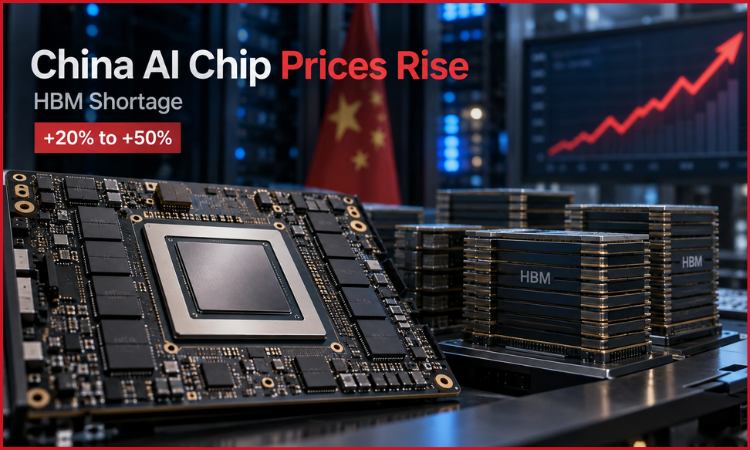
Huawei has raised the indicated price of its upcoming Ascend 950DT accelerator card to more than 250,000 yuan, or approximately $37,250, according to people familiar with private supplier negotiations. Depending on the contract terms, that represents an increase of between 20% and 50% from quotations provided about two months earlier.
Cambricon has reportedly increased preliminary pricing for its next-generation processor, tentatively known as the 690, by between 20% and 30% over the same period. Smaller domestic suppliers MetaX and Iluvatar CoreX have also raised prices.
The companies did not confirm the pricing changes publicly. The figures are based on private quotations and may differ according to purchase volume, delivery timing, product configuration and customer agreements.
At the centre of the increase is high-bandwidth memory, or HBM, a specialised form of memory positioned close to an AI processor. It allows large quantities of data to move rapidly between memory and the computing cores, making it essential for training and operating advanced AI models.
Huawei’s Ascend Roadmap Faces Higher Costs
Huawei officially plans to make the Ascend 950DT available during the fourth quarter of 2026. The processor is designed for AI model training and the decode stage of inference, when a system generates tokens in response to a user request.
The company says the chip will be paired with its proprietary HiZQ 2.0 memory system, offering 144GB of capacity and memory bandwidth of 4TB per second. The processor itself is expected to provide interconnect bandwidth of 2TB per second and support several low-precision data formats intended to improve AI-computing efficiency.
Huawei has not explained where or how its proprietary memory will be manufactured. That unanswered question is important because the global market for advanced HBM is dominated by South Korea’s SK Hynix and Samsung Electronics, along with US-based Micron Technology.
The company’s Ascend 950PR, developed for the prefill stage of inference and recommendation systems, has also become more expensive. Its price has reportedly risen from around 60,000 yuan at the start of the year to more than 80,000 yuan, an increase of approximately one-third.
Huawei’s older Ascend 910C accelerator board is now being quoted above 110,000 yuan, compared with roughly 90,000 yuan at the beginning of 2026.
The 950PR is already part of Huawei’s public product roadmap, while the 950DT is scheduled for later this year. By contrast, Cambricon has not formally launched its reported 690 processor. Its current flagship product is the 590, meaning details and pricing for the next-generation model remain provisional.
Export Controls Complicate Memory Supply
China’s AI-chip manufacturers have gained customers after US restrictions limited the sale of Nvidia’s most advanced processors to the country. However, those same restrictions have made it more difficult for Chinese suppliers to obtain the memory required to build competitive alternatives.
The United States introduced additional export controls covering advanced HBM in December 2024. Since then, Chinese technology companies have increasingly relied on existing inventories, domestic alternatives and unofficial trading channels.
Memory acquired through grey-market suppliers can cost several times more than comparable products sold to buyers outside China. Those higher expenses are now moving through the supply chain and appearing in the prices quoted for completed AI accelerator cards.
The problem cannot be solved simply by manufacturing more conventional memory. HBM uses vertically stacked memory dies and sophisticated packaging that connects the memory closely with a processor. Producing it requires specialised manufacturing, testing and packaging capabilities that take time to expand.
Global demand is also rising rapidly. Nvidia, AMD, cloud providers and major AI developers are competing for HBM capacity as they build increasingly powerful data-centre systems. Chinese chipmakers therefore face both export restrictions and a wider international shortage.
Higher Prices Could Raise AI Infrastructure Spending
The increases may lift computing costs for Chinese internet platforms, cloud providers and businesses deploying AI services.
Huawei is reportedly ByteDance’s largest domestic AI-chip supplier, followed by Cambricon and Iluvatar CoreX. Iluvatar has doubled the number of graphics processors allocated to ByteDance this year to approximately 100,000 units, according to people familiar with the arrangement.
The supplier reportedly redirected some processors originally intended for internal use to meet the order. ByteDance and the chipmakers involved did not publicly confirm the commercial details.
For large technology companies, a higher price per accelerator can have a substantial effect because AI data centres require thousands or tens of thousands of processors. The total cost also includes servers, networking equipment, electricity, cooling and software.
The situation illustrates the difference between designing an AI processor and producing complete systems at scale. A technically capable chip still depends on memory, packaging equipment, manufacturing capacity and reliable access to other components.
China’s domestic AI chip market is estimated at approximately $50 billion, creating a major commercial opportunity for local suppliers as companies seek alternatives to restricted Nvidia products. Yet the latest increases show that domestic processors are not insulated from international supply pressures.
Huawei, Cambricon and their smaller competitors may be able to pass some of the additional expense to customers because demand for computing remains strong. Their longer-term challenge will be securing enough advanced memory to increase shipments without allowing costs to rise to levels that slow AI adoption.
For customers, the next important measures will be the final commercial price and availability of the Ascend 950DT when it arrives in the fourth quarter. Until then, current quotations provide a warning that memory could determine how quickly China expands its AI-computing capacity.