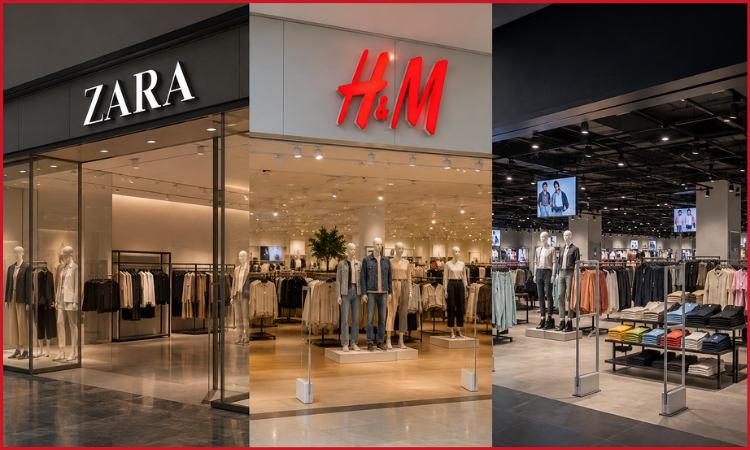
Twenty-two Zara stores. Forty-seven H&M outlets. Over nine hundred Zudio stores and counting. One of these numbers explains why Tata’s retail arm has been quietly trimming its own stake in the Zara India joint venture even as the brand’s profits climb.
That contradiction sits at the centre of the Zara vs H&M vs Indian fast fashion brands debate playing out in boardrooms right now. Global brands are posting healthier margins on smaller footprints. Indian fast fashion brands are scaling faster than either of them, store by store, city by city. Founders and investors tracking the fashion retail market India needs to understand which model is actually built to last.
This piece breaks down the Zara vs H&M comparison, weighs it against the rise of the best fast fashion brands built at home, and lays out the numbers behind fast fashion in India today.
Quick Glance
| Brand | Founded | Founder | Sector | Key Metric (FY25) | Current Standing |
| Zara | 1975 | Amancio Ortega | Premium fast fashion apparel | Rs 2,782 crore India revenue | 22 stores, 13 cities; sales flat, profit up 23% |
| H&M | 1947 | Erling Persson | Value-to-mid fast fashion apparel | Rs 3,595 crore India revenue | 47 stores; revenue leader among global entrants |
| Indian Fast Fashion (Zudio, Trent) | 2016 (Zudio launch) | Trent Ltd, Tata Group | Value fast fashion, mass retail | Revenue crossed $1 billion | 963+ stores; fastest-expanding format in India |
Background Of Zara
Zara entered India in 2010 through a joint venture between Spain’s Inditex and Tata-owned Trent. It built its reputation on runway-to-rack speed and deliberately kept its store count small, betting on premium mall locations over mass reach. Trent has since pared its stake in the venture twice, even as Zara’s profitability improved.
Background Of H&M
H&M arrived in India in 2015 and leaned into affordability from day one, pricing itself below Zara while still packaging global trend cycles. A decade in, it now runs more stores than Zara and posts the highest revenue among foreign fast fashion players in the country. Beauty and accessories have become a quiet second growth lever for the brand.
Background Of Indian Fast Fashion Brands
Indian fast fashion brands took a different route entirely. Zudio, Trent’s own value label, skipped e-commerce almost completely and instead opened stores at a punishing pace across residential markets and smaller towns. Libas, meanwhile, shows how a family apparel business can pivot into a fast-fashion-adjacent D2C label and still cross Rs 600 crore in revenue within a decade. Both examples reflect how fast Indian clothing brands are professionalising, whether Tata-backed or founder-led.
Business Model
Zara and H&M both run on the classic global fast fashion playbook: design centrally, manufacture in low-cost hubs, ship frequently, price at a premium to Indian domestic clothing brands. Indian fast fashion brands, particularly Zudio, borrowed Zara’s inventory-refresh discipline but stripped out the mall-first real estate strategy and the online discounting culture altogether.
Zudio refreshes inventory roughly every fortnight and rarely discounts, choosing volume over margin. That single decision, more than any marketing spend, is what’s rattling H&M’s core price-sensitive customer base and reshaping the wider Zara vs H&M India rivalry.
Financial Performance And Store Economics
| Brand | Revenue (FY25) | YoY Growth | Profit | Store Count | Revenue Per Store (FY24 base) |
| Zara India | Rs 2,782 crore | Roughly flat, up 0.4% | Rs 299 crore, up 23% | 22 | Rs 54.3 crore |
| H&M India | Rs 3,595 crore | 9.6% | Not separately disclosed | 47 | Rs 51.2 crore |
| Zudio (Trent) | Over $1 billion (~Rs 8,300 crore) | Strong double digits | Reported within Trent’s consolidated results | 963+ | Not separately disclosed |
According to Business Standard, H&M’s India revenue climbed to roughly Rs 3,595 crore in FY25, pulling further ahead of Zara, whose revenue stayed nearly flat at around Rs 2,782 crore in the same year.
Zara’s math still works in its favour on a per-store basis. Fewer stores, tighter real estate, higher footfall per outlet, and a profit line that keeps climbing even when the topline doesn’t.
Market Strategy
Zara plays a scarcity game. Limited stores, premium malls, no aggressive discounting, and a customer who associates the brand with genuine exclusivity within the fast fashion in India landscape.
H&M went the opposite direction. It chased breadth early, expanded into Tier 2 cities faster than Zara, and added beauty products to extend basket size per customer.
Indian fast fashion brands, led by Zudio, chose reach over both. The Zudio Success Story shows a brand that targets neighbourhood footfall rather than mall culture, keeps most products under Rs 999, and franchises expansion so capital never becomes the bottleneck. That franchise structure, run by a company under the broader list of Companies Under Tata Group, is arguably the single biggest reason Zudio scaled past 900 stores while Zara stayed under 25.
Good fast fashion in India increasingly means owning either the premium scarcity end or the mass-volume end. The middle is getting squeezed, which is exactly where the Zara vs H&M comparison gets uncomfortable for both global brands.
Where Each Wins
Zara wins on margin discipline and brand pull within metro India, where a smaller store count translates into higher revenue per outlet and stronger profit growth despite flat sales.
H&M wins on scale among foreign players, with the highest India revenue of any global fast fashion brand and category extensions like beauty adding fresh growth.
Indian fast fashion brands, led by Zudio, win decisively on reach and speed. No foreign chain has matched Trent’s store-opening velocity, and none has replicated its no-discount, high-frequency inventory model at that scale.
Investors comparing the three should note that Zara vs H&M India is really a contest between two foreign entrants defending shrinking whitespace, while Trent’s homegrown format is busy creating whitespace of its own in towns neither brand has entered.
Key Takeaways
- Zara keeps its India footprint deliberately small and still grows profit faster than revenue.
- H&M leads global brands on revenue in India but faces margin pressure as Indian clothing brands undercut it on price.
- Indian fast fashion brands, especially Zudio, have crossed a billion dollars in revenue on a no-discount, franchise-led model.
- Store count alone does not determine profitability, as Zara’s per-store economics show.
- The fashion retail market in India is still expanding fast enough to support all three approaches simultaneously.
- Category extension, like H&M’s move into beauty, is becoming a common growth lever across fast fashion in India.
Conclusion
Founders studying the Zara vs H&M vs Indian fast fashion brands question should resist picking a single winner. Zara’s model rewards patience and margin discipline. H&M’s model rewards breadth and category diversification. Zudio’s model, backed by Trent’s franchise engine, rewards sheer distribution speed, and it is currently growing faster than either global brand. According to Ken Research, the domestic fashion retail market in India is valued at roughly $9.6 billion, which suggests there is still enough room for premium, mid-market, and value formats to expand without directly cannibalising one another for several years yet.
Frequently Asked Questions
1. Which brand makes more money in India, Zara or H&M?
H&M has the highest revenue of about Rs 3,595 crore in the current financial year (FY25) compared to Zara’s revenue of about Rs 2,782 crore for FY25. But Zara’s growth is strong on a smaller base, making the Zara vs H&M India profitability debate closer.
2. What is the extent of the difference between Indian and foreign fashion brands?
Yes, on the number of stores and on the rate of growth in revenues. The only one that reported revenue of almost one billion dollars in FY25, and the number of stores they operated was nearly 40 times more than that of Zara in India, is Zudio.
3. What is the difference in the India Zara vs H&M competition, as compared to their international one?
Both brands have local partnerships in India and offer products at similar price points, which is not the case in Western markets, and are fierce competitors with low-cost Indian clothing brands.
4. Why does Zara have only a small number of stores in India as compared to H&M?
Zara has always opted for smaller stores with a higher number of shoppers than for an extensive retail network, and, simply, higher profits per store.
5. Do all these brands have the room to expand in India’s fashion retail market?
The fast fashion opportunity in India is roughly estimated at $9.6 billion, with good growth forecast till 2030, thus a good opportunity for the premium, mid-market and value players.
6. What are the nearest brands to Zara and H&M in India?
Zudio is the biggest direct competitor in volume and price, with niche, local brands like Libas gaining ground in areas like ethnic and fusion wear, which have been largely overlooked by global fast fashion brands.