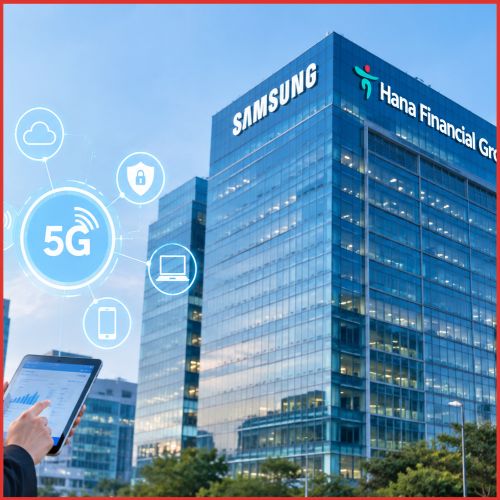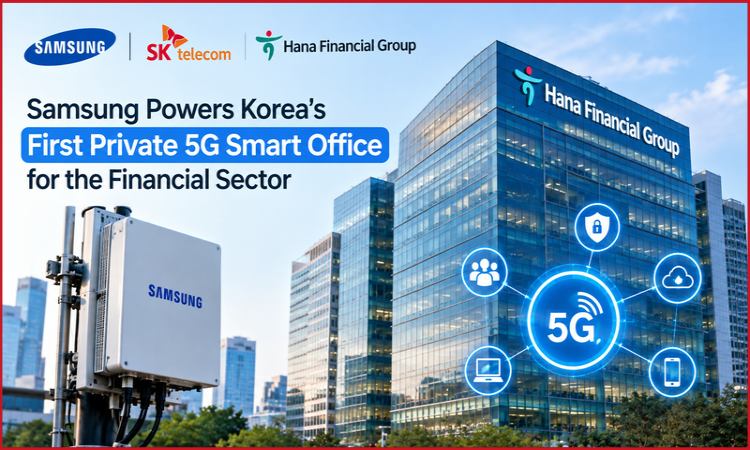
Samsung Electronics has supplied the network technology behind what is being described as South Korea’s first private 5G smart office in the financial sector, giving thousands of employees secure wireless access across Hana Financial Group’s new headquarters.
The project brings together Samsung, SK Telecom and Hana Financial Group at a large new office in Incheon. Samsung is the sole network-equipment vendor, providing the radio, baseband and core technology needed to run the private 5G smart office.
The network spans 16 floors and supports several Hana Financial Group affiliates, marking an unusual deployment of private 5G in an industry where security requirements have historically kept many internal systems dependent on wired connections.
Hana Financial Is Replacing Part of the Wired Office Model
Financial companies handle large volumes of sensitive information, from customer bank details to internal financial records.
That has made network security a particularly important issue for banks and other regulated financial businesses.
Traditional office Wi-Fi can create additional cybersecurity concerns, while financial organisations in South Korea also operate under strict network-separation requirements.
The Hana project aims to provide the mobility of wireless connectivity without giving up the security controls normally associated with a wired corporate network.
Employees using private 5G connectivity can access internal systems through compatible laptops, tablets and mobile devices as they move around the building.
That means a worker is less dependent on a fixed desk or Ethernet connection to access company resources.
The Deployment Covers 16 Floors
The scale of the project makes it more than a small private-network trial.
The system covers 16 floors of Hana Financial Group’s new Incheon headquarters, several group affiliates and thousands of employees.
The objective is to create a workplace where authorised devices maintain secure connectivity throughout the building.
For large corporate offices, that can make desk allocation and workspace changes easier.
Moving a team from one area to another normally involves physical network adjustments if employees rely heavily on wired connections.
A secure enterprise private 5G network reduces some of that work because connectivity moves with the approved device.
Samsung says this can reduce the time and resources needed to reconfigure office spaces while supporting more flexible working arrangements.
Samsung Is Supplying the Complete 5G Stack
Samsung’s role goes beyond supplying individual radios.
The company is providing the full network stack, including radio units, baseband equipment and a cloud-native 5G Standalone core.
The network operates using Korea’s 4.7GHz mid-band spectrum allocated for private 5G services.
A standalone architecture is important because it allows the network to use capabilities developed specifically for 5G rather than relying partly on older 4G infrastructure.
One of those capabilities is network slicing.
Samsung’s 5G Standalone Core can divide the same physical network into several virtual networks that operate separately.
Hana Financial Group can therefore give different subsidiaries their own slices while maintaining individual security and operating policies.
Security Is Built Around Multiple Layers
Hana’s financial-sector deployment uses several layers of security rather than relying on one authentication method.
The network includes enhanced encryption, firewall protection and defence against distributed denial-of-service attacks.
Access is also controlled using USIM-based authentication.
That means only authorised users and registered devices can connect to the network.
This is one of the main differences between the deployment and an ordinary office wireless setup.
Private 5G gives the organisation control over who can connect as well as the infrastructure carrying the traffic.
For a financial institution, that level of control is central to making wireless working practical for systems containing sensitive information.
SK Telecom Brings Network Expertise
Samsung is supplying the network equipment, while SK Telecom is participating through its telecommunications and enterprise-network experience.
The partnership gives Hana Financial a combination of infrastructure technology and network-operation expertise.
The companies see the project as a foundation for wider digital changes rather than simply a faster way for employees to connect laptops.
One of the main areas they are looking towards is enterprise artificial intelligence.
AI tools often need access to large amounts of internal data and computing resources.
Giving employees secure, reliable wireless access to those systems can make it easier to integrate AI into everyday work without relaxing security requirements.
Private 5G Is Moving Beyond Factories
Private 5G has often been associated with industrial environments.
Factories, shipyards, warehouses and logistics centres can use dedicated wireless networks to connect equipment, robots, cameras and sensors while keeping latency low and network performance predictable.
The Hana project shows how the technology is beginning to move into more conventional offices.
A financial headquarters may not contain industrial robots, but it has another demanding requirement: sensitive information must remain protected while employees increasingly expect mobile access to digital tools.
That makes finance an interesting test case for private 5G networks.
If the model works well, other banks and regulated businesses may consider similar deployments.
Samsung Is Expanding Its Enterprise Network Business
The project is also strategically important for Samsung.
The company competes in network infrastructure with global suppliers while continuing to expand beyond the public 5G networks operated by telecom companies.
Private networks offer another market.
Businesses can deploy dedicated infrastructure for their own facilities rather than depending entirely on public cellular coverage or conventional Wi-Fi.
Samsung’s portfolio covers radios, cloud-native cores, virtualised RAN, Open RAN and newer AI-related network technologies.
The Hana Financial deployment gives the company a high-profile example of private 5G working in a heavily regulated industry.
The Smart Office Could Become a Test Case for Finance
The technology itself may be less important than what Hana eventually builds on top of it.
The network gives employees secure mobile access today, but the longer-term value could come from applications that depend on reliable connectivity, data access and AI.
Hana could use the infrastructure to support new collaboration tools, connected devices and future AI services without redesigning the office network each time.
For Samsung and SK Telecom, success could also make the private 5G smart office model easier to sell to other financial institutions.
The Incheon headquarters is therefore more than a workplace connectivity upgrade.
It represents an attempt to combine the security of a tightly controlled financial network with the freedom employees expect from modern wireless systems.
If that balance works at scale across thousands of workers, Korea’s first private 5G financial smart office may provide a useful blueprint for banks and other regulated companies far beyond Hana Financial Group.