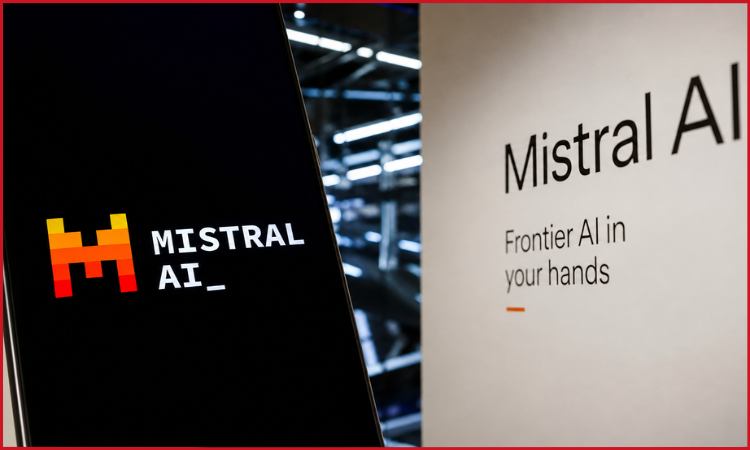
Three researchers. A borrowed office in Paris’s 9th arrondissement. No product, no revenue, no customers. In April 2023, that was Mistral AI. Within a month, it had raised €105 million ($113 million) at a €240 million valuation, the largest seed round in European history at the time.
Arthur Mensch, fresh off a stint at Google DeepMind, put up the idea. Guillaume Lample and Timothée Lacroix, both coming out of Meta’s AI research lab in Paris, built the technical case. All three had studied engineering and AI in Paris between 2011 and 2014, long before “large language model” was a boardroom phrase.
What makes the Mistral AI Success Story worth studying is not the seed round. It’s what came after: a company that shipped open-weight models nobody expected a three-person outfit to ship, then converted that credibility into enterprise contracts, government deals, and a valuation north of €11 billion in under three years.
This piece breaks down how Mistral AI built its business model, who backs it, where it stands against OpenAI, and what founders can actually take from its playbook.
Quick Glance
| Company Name | Mistral AI SAS |
| Founded | April 2023 |
| Founders | Arthur Mensch, Guillaume Lample, Timothée Lacroix |
| CEO | Arthur Mensch |
| Headquarters | Paris, France |
| Valuation | About €11.7 billion (~$13.5 billion) as of the Series C round, September 2025; a further round near €20 billion ($23 billion) was reported “in talks” by Bloomberg in June 2026 |
| Total Funding Raised | Over $3.9 billion across multiple equity and debt rounds |
| Annual Recurring Revenue | Roughly $400 million as of January 2026, up from about $20 million a year earlier |
| Known For | Open-weight large language models, the Le Chat assistant, European AI sovereignty |
| Key Deal | €1.7 billion Series C led by chipmaking giant ASML, September 2025 |
From A Paris Apartment To Europe’s AI Flagship
Three guys left good, stable jobs to start Mistral AI right around the time ChatGPT was making every company in Europe nervous about falling behind in AI. But these weren’t random founders. Two of them (Lample and Lacroix) had helped build Meta’s LLaMA model. The third (Mensch) had worked on Chinchilla, an important AI research project at DeepMind (Google’s AI lab). So investors weren’t betting on an idea; they were betting on people who’d already proven they could build cutting-edge AI.
The money came fast
- May 2023: Lightspeed (a big venture capital firm) led their first funding round.
- December 2023 – just 7 months later: Mistral raised $415 million, valuing the company at nearly $2 billion.
The wild part: this happened before they’d really shipped a product. Investors were purely betting on the team’s reputation.
Their big strategic bet
Companies like OpenAI (ChatGPT) and Anthropic keep their AI models locked up you can only use them through an API; you never get the actual underlying model. Mistral did the opposite: they released some of their models openly, so developers could download them, modify them, and build with them freely.
This one decision did three things for Mistral:
- Got developers talking about them (free publicity/word of mouth)
- Got developers building on their tech (instead of a competitor’s)
- Made them politically valuable to Europe European governments and companies wanted their own AI option so they wouldn’t be totally dependent on American tech giants. Mistral positioned itself as that option.
Mistral AI Business Model: How It Actually Makes Money
Open weights look generous on the surface. They aren’t charity. Mistral gives away smaller models to seed adoption, then charges where usage gets serious.
Revenue Streams
| La Plateforme API | Pay-per-token developer access to Mistral’s models, billed by usage |
| Le Chat Subscriptions | Free, Pro ($14.99/month), Team ($24.99/user/month), and Enterprise tiers for its consumer-facing assistant |
| Enterprise And Sovereign Deployments | On-premise and private-cloud installs for banks, telecoms, and governments with data-residency rules |
| Mistral Forge | A licensed platform, launched March 2026, that lets organizations pre-train and fine-tune proprietary models on their own infrastructure |
| Professional Services | Nine-figure co-development contracts with large enterprise and public-sector clients |
According to revenue-tracking firm Sacra, Mistral’s annual recurring revenue hit roughly $400 million in January 2026, a near-20x jump from about $20 million a year prior. Europe alone accounts for around 60% of that revenue, which tells you exactly where the company’s sovereignty pitch is landing hardest.
Early customers named publicly include ASML, HSBC, BMW, and the European Space Agency, alongside government bodies exploring homegrown alternatives to US-based AI vendors.
Funding Journey And The Valuation Climb
Mistral has raised money at a pace few European startups have matched. Nvidia, Samsung, IBM, and Databricks all joined its Series B in March 2024. Its Series C, closed in September 2025, brought in €1.7 billion, led by ASML, which took roughly an 11% stake and became the company’s largest shareholder.
Funding Snapshot
| Seed Round | €105 million, May 2023, led by Lightspeed Venture Partners |
| Series A | $415 million, December 2023, valuation near $2 billion |
| Series B | Closed March 2024, backers included Nvidia, Samsung, IBM, Databricks |
| Series C | €1.7 billion, September 2025, led by ASML, valuation €11.7 billion |
| Debt Financing | $830 million, March 2026, from a consortium of seven banks, earmarked for Nvidia chips and a new Paris-area data center |
By June 2026, Bloomberg reported Mistral was in early talks to raise around €3 billion at a valuation near €20 billion, nearly double its Series C mark. That round wasn’t confirmed closed at the time of writing, and terms could still shift.
The pattern is telling: Mistral funds compute-heavy growth mostly through equity from strategic industrial partners, then patches short-term infrastructure needs with debt rather than diluting further. That’s a mature capital structure for a company barely three years old.
Mistral AI Vs OpenAI: Where It Competes And Where It Doesn’t
Comparing Mistral AI vs OpenAI on scale alone is a mismatch, and pretending otherwise does readers a disservice. Here’s how the two actually stack up, side by side.
Mistral AI Vs OpenAI: Side-By-Side Comparison
| Attribute | Mistral AI | OpenAI |
| Founded | 2023 | 2015 |
| Headquarters | Paris, France | San Francisco, USA |
| Model Approach | Ships several models with open weights | Keeps frontier models closed |
| Estimated Valuation | €11.7B-€20B (~$13.5B-$23B) | Hundreds of billions of dollars |
| Reported Revenue Scale | ~$400 million ARR (Jan 2026) | Tens of billions of dollars |
| Core Wedge | European data sovereignty, cost efficiency | Frontier scale, consumer reach via ChatGPT |
| Flagship Consumer Product | Le Chat | ChatGPT |
| Key Backers | ASML, Nvidia, Samsung, IBM, Databricks | Microsoft, Thrive Capital, SoftBank |
Products That Built The Company
Le Chat is Mistral’s consumer and productivity front door, now built on Mistral Medium 3.5 and pitched directly at ChatGPT users who want European hosting. Codestral and Devstral power in-editor coding assistance. Pixtral handles vision tasks, Voxtral handles audio, and Magistral targets step-by-step reasoning work.
Forge, announced at Nvidia’s GTC in March 2026, marked a shift from selling model access to selling model-building infrastructure itself, aimed squarely at enterprises that want to own what they train rather than rent it.
Key Business Lessons From The Mistral AI Success Story
● Open weights can be a distribution strategy, not just an ideology. Free access built the developer base that paid access later monetized.
● A geopolitical narrative is a real moat when it’s backed by product. “European AI sovereignty” only worked because Mistral had shippable models to point to.
● Strategic investors buy more than capital. ASML’s stake ties Mistral to Europe’s chip-industrial complex, not just its balance sheet.
● Debt has its place even in venture-heavy sectors. Financing GPUs through bank debt kept equity dilution lower during a compute-hungry buildout.
● Enterprise contracts compound faster than consumer subscriptions. Nine-figure co-development deals moved the ARR needle harder than Le Chat’s consumer tiers.
Challenges And Risks Mistral AI Still Faces
- Compute Cost Pressure
Compute costs remain brutal, and Mistral is racing against companies with far deeper pockets. Nvidia GPUs, data center buildouts, and training runs all scale in cost faster than a mid-sized startup’s revenue typically can. - Revenue Gap Versus Rivals
Mistral’s ARR, while growing fast, is a rounding error next to OpenAI and Anthropic’s revenue base. Closing that gap purely on compute spend isn’t realistic, which is why the company leans so heavily on its European positioning instead of a scale argument.
- Regulatory And Procurement Dependence
A meaningful share of Mistral’s growth rides on European public-sector contracts and data-residency rules that favor a local vendor. Any slowdown in that procurement pipeline, or a shift in EU AI regulation, could dent the sovereignty pitch that’s currently doing a lot of commercial work. - Talent Retention Against Silicon Valley Pay
Frontier AI research pays enormous premiums in the US. Europe’s biggest AI success story still has to compete with Silicon Valley paychecks to keep its research bench intact, and losing even a handful of senior researchers to US labs would sting a team this small.
Conclusion
Mistral AI’s climb from a €240 million seed valuation to a possible $23 billion mark in three years isn’t just a funding story. It’s a working example of a French AI startup turning open-source distribution, strategic capital, and a sovereignty argument into actual enterprise revenue. Whether Mistral becomes Europe’s lasting European AI unicorn or gets squeezed by bigger, better-funded rivals will depend on how well it defends the regulated, European ground it has already claimed. For founders building anywhere outside Silicon Valley, that’s the more useful lesson than the headline valuation.
FAQs
1. What is Mistral AI and when was it founded?
Mistral AI is a French artificial intelligence company founded in April 2023 by Arthur Mensch, Guillaume Lample, and Timothée Lacroix. It builds open-source and proprietary large language models, along with its Le Chat assistant.
2. What is Mistral AI’s current valuation?
Mistral AI was last confirmed at roughly €11.7 billion (about $13.5 billion) following its September 2025 Series C round led by ASML. Bloomberg reported in June 2026 that a new round near €20 billion was under discussion, though it wasn’t confirmed closed.
3. How does Mistral AI make money?
Mistral AI earns revenue through pay-per-token API access on La Plateforme, paid tiers of Le Chat, enterprise and on-premise deployments for regulated industries, and its Forge platform for custom model training.
4. Who are Mistral AI’s biggest investors?
Mistral AI’s backers include Lightspeed Venture Partners, General Catalyst, Andreessen Horowitz, Nvidia, Samsung, IBM, Databricks, and ASML, which became its largest shareholder after leading the Series C round.