In the span of just a few years, artificial intelligence has transitioned from a niche technology to a mainstream business solution. And at the heart of the organization lies OpenAI, the creator of ChatGPT.
What was decades ago an artificial intelligence research organization has grown into one of the fastest-growing technological companies in history, providing products to consumers, developers, startups, and large enterprises.
ChatGPT’s debut shifted the human-AI relationship. Countless users employed generative AI in writing, coding, research, customer help, schoolwork, and even automation.
With the widespread embrace of AI, OpenAI capitalized by establishing revenue streams, manifesting a sustainable business through a combination of consumer subscriptions, enterprise software, developer services, and AI infrastructure.
We will discuss in this article the business model of OpenAI and its revenue streams, its growth strategy, its challenges, and most importantly, the reasons behind its success.
OpenAI at a Glance
| Detail | Information |
| Founded | 2015 |
| Headquarters | San Francisco, California |
| Founders | Sam Altman, Elon Musk, Greg Brockman, Ilya Sutskever, Wojciech Zaremba, John Schulman, and others |
| Industry | Artificial Intelligence |
| Core Products | ChatGPT, API Platform, Enterprise AI Solutions |
| Business Model | Subscription, API Usage, Enterprise SaaS |
| Primary Market | Consumers, Developers, Businesses |
The Problem OpenAI Solves
Before the widespread adoption of generative AI, numerous AI applications consumed significant cost, infrastructure, and technical skill; thus, inhibiting their proliferation and the ability for many enterprises to leverage AI.
To combat this, OpenAI developed advanced AI accessible via easy-to-use interfaces and APIs.
Instead of having to develop one’s own AI systems, users can simply work with ChatGPT or other OpenAI models.
It means immediate availability for users to tap into AI-based support. For developers, it means ever-ready AI functionalities. For businesses, it means scalable tools to enable productivity, automation, and decision-making.
This accessibility laid the ground for OpenAI’s rapid expansion.
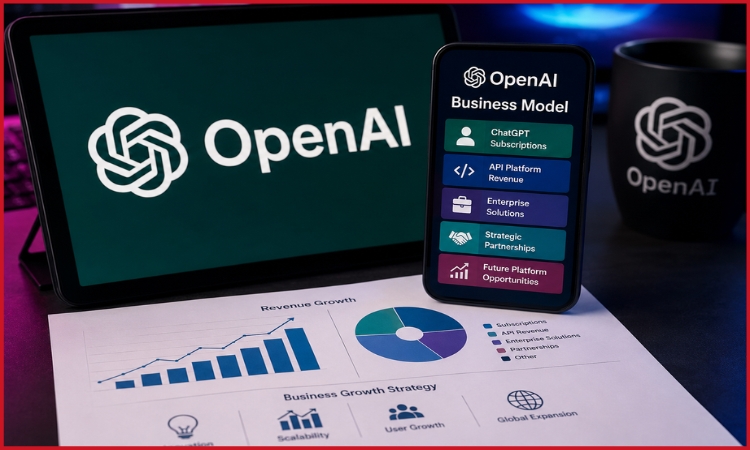
OpenAI Business Model Explained
OpenAI has a diversified business model, though, and depends on multiple revenue streams.
Rather than relying on a single source of income, OpenAI generates revenue from subscriptions, enterprise customers, and the developer ecosystem.
1. ChatGPT Subscription Revenue
Paid ChatGPT subscriptions constitute one of OpenAI’s largest revenue streams.
OpenAI’s business model is based on Freemium.
Users use the AI for free, hence OpenAI is able to have an enormous user base.
After experiencing the usefulness of their platform, many users move to premium plans for higher performance, enhanced models, increased limits, and supplementary features.
By adopting this strategy, OpenAI generates recurring monthly revenue while continuing to grow its user funnel.
The freemium model decreases the cost of customer acquisition through the mere existence of usage as a channel for marketing.
2. API Platform Revenue
OpenAI’s API business is primarily aimed at developers and software companies.
Instead of building AI models internally, businesses can access OpenAI’s technology through APIs and integrate it into their own products.
This allows companies to add AI-powered features such as:
- Content generation
- Chatbots
- Customer support automation
- Code assistance
- Data analysis
- Knowledge search
The API business scales with usage.
When API users send more requests, OpenAI makes more revenue without actual effort to sell it.
This creates a revenue machine capable of scaling to tremendous proportions as it scales with customers.
3. Enterprise AI Solutions
Another major revenue source is large organizations.
Enterprises with needs for high-level security, compliance controls, administration of users, and private deployments.
OpenAI caters to these needs with enterprise-focused products.
Enterprise customers use OpenAI’s solutions for:
- Employee productivity
- Internal knowledge management
- Customer service automation
- Software development
- Business process optimization
The fact that enterprise contracts tend to be of higher value and longer term than consumer subscriptions makes them especially important drivers of sustainable growth.
4. Strategic Partnerships
And OpenAI has also benefited from significant strategic alliances.
The technology partners give OpenAI the infrastructure, cloud computing, distribution, and enterprise access.
The partnerships enable OpenAI to scale quickly.
Instead of just selling directly, OpenAI makes use of partner ecosystems to grow market share.
5. Future Platform Opportunities
OpenAI is now venturing into other areas.
Emerging opportunities include:
- AI agents
- Workflow automation
- Business process orchestration
- Industry-specific AI solutions
- AI-powered software platforms
While key to where the world is headed, we could also see these opportunities becoming a major part of future revenue as more organizations begin to embed AI into their workflows.
How OpenAI Makes Money
There are 3 main parts to the OpenAI business model.
Consumer Revenue
Produced using paid ChatGPT plans acquired by personal users who require more powerful AI.
Developer Revenue
Produced via API by startups and software companies, and by developers who are integrating OpenAI models into their products.
Enterprise Revenue
Created from business contracts, enterprise deployments, and organization-wide AI adoption programs.
This diversification of revenue has been used to reduce the vulnerability of depending on specific customer market segments.
OpenAI Revenue Growth Timeline
Early Research Phase (2015-2022)
In its first years, OpenAI has been focusing on research and models; making revenue was never the goal.
The organization’s initial purpose was to push artificial intelligence towards higher capabilities and develop a technology base.
ChatGPT Breakthrough (2022-2023)
The arrival of ChatGPT was a game-changer.
Consumer adoption took off as millions of people used generative AI to address daily needs.
This rapid adoption laid the groundwork for widespread monetization.
OpenAI was quick to roll out paid subscription plans and increase API availability.
Hypergrowth Phase (2024-2025)
As enterprise adoption quickly gathered momentum, OpenAI saw some of the fastest revenue growth in the software industry.
Several factors contributed to this growth:
- Global AI adoption
- Enterprise demand
- Developer ecosystem expansion
- Product innovation
- Increased awareness of generative AI
The company grew from being a research-driven entity to a very significant commercial technology platform.
The Secret Behind OpenAI’s Success Strategy
It isn’t all due to magic technology that OpenAI was able to grow so quickly.
It was also due to a series of tactical decisions.
Product-Led Growth
OpenAI gives users the ability to experience value before purchasing.
Instead of relying on aggressive selling strategies, the product itself drives adoption through user experiences and recommendations from existing users.
It is an accelerant for great organic growth.
Freemium Acquisition Strategy
The free iteration of ChatGPT acts as an acquisition engine.
Allowing millions of users to try it out without paying.
A certain percentage will then opt in to become paying customers as they rely on the product more and more.
This approach helps OpenAI grow its user base quickly while generating revenue from paying customers.
Developer Ecosystem Expansion
Though OpenAI is not a platform just for end users.
OpenAI builds out its reach into thousands of products and services by allowing developers to integrate apps with its models.
This expansion is strengthened by developers successfully building applications on OpenAI technology.
Enterprise Adoption Focus
Consumer popularity drew attention, and enterprise customers gave scale.
Much more than individual users, businesses are making large investments in AI and incorporating it into vital workflows.
OpenAI’s broadening of enterprise services has positioned them to produce sustainable revenues in the long term.
Continuous Product Improvement
OpenAI is always advancing model performance, functionality, stability & ease of use.
And each should be designed to improve the user experience and to enhance the company’s competitive advantage.
All this creates a distributive feedback loop where better and more popular products will bring far more users and, consequently, far more revenues for further innovation.
Challenges in OpenAI’s Business Model
However, OpenAI encounters a few struggles and drawbacks, such as:
High Infrastructure Costs
Modern AI processes demand vast computation.
The high costs of GPUs, data centers, or any other infrastructure remain one of the most operational challenges for AI companies.
Infrastructure growth must be balanced with system efficiency and operational performance.
It is very delicate to balance the growth and the efficiency.
Intense Competition
The AI industry is highly competitive.
Significantly, the leading tech firms and AI startups remain committed to intensively investing in the development of models, enterprise tools, and developer ecosystems.
Continual innovation is necessary to sustain world technology leadership.
Regulatory and Ethical Considerations
With the increasing adoption of AI, authorities and regulators are establishing new rules with respect to transparency, privacy, and responsible AI usage.
OpenAI faces evolving regulations while continuing to innovate at scale.
Monetization Pressure
Rapid growth likewise leads to the expectation of rising turnover and profits.
OpenAI should maintain its revenue streams at a rapid rate of growth while keeping costs low in infrastructure and competition.
Key Lessons Businesses Can Learn From OpenAI
OpenAI’s journey is full of lessons for startups and established companies alike.
1. Solve a Massive Problem
OpenAI concentrated on democratizing cutting-edge AI.
Addressed a large market with an opportunity for creating huge demand.
2. Let Users Experience Value First
Freemium products can speed up adoption, lowering the barriers to entry.
3. Build an Ecosystem
Platforms generally have a more sustainable growth than individual products.
4. Diversify Revenue Streams
OpenAI benefits from multiple growth engines, including consumer subscriptions, enterprise sales, and developer platforms.
5. Invest in Continuous Innovation
Sustainable achievement can only be attained with constant improvements rather than waiting for one fortunate breakthrough to occur.
Conclusion
OpenAI’s business model integrates consumer subscriptions, developer APIs, enterprise offerings, and strategic partners into a highly scalable growth engine.
The company built a global commercial platform by bringing state-of-the-art AI technology to consumers worldwide.
Its triumph showcases the potential for a technology firm to grow quickly by using the product-led model, building an ecosystem, and developing a sustainable revenue model.
Though there are still major hurdles of infrastructure costs and competition, the innovation capability has helped OpenAI become one of the most powerful companies in the industry.
OpenAI’s business model offers an impressive example of how innovation can be converted into a whole business, while AI becomes increasingly integrated into work and business operations.
FAQs
1. Why did OpenAI choose a freemium business model instead of a paid-only model?
OpenAI employs a freemium approach to scale user adoption and gather large-scale real-world usage data. Free users number in the millions, while premium plans catering to power users turn them into paying customers.
2. How does OpenAI balance massive AI infrastructure costs with revenue growth?
OpenAI, which is currently in the process of raising investment, has high expenses for training models on large-scale data and various other computing-related expenses. OpenAI’s multiple monetization mechanisms, such as ChatGPT subscriptions, API subscriptions, and enterprise contracts, help cover these costs.
3. Why is OpenAI’s API business strategically important?
The API business allows OpenAI to grow its offerings far beyond ChatGPT and to become the underlying platform for thousands of other apps. Each new SaaS platform, startup, or enterprise product based on OpenAI API calls will continue to drive usage and create new revenue paths.
4. What gives OpenAI a competitive advantage in the AI market?
OpenAI benefits from its excellent AI research pipeline, a very large user base, a still-expanding developer ecosystem, and enterprise uptake. All these aspects generate a network effect in which more users, developers, and companies keep amplifying the platform’s position in the market.
5. Can OpenAI sustain its growth in an increasingly competitive AI industry?
OpenAI’s future growth will hinge on further model innovations, scaling new offerings to businesses, efficiency achievements, and new pure-AI offerings, including agents and workflow automation functionalities. The ability to translate technological leadership into enduring profitability will be a crucial aspect of ongoing success.