India’s skincare market is the fastest-growing category within the country’s personal care industry. As Indian consumers move away from celebrity-backed products, they are increasingly seeking ingredient-focused, scientifically proven skincare solutions tailored to specific skin concerns. With a stronger emphasis on product efficacy than on traditional marketing, direct-to-consumer (D2C) skincare brands have gained significant traction.
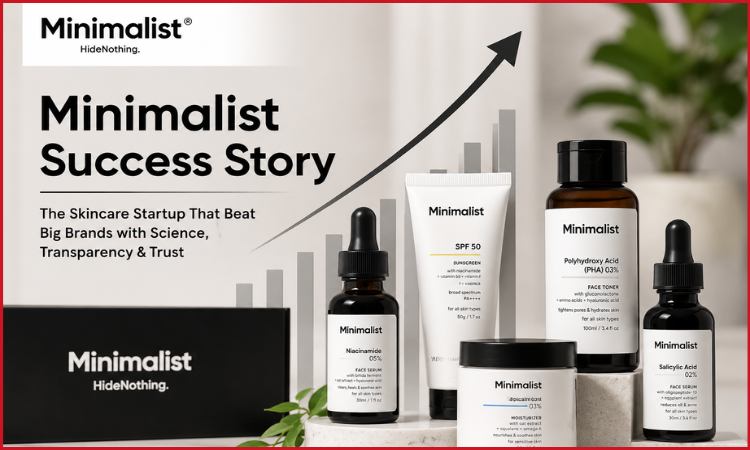
One brand that has successfully capitalized on this shift is Minimalist. Founded in 2020 in Jaipur, the company set out to challenge traditional FMCG brands with science-backed formulations, transparent ingredient lists, and educational marketing. Within five years, Minimalist reached a valuation of nearly ₹3,000 crore and was acquired by Hindustan Unilever Limited (HUL).
In 2026, Minimalist continues to be led by its founders while leveraging HUL’s distribution network and operational expertise to expand its market presence. Its success has shown that a differentiated business strategy can compete against larger established players.
About Minimalist
Minimalist is an Indian direct-to-consumer (D2C) skincare, haircare, and body care brand founded in 2020 by Mohit Yadav and Rahul Yadav. The company is based in Jaipur, Rajasthan. The brand positions itself as a science-led skincare company and focuses on ingredient-led formulations instead of relying on traditional beauty marketing.
While many skincare brands promote terms such as “herbal” or “natural” in their marketing, Minimalist focuses on clearly explaining its active ingredients, the scientific research behind them, and the benefits consumers can expect from each formulation. This has become one of the company’s strongest USPs.
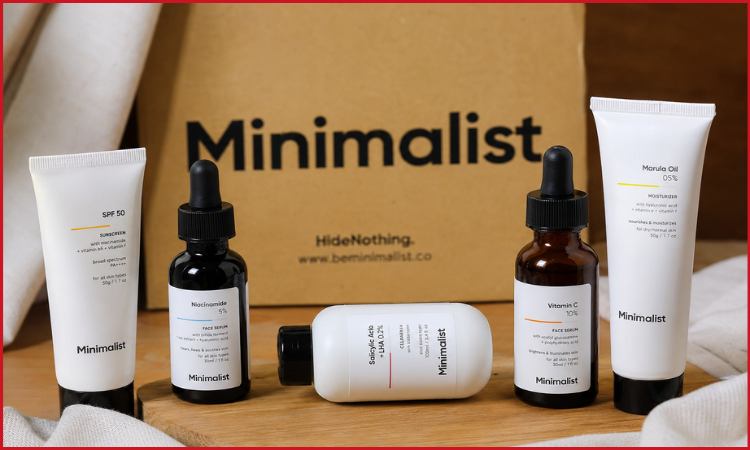
Its product portfolio includes serums, moisturisers, sunscreens, cleansers, haircare, and body care products, which are available through its official website, Amazon, Nykaa, and an expanding offline retail network.
How the Founders Identified a Market Gap
Before launching Minimalist, Mohit Yadav and Rahul Yadav had previously built other ventures, giving them entrepreneurial experience.
They understood that despite many established brands in India’s beauty industry, customer demand for ingredient-based skincare continued to grow, largely driven by international products.
Their research identified several market gaps:
- A lack of openness regarding product ingredients from most of the larger brands
- A complex claim that made it nearly impossible to compare products
- Very costly imported cream & serum with active ingredients
- Growing consumer awareness of ingredients such as Niacinamide, Salicylic Acid, Vitamin C, and Retinol indicates that buyers increasingly value scientifically formulated skincare products.
Rather than giving a celebrity endorsement-driven marketing message or an image-driven product message, the two founders sought to educate consumers via openness about their product and the science behind it. This positioning ultimately became one of Minimalist’s best competitive advantages.
Minimalist Business Model
Minimalist follows a D2C business model while gradually building an omnichannel retail strategy.
Transitioning to an online-first model allowed the company to quickly obtain customer insights to improve existing products and develop new ones, while bypassing the distribution expenses typically involved with traditional retailers. As popularity increased, the company added new sales channels to enhance accessibility, yet continued to maintain close customer bonds through its website.
Today, its products are available through:
- Official website
- Amazon
- Nykaa
- Select offline retail stores
- Pharmacy chains
By adopting this omnichannel approach, Minimalist combines broad market reach with direct customer engagement, reducing its dependence on any single distribution channel.
Growth Timeline
Minimalist’s success has been driven more by strong execution than aggressive capital raising.
| Year | Key Milestone | Business Impact |
| 2020 | Minimalist enters the scene in the midst of the global turmoil of COVID-19 | Leads the fast-growing D2C skincare space in India |
| 2021 | Available in Series A funding totalling c. $15 million from Peak XV Partners and Unilever Ventures | Great for expediting innovation and capturing new markets. |
| 2022-2023 | Broadens into skincare, haircare, and body products | Increases average customer spending |
| 2024 | Revenue exceeds 347 crore | Is now one of India’s leading skincare startups |
| 2025 | HUL takes a majority stake of 90.5 % on a valuation of close to 2,955 crore | Obtain the delivery and distribution capabilities of HUL |
| 2026 | 19 FY25 financials feedback: revenue is 514 crore+. | The continued strength of the HUL acquisition |
Within five years, Minimalist has grown from a startup into one of India’s highest-valued skincare brands. Operating across both online and offline channels, the brand has built a strong customer base, expanded its retail presence, and attracted significant interest from leading global investors.
Funding Strategy: Growing Without Excessive Capital
Although most D2C startups have gone through multiple funding rounds before achieving scale, Minimalist has remained relatively capital-efficient.
The company raised an institutional funding round of approximately US$15 million from Peak XV Partners (formerly Sequoia India) and Unilever Ventures. Rather than raising additional capital, the founders focused on product innovation, expanding distribution, strengthening customer retention, and building a sustainable business.
This disciplined approach minimized founder dilution while demonstrating that strong execution and capital efficiency could attract strategic investors. The company’s eventual acquisition by HUL validated this strategy.
Financial Performance: 2026 Update
According to the FY25 financial results released in 2026, Minimalist continues to maintain strong business momentum.
Revenue from operations reached ₹514.8 crore, representing a 48.1% year-on-year increase from ₹347.4 crore in FY24. Total income increased to ₹517.6 crore, supported by sustained consumer demand across its product portfolio.
The company reported a net loss of ₹31.5 crore, primarily due to a one-time exceptional expense of ₹46.1 crore. Excluding this one-time item, the company would have reported an adjusted profit of ₹13.6 crore, indicating that its core business remained profitable.
Its FY25 cost structure also underscores an ongoing commitment to long-term growth:
- Total expenses increased to ₹504.1 crore.
- Materials Cost was 150.5 Crore.
- Employee benefits totalled ₹36.8 crore.
- Depreciation and amortisation were 36.9 crore.
- Marketing, logistics, marketplace commissions, and other operating expenses totalled ₹313.3 crore.
The increase in the operating expenses post the HUL deal can mostly be attributed to market investments in acquiring new customers, building brands, growing the distribution presence, and scaling the business.
For investors and those following the industry, a more critical message is the consistent revenue growth and increasing scale of the business. The accounting loss does not detract from the strong operational results, robust consumer demand, and continued scale that underpin why Minimalist has been ranked among India’s fastest-growing skin care brands and why HUL viewed it as a natural fit with the rest of its B&W portfolio.
Why Minimalist Beats Established Beauty Brands
Minimalist competes directly with large FMCG companies, established skincare brands, and rapidly growing D2C players that have significantly larger advertising budgets. Rather than anchors and billboards, celebrity campaigns, and emotion-driven branding, Minimalist is speaking to its consumers through transparency, scientific formulations, and education.
One of Minimalist’s key differentiators is its transparent disclosure of product ingredients. The ingredients used in each product are presented clearly by highlighting all active ingredients, the amount used, and their application/benefit, which gives consumers confidence in choosing a product. This is vital for content-savvy ingredients shoppers.
Product pricing is also affordable. The product is priced significantly lower than the majority of other international skin care brands, while providing a similar concentration of active ingredients and containing comparable formulations. This pricing strategy makes Minimalist an accessible choice for consumers seeking science-based, effective skincare.
Instead of releasing too many products, Minimalist tends to address individual skin problems, including acne, skin pigmentation, hydration, sun protection, and anti-aging, more effectively. The well-arranged range of products further enhances the buying journey.
Marketing Strategy That Prioritises Education
Minimalist’s marketing strategy differs significantly from that of traditional beauty brands.
Rather than spending money on celebrities, they spend on education through blogs, ingredient discussion, dermatologist support, social media, and product education. They don’t tell people that they’re beautiful; what they do tell them is how the ingredients work as ingredients, what the science is behind each product, and the results they can achieve.
Performance marketing continues to play a key role in their growth strategy, too. They invest heavily in their paid advertising offerings across platforms such as Google Search, Meta, Amazon, and Nykaa digital marketplaces while also motivating their customers to regularly share reviews to provide social validation.
These investments are accounted for in the company’s financials. FY25 operating expenses show ongoing investment in customer acquisition, building the brand, and future growth of our business.
Distribution Strategy Supports Long-Term Growth
Minimalist went digital first and then started to evolve into an offline retail Brand.
Its omnichannel distribution strategy now includes:
- Direct-to-consumer website
- Amazon
- Nykaa
- Offline retail stores
- Pharmacy chains
This multi-channel distribution model, on the other hand, minimizes the risk of having over-reliance on just one channel and enables the company to target a wider market.
The acquisition by HUL has reinforced it even further. With the rich retail experience and the dense supply chain and distribution network of HUL, Minimalist would be able to tap into newer markets and newer customers, which otherwise would not have been possible through online channels.
By combining a strong digital-first foundation with an expanding offline retail presence, Minimalist has built a scalable distribution network that provides a significant competitive advantage in India’s fast-growing skincare market.
Why HUL Acquired Minimalist
In 2025, HUL bought a 90.5% stake in Minimalist at a valuation of roughly ₹2,955 crore, one of India’s largest D2C beauty acquisitions.
Instead of building a science-based skincare brand from scratch, HUL chose to acquire Minimalist, recognizing its strong market position and rapid growth.
For HUL, the acquisition strengthens its Beauty & Wellbeing business and provides greater exposure to the rapidly growing science-led skincare segment.
The partnership with HUL gives Minimalist access to HUL’s manufacturing expertise, retail distribution network, and international expansion opportunities, while allowing founders Mohit Yadav and Rahul Yadav to continue leading the business.
HUL also holds the right to buy the remaining 9.5% share in the next two years.
Competitor Comparison
| Company | Core Positioning | Primary Strength | Competitive Challenge |
| Minimalist | Science-backed ingredient skincare | Ingredient transparency, affordability, and consumer education | How to keep up with fast growth and grow across the world |
| Mamaearth | Natural and toxin-free personal care | Good offline presence and great brand recognition | Differentiating beyond its natural positioning |
| The Derma Co. | Dermatologist-inspired skincare | Clinical formulations for particular skin issues | Confronting the hyper-competitive active skincare market |
| Plum | Vegan and clean beauty | Sustainability-focused branding | Premium pricing pressure |
| Foxtale | Everyday skincare routines | Digital-first customer engagement | Scaling offline distribution |
| Deconstruct | Ingredient-first skincare | Affordable science-backed formulations | Lower overall brand awareness |
What makes Minimalist stand out is its ingredient transparency, science-backed formulations, affordable pricing, and education-first marketing approach.
Challenges Ahead
Although Minimalist has experienced rapid growth, it still encounters certain problems.
In India, the skincare market is getting increasingly competitive with more and more local startups and international brands launching ingredient-based products. However, marketing costs on digital advertising mediums are on the rise across the board.
The company must continue innovating its product portfolio while maintaining its premium positioning.
As its offline retail presence expands, Minimalist will also need to communicate its science-backed value proposition and educational approach more effectively to a broader consumer base.
2026 Outlook
The company, as of July 2026, has not announced FY26 financial results, an IPO, or further fundraising.
However, the company’s long-term vision remains clear. Minimalist will use the manufacturing, retail, and distribution strengths of the more experienced HUL alongside its current leadership team.
This reflects a broader trend across the Indian beauty industry, where established FMCG companies are increasingly acquiring high-performing digital-first skincare brands.
The acquisition activity in this segment is only further evidence of the rising importance of science-led, ingredient-driven consumer brands.
If Minimalist successfully expands its offline presence while maintaining product quality, ingredient transparency, and consumer trust, it is well positioned to strengthen its leadership in India’s premium skincare market.
Key Business Lessons
Minimalist’s success demonstrates that even new companies can compete with established industry leaders through strong execution and a differentiated business strategy.
Its journey offers several valuable business lessons:
- Create products that address specific customer problems.
- Build long-term customer trust through transparency and science-backed product information.
- Scale sustainably through disciplined execution rather than excessive fundraising.
- Customer education is a proven strategy to:
- Increase customer loyalty.
- Increase repeat purchases.
- Pair digital-first growth with a well-executed omnichannel plan.
- Leverage strategic partnerships and acquisitions to accelerate market expansion while maintaining operational excellence.
Since debuting during the COVID-19 crisis and scaling to a valuation of almost ₹3,000 crore in five years, Minimalist demonstrates how focused execution, efficient capital deployment and a sharply defined value proposition can challenge one of India’s most competitive consumer markets.
Its journey reflects the broader transformation of India’s beauty industry, where ingredient transparency, science-backed products, and consumer trust are becoming stronger competitive advantages than advertising alone.
Conclusion
Minimalist has demonstrated how a focused business model can successfully challenge established market leaders.
Within five years, its combination of ingredient transparency, science-backed formulations, disciplined capital allocation, and a digital-first strategy helped build one of India’s fastest-growing skincare brands.
Its acquisition by HUL validates both its business model and long-term growth potential while providing access to a significantly larger manufacturing, distribution, and retail ecosystem across India. By 2027, further growth in India’s premium facial skincare market is expected, with Minimalist well-positioned to capitalize on this opportunity while maintaining its focus on transparency, consumer education, and product efficacy.
FAQs
1. Who founded Minimalist?
Minimalist was established in 2020 by Mohit Yadav and Rahul Yadav. Based in Jaipur, the brand concentrates on creating science-backed skincare, body care and haircare products while simultaneously focusing on ingredient transparency and consumer education.
2. Why did Hindustan Unilever acquire Minimalist?
Hindustan Unilever Limited (HUL) has taken a controlling stake of 90.5% in Minimalist to bolster its Beauty & Wellbeing portfolio and grow in the high-potential science-led skincare segment. With this stake and the support of HUL’s manufacturing and distribution infrastructure, Minimalist founders will be able to manage the brand going forward.
3. How does Minimalist compete with larger skincare brands?
Minimalist competes through ingredient transparency, science-backed formulations, educational marketing, accessible premium pricing, and a digital-first business model rather than relying on celebrity endorsements or traditional beauty advertising.
4. How much revenue does Minimalist generate?
In its most recent earnings for FY25 filed with the SEC in 2026, Minimalist posted ₹514.8 crore in revenue from operations, about 48% growth year over year.
5. What makes Minimalist’s business strategy successful?
Minimalist’s business strategy is built around ingredient transparency, science-backed products, capital-efficient growth, customer education, and disciplined execution. By focusing on trust, product efficacy, and long-term value instead of traditional beauty marketing, the company has established a strong competitive position in India’s skincare market.