Imagine running a factory, operating a railway network, or even powering millions of homes without a reliable electricity supply. This was one of India’s biggest challenges during the 1970s, when rapid industrialisation and growing energy demand exposed major gaps in the country’s power infrastructure.
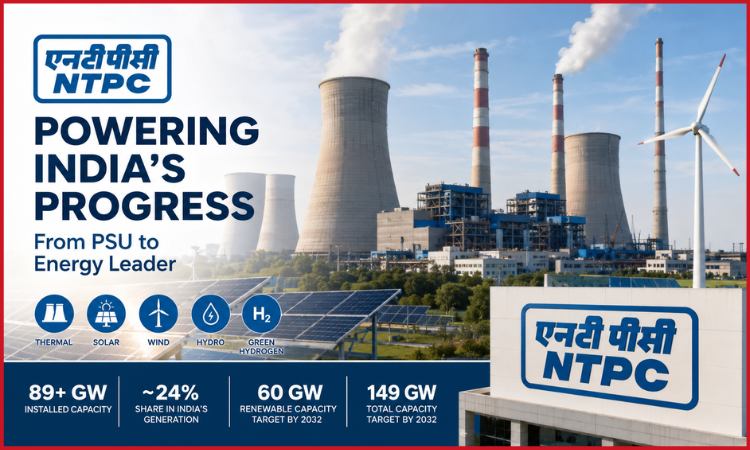
In an effort to combat this shortcoming, the Government of India founded NTPC on the 7th of November, 1975. What began as a government-owned thermal power corporation has now grown into India’s largest integrated power utility. Nearly 50 years after its establishment, NTPC has an installed capacity of over 89 GW. It provides almost ¼ th of India’s electricity generation & has high investments in renewable energy, green hydrogen, battery storage & environmentally friendly infrastructure.
NTPC at a Glance
| Particulars | Details |
| Founded | 7 November 1975 |
| Headquarters | New Delhi, India |
| Ownership | Government of India |
| Industry | Power Generation & Energy |
| Installed Capacity (2026) | Over 89 GW |
| Employees | 18,816 |
| FY26 Consolidated PAT | 27,546 Crore |
| FY26 Standalone PAT | 23,162 Crore |
| Renewable Capacity Target | 60 GW by 2032 |
| Total Capacity Target | 149 GW by 2032 |
| Status | Maharatna PSU |
(Sources: NTPC Corporate Information and FY26 disclosures.)
Why Was NTPC Created?
In the 1970s, the power sector in India was highly fragmented and dominated by state electricity boards. Rapid urbanisation and industrial growth placed significant pressure on India’s existing power infrastructure, leading to chronic shortages.
In order to achieve these, the Government of India set up the National Thermal Power Corporation (NTPC). The objective was to develop large-scale power projects while improving operational efficiency and ensuring a reliable electricity supply. The government aimed to create a centralised power generation company that could support India’s long-term economic growth.
From Zero to India’s Largest Power Producer
The company began with its first thermal power project at Singrauli and gradually expanded its presence across multiple states. During the 1980s and 1990s, the focus was on constructing large capacity plants and on efficiency.
| Year | Major Milestone |
| 1975 | NTPC established |
| 1985 | Capacity reached 2,000 MW |
| 1994 | Capacity crossed 15,000 MW |
| 2002 | Capacity crossed 20,000 MW |
| 2010 | Capacity exceeded 31,000 MW |
| 2026 | Installed capacity surpassed 89 GW |
The IPO That Changed NTPC’s Future
NTPC entered a new phase of growth in 2004 when it launched its IPO. The public issue attracted strong investor interest and gave the company additional resources to support future expansion plans.
Listed on NSE and BSE, the company’s IPO was one of the biggest in India at the time. On the day of listing, NTPC stock opened higher and closed substantially higher than its IPO price. Today, NTPC ranks among the largest company in India in terms of market cap and is also considered one of the most valuable companies in India.
The IPO provided access to capital for future expansion while allowing the Government of India to retain strategic control.
How NTPC Built Over the Years
Diversification
Unlike traditional utilities focused on a single segment, NTPC expanded across the energy value chain through:
- Coal mining
- Energy trading
- Hydro power
- Solar power
- Wind energy
- Green hydrogen
- Battery storage
- Consultancy services
The Shift Beyond Thermal Power
For a long time, NTPC was known primarily as a thermal power giant.
As governments and corporations accelerated the transition toward cleaner energy sources, the global energy market began to shift.
The company proceeded to enter the renewable energy sector with a fast growth approach and extensive long-term sustainability goals. Currently, NTPC has over 8 GW of renewable capacity in operation and 13 GW under installation. Its long-term plan is to reach 60 GW of renewable capacity in 2032, with half of its capacity using non-fossil fuels.
NTPC Green Energy and the Renewable Revolution
Renewable energy has become a major focus area for NTPC over the past few years.
In 2020, to fast-track the company’s clean energy vision, NTPC Renewable Energy Limited was incorporated. This subsidiary develops solar and wind power projects along with energy storage solutions and green hydrogen initiatives.
FY26 Financial Performance
NTPC’s scale is reflected in its FY26 financial and operational performance.
| Metric | FY26 Performance |
| Installed Capacity | 89+ GW |
| Consolidated PAT | 27,546 Crore |
| Standalone PAT | 23,162 Crore |
| Share in India’s Generation | ~24% |
| Renewable Capacity Under Operation | 8+ GW |
NTPC vs Major Competitors
Although India has several major energy companies, NTPC remains the country’s leading power generator.
| Company | Primary Focus |
| NTPC | Thermal, Solar, Hydro, Wind, Hydrogen |
| Tata Power | Integrated Utility & Renewables |
| Adani Power | Thermal Generation |
| NHPC | Hydroelectric Power |
| Power Grid | Transmission Infrastructure |
What sets NTPC apart is its presence across multiple energy segments while maintaining leadership in power generation capacity.
Challenges Along the Way
NTPC’s growth journey has not been without challenges.
The company has faced:
- Environmental issues associated with coal-based generation
- Rising renewable energy competition
- Regulatory changes
- Fuel supply uncertainties
- Pressure to reduce carbon emissions
The company has responded through diversification and continued investment in emerging energy technologies rather than relying solely on thermal power generation.
What’s Next for NTPC?
NTPC’s future growth strategy is focused on building a diversified energy portfolio beyond conventional power generation.
By 2032, the company aims to:
- Achieve 149 GW of installed capacity
- Develop 60 GW of renewable energy capacity
- Increase non-fossil fuel capacity to 50%
- Expand green hydrogen projects
- Strengthen battery storage infrastructure
- Support India’s energy transition goals
Key Lessons from NTPC’s Success Story
NTPC’s growth journey offers valuable lessons for businesses across industries:
- Solving large national challenges can create opportunities for long-term growth.
- Thinking in the long term results in competitive advantages.
- Diversification helps companies adapt to industry disruption.
- Even established organisations must continue innovating to remain competitive.
Conclusion
The remarkable growth of NTPC from a government-owned PSU formed in 1975 to India’s largest integrated power utility reflects decades of sustained growth, operational discipline, and adaptability. Starting with a mission to address India’s electricity shortage, the company has grown into one of the country’s largest energy producers, with over 89 GW of installed capacity, strong financial performance, and ambitious renewable energy targets.
As India transitions toward cleaner energy sources, NTPC’s ability to balance conventional power generation with investments in renewable energy will shape its future growth.
FAQs
1. What is NTPC, and why was it established?
National Thermal Power Corporation (NTPC Limited) was incorporated by the Government of India on 7 th November 1975 to support India’s growing electricity demand and expand power generation infrastructure across the country. It eventually became India’s largest power generation corporation.
2. Is NTPC the largest power generation company in India?
Yes. NTPC is the largest power generation firm in the country. Presently, NTPC has an installed capacity of over 89 GW as of FY26 and accounts for almost a quarter of the total power generated in the country. The company has a diversified portfolio spanning thermal, hydro, solar, wind, and emerging clean energy projects.
3. How does NTPC make money?
The main income for NTPC is through the sale of power. The company primarily sells electricity to state distribution companies under long-term power purchase agreements. It also earns income by way of renewables, coal mining, energy trading, consultancy services, and other power sector-related operations.
4. How has NTPC diversified beyond thermal power?
While NTPC was initially a thermal power producer, the company has diversified into solar and wind power, hydroelectric projects, green hydrogen, battery energy storage systems, coal mining, and energy trading, helping it expand its presence across multiple segments of the Indian energy sector.
5. What is NTPC Green Energy, and why is it important?
NTPC Green Energy, the renewable energy arm of NTP, focuses on the development of solar, wind, green hydrogen, and other green energy projects. It plays a central role in the company’s clean energy strategy and long-term goal of reaching 60 GW of renewable energy capacity by 2032.
6. What are NTPC’s future growth plans?
NTPC has set a target of achieving a total installed capacity of 149 GW by 2032, with 60 GW in renewable energy sources. The company is investing in green hydrogen, battery storage technologies, and other clean energy initiatives to support India’s energy transition.
7. What are the key reasons behind NTPC’s success?
NTPC’s long-term success can be attributed to government support, efficient project execution, operational excellence, long-term power purchase agreements, business diversification, and continued investment in renewable energy initiatives. These factors have helped the company maintain its leadership position in the Indian power sector for nearly five decades.