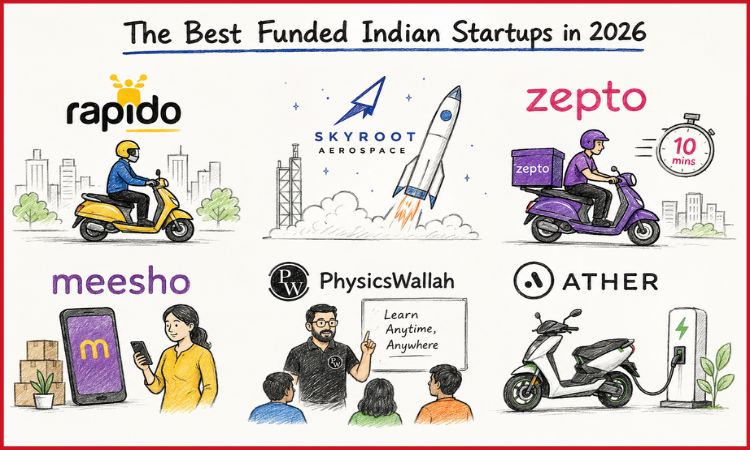
India’s startup world is no longer operating in ‘growth at any cost’ mode. Investors are placing bets on startups that bring together scale with greater business fundamentals, AI capability, infrastructure ownership, and long-term profitability in 2026.
Following the funding downturn across 2023 and early 2024, large funding rounds are returning to India’s startup market, but in a very different form compared to the previous unicorn boom. Capital is now flowing toward startups building defensible ecosystems across mobility, quick commerce, AI infrastructure, spacetech, EVs, and enterprise technology.
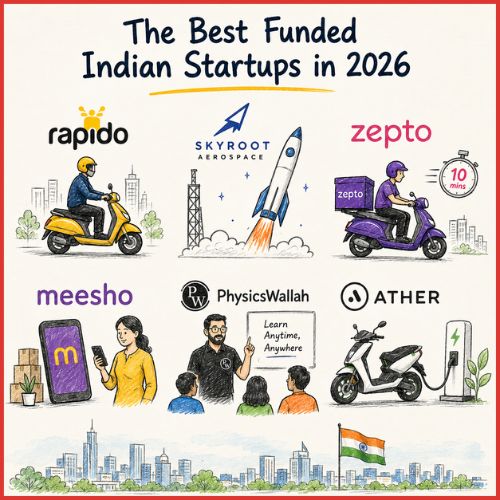
This year has seen several Indian startups cross major valuation milestones. Companies such as Rapido, Skyroot Aerospace, and Zepto attracted huge investor interest and have re-drawn the Indian startup narrative in 2026.
India’s Funding Scenario in 2026
The Indian startup market entered 2026 with a renewed sense of investor confidence, particularly when it came to large late-stage rounds and companies close to their IPO. However, in contrast to the investment binge in 2021, startups are now being rewarded more for operational efficiency, not just scale.
India’s startup ecosystem continued to remain among the world’s largest in 2026, particularly across AI, quick commerce, mobility, fintech infrastructure, and deep-tech sectors. Industry trends also showed growing investor preference toward startups with stronger operational efficiency, infrastructure ownership, and clearer profitability pathways compared to the aggressive expansion cycle seen in 2021.
Three structural shifts mark the 2026 environment:
• AI and deep-tech startups are being prized more than ever.
• Infrastructure-heavy companies are becoming a mainstream VC bet.
• Investors are increasingly valuing the path to profitability over hyper-growth.
This pattern is evident across sectors. Quick commerce firms are already chasing a reduction of their EBITDA losses ahead of an IPO, while the mobility and spacetech sectors are attracting strategic global capital over sheer speculative play.
India’s funding environment also became more concentrated. We are seeing larger bets being placed on category leaders, which have a clear play to become a dominant force in their respective segments, rather than hundreds of smaller, mid-size rounds.
1. Rapido
Rapido emerged as one of India’s most closely watched mobility startups in 2026 following strong late-stage investor interest and continued expansion across urban transportation services.
Industry discussions around Rapido also reflected growing confidence in India’s mobility ecosystem and demand for scalable transportation infrastructure.
Why Investors Backed Rapido
Rapido has grown beyond being a mere bike-taxi service.
The company now also offers: auto-rickshaw aggregation, cab services, local delivery and mobility infrastructure.
India’s local urban transportation needs are hugely underserved, with the demand in Tier 2 and 3 cities remaining extremely high.
Investors also prefer Rapido over incumbent ride-hailing apps such as Uber and Ola due to its leaner operating model and adaptability to regional needs.
The company’s valuation from $2.3 billion to $3 billion, represents substantial confidence from institutional investors about India’s mobility economy.
2. Skyroot Aerospace
Skyroot Aerospace remained one of India’s most closely followed deep-tech startups in 2026 as investor interest in private space and aerospace infrastructure continued growing.
This is a great development for India’s deep tech landscape as funding previously went largely to fintech, food delivery and ecommerce but now signifies a turning point to infrastructural and aerospace ventures.
Why Skyroot is Important
Having successfully tested India’s first private rocket in 2022, Skyroot is now getting set for a Vikram-1 orbital launch and strengthening its production and launch facilities.
The significant investor interest can be attributed to the changes in India’s space policy, allowing more involvement between private players and ISRO.
Most significantly, investors view space as a long-term, strategic sector driven by:
• satellite deployment
• defense infrastructure
• global launch capabilities
• communication technologies
• national aerospace capabilities
Skyroot’s rise reflects growing confidence in India’s long-term aerospace and strategic technology capabilities.
3. Zepto
Zepto remained one of India’s most aggressively funded quick commerce startups in 2026, supported by continued investor confidence in rapid-delivery infrastructure and urban consumption growth.
Industry reports also suggested that Zepto has been evaluating long-term public market plans as competition intensifies within India’s quick commerce ecosystem.
Why Investors are backing Zepto
Although ultra-fast delivery initially seemed too capital-intensive to survive, investors have now shifted their opinion after quick commerce platforms demonstrated the scalability of rapid deliveries in dense urban centers.
Zepto has expanded to over 1000 dark stores with its own logistics infrastructure, high-frequency urban consumption and hyper-local inventory management systems.
The company has reportedly raised over $1 billion from investors in recent years and is currently the best-funded startup in India’s quick commerce industry.
Simultaneously, Zepto is expected to focus on improving profitability, reportedly having reduced its EBITDA losses significantly ahead of its IPO discussion.
4. Meesho
Still one of India’s biggest ecommerce and social commerce successes. While the premium ecommerce space may be getting crowded, Meesho was able to build on affordability and a non-metro user base, a strategy that investors still favor.
Meesho also strengthened its position through its seller-focused ecosystem and affordability-driven commerce strategy, which continues to perform strongly across Tier 2 and Tier 3 markets.
Why it still matters
The Meesho ecosystem maps well to the Indian digital curve:
• Value-first ecommerce
• Tier 2/3 penetration
• Small seller enablement
• Social commerce scalability
Investors now look at firms like Meesho as long-term infrastructure plays, rather than simply temporary, discount-driven platforms.
5. PhysicsWallah
PhysicsWallah continued attracting market attention even as several heavily funded edtech companies struggled following the broader slowdown across the sector.
PhysicsWallah’s growth has largely been driven by:
• Low-cost model
• Reach across mass markets
• Expanding towards hybrid learning
• Exam-focused infrastructure
Why does it still enjoy the trust of investors?
It seems that PhysicsWallah’s business model is far more disciplined capital-wise than other well-funded Indian edtech unicorns in the past, which is significant in 2026, as investors would support companies that could overcome corrections rather than those with over-inflated valuations.
6. Ather Energy
The EV sector in India witnessed astounding interest from institutions, while Ather remains the most important company in this domain.
Ather’s long-term strategy also extends into charging infrastructure and broader EV ecosystem development, areas that continue attracting long-term institutional interest.
The rationale for funding EV startups
This growing interest reflects increasing confidence in India’s long-term electric mobility transition, supported by EV policies, charging infrastructure expansion, and changing urban consumer behavior.
Whereas other mobility companies are about aggregators, EV companies present a long-term opportunity for manufacturing and infrastructure.
The biggest funding trend in 2026: AI and infrastructure
The largest story emerging from India’s startup ecosystem is not funding value. Instead, it is about the distribution of the money.
Instead of being willing to spend money solely on consumer-focused apps, investors are now looking to companies that build infrastructure-heavy ecosystems.
The strongest funded sectors are:
• AI infrastructure
• Automation in enterprise
• Quick commerce logistics
• Mobility platforms
• EVs
• Spacetech
• Defence tech
The startup ecosystem is gradually moving away from pure growth-focused models toward businesses with stronger operational and technological foundations.
The economy is shifting from user-acquisition startups toward ventures with more technology ownership and strategic value.
What investors are looking for in 2026
The funding scenario in 2026 is far more cautious than in previous cycles.
In 2026, investors will focus more on the following:
Quality of revenue
Today, high gross merchandise value alone isn’t enough.
Investors want businesses that show steady revenue generation, good retention numbers, the ability to scale operational efficiency, and a higher level of monetization.
Infrastructure ownership
Businesses that either own or tightly control logistics, supply chains, delivery operations, manufacturing capabilities, or their own unique technology are attracting stronger valuations.
IPO readiness
Private companies, in the late stage, are focused more on readiness to go public than private valuation premiums.
Integration of AI
There is an increase in the number of non-AI startups that are trying to use AI in a few operation areas of their business such as logistics, automation, personalization and thus attract more attention from investors.
Conclusion
Top funded Indian startups in 2026 are demonstrating the growing maturity of the Indian startup economy.
The Indian startup ecosystem is increasingly shifting toward infrastructure-driven growth, where operational efficiency, technology ownership, and long-term scalability are becoming more important than aggressive expansion alone.
The companies with the largest fundraising rounds in 2026, from Rapido’s rise to urban mobility dominance to Zepto’s grip over quick-commerce and Skyroot’s breakthrough into space-tech, reflect the overall trend to incorporate infrastructure.
Frequently Asked Questions
Which Indian startups were among the most sought-after with investors in 2026?
Zepto, Rapido, Skyroot Aerospace, Meesho, and Ather Energy were amongst the startups that remained at the center of investor interest in the year 2026 majorly due to the fact that they were developing businesses around long-term sectors, such as mobility, quick commerce, EV ecosystem, and deep-tech infrastructure.
Why has investment suddenly soared in Indian AI startups?
It appears that AI is no longer viewed as a tech bubble with potential for an imminent burst. Investors are gradually considering it as a basic underlying layer that can boost automation, logistics, personalization, enterprise, and performance. Thus the increased long-term interest in AI startups.
What sectors received the bulk of the funding in 2026?
Quick commerce, AI infrastructure, EV ecosystem, mobility platforms, spacetech, enterprise Saas, deep-tech are among the sectors that are highest funded through 2026.
Why has profitability come back into investor consideration?
Following the broader slowdown across global startup markets, investors have become far more cautious about companies burning large amounts of cash without a clear path toward sustainable growth. Startups with better operational efficiency and better revenue quality, as a result, gained greater investors’ interests in 2026.
Is India still one of the faster-growing startup markets around the world?
Yes, India continues to be one of the world’s largest and fastest-growing startup ecosystems because of a growing digital economy, rising internet penetration, an expanding AI ecosystem, and growing VC inflows from both domestic and international institutions.