In just four years, a Jaipur skincare firm grew from selling 1,000 goods in three days to being acquired by HUL for Rs 2,955 crore.
Mohit Yadav did not create Minimalist by following the standard D2C beauty playbook. He founded it after realizing a basic truth i.e. a lot of skincare marketing in India sounded wonderful but didn’t necessarily assist clients in solving real concerns.
That idea formed the foundation of a brand that began in Jaipur, sold 1,000 things in three days, grew through education and user-generated content, and eventually became valuable enough for HUL to purchase a 90.5% ownership.
The Basic Problem
The skincare market was busy, but the main issue was trust. Many brands sold stories, and customers had to guess whether an ingredient-heavy claim meant anything.
Mohit and his team noticed that the industry was full of marketing-led positioning, vague claims, and products that looked different on the outside but were often not that different in performance.
That gave them a clean opportunity to build a brand that explains what it does, what is inside, and focuses on outcomes instead of hype.
From Freewill to Minimalist
Minimalist did not start as a skincare brand right away. Before Minimalist, Mohit and the team were building Freewill, a personalized haircare business that used tech and data to create customized formulas based on customer responses.
They learned a valuable lesson from that experiment: while personalization sounded great, it was challenging to expand through distribution. Retail and marketplaces become challenging to use if every product is created from scratch.
They turned around as a result. They created problem-specific products rather than fully customized ones, which were far simpler to market on a large scale while yet feeling customized to a customer’s needs.
Why the Pivot Worked
The shift from “personalized for one person” to “specific for one problem” was the key business move made by the founders. It gave the brand both clarity and scale, which is a rare combination in consumer startups.
They learnt an important lesson from that experiment: while personalization sounded nice, it was difficult to scale through distribution. Retail and marketplaces become difficult to use if each product is manufactured from scratch.
They turned around as a result. They designed problem-specific products rather than fully personalized ones, which were far easier to market on a big scale while yet appearing tailored to a customer’s demands.
The First Growth Engine
That trial taught them a valuable lesson: personalization was a good idea, but it was hard to scale via distribution. If everything is made to order, retail and marketplaces are difficult to navigate.
This caused them to turn round. They made products that were specific to the problem, rather than completely tailored products that were much easier to sell on a mass basis and still looked as if they were tailored to the needs of the customer.
Here is the simple growth loop that drove early momentum:
| Step | What happened | Why it mattered |
| 1 | A creator found the brand | Created the first wave of attention |
| 2 | Early users tried the product | Built initial trust |
| 3 | Users posted their own results | Turned customers into promoters |
| 4 | More people tried it from those posts | The cycle repeated organically |
| 5 | Results built confidence | The brand gained credibility fast |
This systematic loop followed by Minimalist founders became the very first growth engine for the skin care brand.
What Minimalist Sold
Minimalist didn’t start with a broad lifestyle theme. It began with problem-focused skincare, including products for acne, pigmentation, age problems, and oily skin.
The founder’s thinking was straightforward: if the consumer has a specific problem, the product should also be specialized. That is much easier to understand than the ambiguous “beauty enhancement” jargon.
Here is a snapshot of the early brand logic:
| Brand choice | Why it mattered |
| Serums instead of generic creams | Made the format feel modern and active-driven |
| Ingredient-led naming | Helped educated buyers understand the product faster |
| No fragrance-heavy positioning | Reinforced a functional, no-nonsense image |
| Clinical and transparent language | Built trust over time |
This positioning made Minimalist feel less like a beauty brand and more like a problem-solving brand.
Education Became the Marketing
One of the most intriguing aspects of the story is how education itself became a marketing technique. The team used content to describe substances, skin issues, and what customers should look for while purchasing.
That is important because skincare is not a sector where impulse is sufficient. People frequently need to comprehend the problem before they can believe the solution.
Instead of opposing that reality, minimalists leaned into it. Because of this, the brand’s approach to community-building and content felt more like a long-term business system than a one-time campaign.
The Trust Advantage
A big part of the brand’s success came from trust. Mohit’s approach was to be transparent about what the product contains, what it can do, and what it should not claim.
That is a strong position in a market where many brands lean on big claims and weak proof. The Minimalist team saw this as a serious gap in the industry and chose to be the opposite.
The result was not just better branding. It was a stronger customer relationship, because people felt they were buying something honest.
The Scale Story
Minimalist’s scale makes this a business case study, not a startup story. The brand sold 1,000 products in its first three days and grew quickly, achieving revenue milestones as the company grew.
As per HUL’s official press release, Minimalist has been created in 2020 and has delivered an annual revenue run rate of INR 500 crore in four years. Minimalist’s FY25 revenue rose to Rs 514.8 crore, up 48% year-on-year.
| Metric | Figure |
| Launch sales | 1,000 products in 3 days |
| HUL stake acquisition | 90.5% |
| Acquisition valuation | Rs 2,955 crore |
| FY25 revenue | Rs 514.8 crore |
| YoY revenue growth | 48% |
(Source:- Media reports and estimates from Moneycontrol and The Indian express.)
HUL Acquisition
The biggest validation of Minimalist’s business model came when HUL agreed to acquire a 90.5% stake. The company was described as a premium active-led beauty brand, and the founding team continued to operate the business after the deal.
That acquisition is important for two reasons. Firstly, it shows how a D2C brand that originates from Jaipur can be strategically valuable to one of India’s largest FMCG players. Second, it demonstrated that there was more to the brand’s product and positioning than just startup hype. There was real corporate value.
The important lesson for founders here is that if you have great category positioning and a product that builds trust, the exit path can be way bigger than the initial business plan.
Shark Tank Visibility
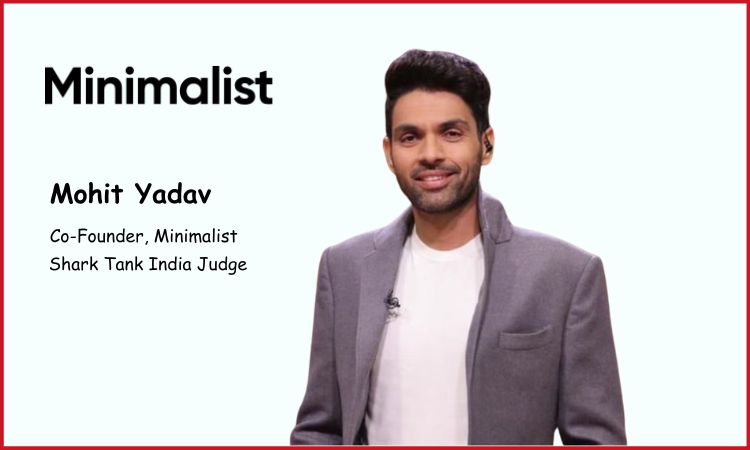
Mohit Yadav’s public profile grew further when he joined Shark Tank India Season 5 as one of the newer sharks on the panel. He is no longer only the person behind Minimalist; he is also part of the broader startup conversation in India.
What Founders Can Learn
Minimalist’s story is useful because it shows a very practical startup lesson. The market does not always reward the loudest brand, but it often rewards the clearest one.
| Lesson | What it means in practice |
| Solve one problem well | Don’t try to be everything to everyone |
| Make the product easy to understand | Clarity beats confusion |
| Use education as marketing | Teach before you sell |
| Build trust early | Honest messaging compounds over time |
| Start with a narrow audience | Early adopters can shape the whole brand |
This is why Minimalist works for most new entrepreneurs. The brand grew with a logic that other founders can study and repeat.
Mohit Yadav Net Worth
Mohit Yadav’s exact net worth has not been publicized, however it is widely associated with Minimalist’s quick rise and HUL acquisition. As co-founder of a brand bought at a valuation of Rs 2,955 crore, his financial result is considered one of the more significant wealth creation tales in India’s D2C ecosystem.
Conclusion
The story of minimalism is a perfect example of how a business can succeed by being more functional than fashionable. What Mohit Yadav had going for him was not just the discovery of a skincare market, but the development of a product system that consumers could truly understand, trust and clarity.
The brand didn’t simply grow up. It grew with a reasoning that stands up to scrutiny: solve a real problem, be transparent on how you solved it and let the product speak for itself.
Minimalist demonstrated how clarity itself may be a competitive advantage in a market full with promises.
FAQs
Who is Mohit Yadav?
Mohit Yadav is the co-founder of Minimalist, the Indian skincare brand known for its active-led, transparent, and problem-specific products.
How did Minimalist start?
It started after the team’s earlier venture, Freewill, taught them that personalized products were hard to scale, so they pivoted to problem-specific skincare.
Why did Minimalist become popular?
Minimalist became popular because it focused on real skin problems, transparent ingredients, and educational content rather than flashy marketing.
How much did HUL acquire Minimalist for?
HUL acquired a 90.5% stake in Minimalist, with the valuation reported at around Rs 2,955 crore.
What was Mohit Yadav’s role in Shark Tank India?
He joined Shark Tank India Season 5 as one of the sharks on the panel.
What was the first major growth trigger for Minimalist?
The first big trigger came from early users and content-driven word of mouth, not from large paid campaigns.
Is Mohit Yadav’s net worth public?
No exact verified public figure is available. His wealth is linked to Minimalist’s scale and the HUL acquisition outcome.