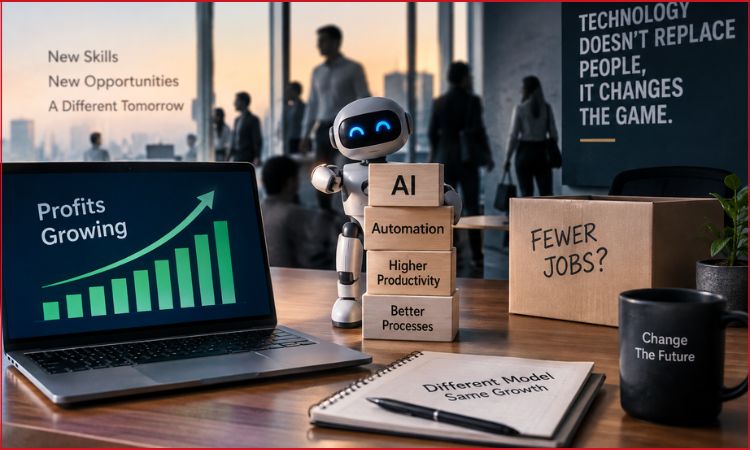
Some of India’s biggest technology companies are posting healthy profits while shrinking their workforce, and the reason has less to do with trouble and more to do with a changing business model.
For years, the Indian IT industry followed a simple growth formula: more clients meant more projects, more projects meant more employees, and a larger workforce supported higher revenue. That formula is beginning to change.
Some of India’s biggest technology companies are reporting healthy profits, stronger margins, or continued revenue growth while reducing, rationalising, or slowing workforce expansion. TCS ended FY26 with 584,519 employees, down from 607,979 a year earlier, while its FY26 operating margin rose to 25%. Tech Mahindra ended FY26 with 147,623 employees, down 1,108 year on year, even as its revenue increased 7.2% and profit after tax rose 13.2%.
But the picture is not uniform. Infosys increased its FY26 headcount to 328,594 from 323,578 while its net profit rose 10.2%. Wipro also ended FY26 with more than 240,000 employees.
The real story, therefore, is not that India’s IT companies are simply running out of work. The business model is changing. AI, automation, higher utilisation, tighter cost management, and a shift from billing for effort toward delivering measurable outcomes are weakening the old relationship between headcount and revenue.
Why Can IT Companies Cut Jobs When Profits Are Rising?
A profitable company does not necessarily need to increase its employee count. Consider a simplified example: if a 100-person team can deliver the same volume of work that previously required 110 people, the company can maintain revenue while carrying a lower cost base.
That can happen through:
- AI-assisted software development
- Automated testing and documentation
- Higher employee utilisation
- Smaller project teams
- Better delivery processes
- Reduced bench strength
- Selective hiring
- Greater use of reusable platforms and software
The result is a change in one of the industry’s most important metrics: revenue per employee. Nasscom’s 2026 strategic review describes the Indian technology sector as moving from scale-led growth toward value and innovation, with providers increasingly shifting from traditional full-time-equivalent delivery models toward outcome-based and risk-sharing structures as AI productivity develops. That is the key to understanding the apparent contradiction.
The Old Indian IT Model Was Built on Headcount
India’s IT-services success was built partly on labour arbitrage. Global companies could outsource technology work to Indian firms, which could assemble large teams of engineers and deliver services at competitive costs. The traditional model, broadly, ran on a simple chain: more clients led to more projects, more projects led to more employees, more employees meant more billable hours, and more billable hours meant more revenue.
It worked particularly well when software development, maintenance, testing, and support required large numbers of people. The model is not disappearing overnight, but the economics are changing. Today, clients increasingly want technology companies to demonstrate what business outcome was delivered, rather than simply how many people worked on a project. That distinction matters, because a client may no longer want to pay for a large team if technology can produce the same outcome with fewer people.
AI Is Weakening the Link Between Revenue and Employees
Artificial intelligence is one of the biggest forces behind this transition. Modern AI tools can assist with coding, testing, documentation, software maintenance, customer support, and knowledge retrieval. The important point is that an entire job does not have to disappear for AI to affect hiring.
Suppose an engineer becomes 20% more productive because AI handles some routine work. The company may not immediately dismiss that engineer. Instead, it may simply decide that its next project needs fewer additional engineers. That difference is crucial: AI can reduce future hiring demand before it eliminates existing jobs. This helps explain why the first visible effect of AI may be weaker fresher hiring, fewer replacement positions, or selective workforce rationalisation, rather than an immediate collapse in employment.
Indian IT companies themselves are increasing investment in AI capabilities. TCS reported that its annualised AI revenue exceeded $2.3 billion in Q4 FY26 and that more than 270,000 employees had higher proficiency in AI and machine learning. HCLTech reported FY26 annualised Advanced AI revenue of $620 million, alongside 3.9% constant-currency revenue growth. The message is increasingly clear: companies are not simply cutting technology capacity. They are reconfiguring it.
Clients Are Demanding More for Less
AI is also changing the buyer’s expectations. Under traditional technology-services contracts, companies could often associate revenue with effort — people, hours, and project scope. Now clients are asking a harder question: what result am I receiving for the money I spend?
Recent industry reporting shows Indian IT-services companies moving toward performance- and outcome-based contracts as clients demand higher productivity at lower costs. Reuters has described this as a significant shift away from traditional labour-linked pricing. That creates pressure on IT firms from both sides — they need to invest in AI and new capabilities while clients simultaneously expect productivity gains. The companies that can deliver the same outcome with fewer resources gain an economic advantage.
Why Higher Productivity Can Mean Fewer Jobs
The equation becomes fairly straightforward once it’s laid out:
| Change | Business effect |
|---|---|
| More automation | Fewer routine tasks require manual work |
| Higher utilisation | More work is handled by existing employees |
| AI-assisted development | Higher output per engineer |
| Leaner teams | Lower employee costs |
| Reusable platforms | Less repeated project work |
| Outcome-based contracts | Greater pressure to deliver efficiently |
This does not mean every company will continuously shrink its workforce. It means headcount can grow more slowly than revenue, or temporarily decline while productivity improves. TCS provides a clear illustration: its FY26 headcount fell by more than 23,000 from FY25, yet the company reported a 25% operating margin, up 70 basis points year on year.
The Fresher-Heavy Pyramid Is Under Pressure
The traditional IT-services pyramid depended on large numbers of junior employees handling structured and repetitive work under the supervision of experienced professionals. That structure made economic sense when routine activities required human labour at scale. AI changes the equation.
Routine coding, testing, documentation, and support can increasingly be automated or accelerated. As a result, companies can become more selective about entry-level recruitment while increasing demand for employees who can work with AI and solve more complex problems.
This is why the question is not simply whether AI will replace IT employees. A more useful question is which parts of the IT workforce become more valuable when AI handles more routine work. The answer increasingly includes AI engineering, cloud, cybersecurity, data, architecture, consulting, domain expertise, and technology-enabled business transformation. TCS said its FY26 talent strategy included large-scale upskilling in AI/ML, while HCLTech highlighted growing demand for advanced AI capabilities.
Why Companies Are Hiring Some Skills While Cutting Others
The industry’s workforce transformation is therefore uneven. Companies may simultaneously reduce certain roles and increase hiring in others.
| Workforce area | Emerging trend |
|---|---|
| Routine entry-level tasks | Greater automation pressure |
| Generic coding | Higher productivity expectations |
| AI and machine learning | Stronger demand |
| Cloud | Continued strategic demand |
| Cybersecurity | Continued importance |
| Data and analytics | Growing relevance |
| Domain specialists | Greater value |
| Consulting and architecture | Greater strategic importance |
This is why headline job numbers can sometimes hide a deeper change in the composition of employment. The industry may need fewer people for repetitive work but more people with specialised skills.
Utilisation Is Another Piece of the Puzzle
IT companies do not earn the same economics from every employee. An employee working on a billable project can contribute directly to revenue, while someone sitting without a project — often referred to as being on the bench — still represents a cost. That makes utilisation a critical operating metric.
If demand is uncertain, a company may prefer to improve the utilisation of its existing workforce before adding thousands of new employees. Wipro, for example, reported FY26 net utilisation of 84.5%, alongside revenue of $10.48 billion and an IT-services operating margin of 17.2%. The logic is simple: use existing capacity better before building more capacity.
Profits and Job Cuts Can Coexist
The contradiction becomes easier to understand when looking at the basic profit equation: profit equals revenue minus costs. A company’s profit can rise even without strong revenue growth if its costs are controlled effectively, and for an IT-services company, workforce costs are a major part of the operating structure. A combination of stable or growing revenue, higher productivity, better utilisation, and controlled employee costs can therefore produce stronger profitability.
Tech Mahindra illustrates this relationship particularly clearly. Its FY26 revenue increased 7.2%, EBIT increased 39.2%, and profit after tax increased 13.2%, while its total headcount declined by 1,108 employees year on year. The conclusion is not that job cuts caused the entire increase in profits — many factors influence profitability. But it demonstrates that workforce reduction and improved financial performance are not mutually exclusive.
Is AI the Only Reason for Indian IT Job Cuts?
No. Reducing every workforce decision to AI would oversimplify what is happening. Other factors include:
- Weak discretionary technology spending
- Delayed client decisions
- Global economic uncertainty
- Geopolitical risks
- Margin pressure
- Previous overhiring
- Higher employee utilisation
- Changes in project demand
- Restructuring around new business priorities
HCLTech, for example, described FY26 as a year affected by softer discretionary technology spending and geopolitical volatility, even while reporting revenue growth and increased demand for advanced AI offerings. This is why layoffs should be viewed as the result of several overlapping forces, not a single technology replacing humans.
Why Mid-Sized IT Companies Are Worth Watching
The shift is also changing competitive dynamics. Large technology companies built their advantage partly on scale, but AI-enabled productivity can reduce the economic importance of maintaining very large teams. Smaller firms can potentially compete by being faster, more specialised, and more flexible in how they structure contracts.
Reuters recently highlighted stronger growth at firms such as Persistent Systems and Coforge compared with some larger peers, while noting that the industry is moving toward more flexible, outcome-oriented delivery models. This creates a bigger strategic question for India’s IT sector: is scale still the biggest advantage, or is productivity becoming more important? The answer is increasingly moving toward the latter.
What Does This Mean for IT Employees?
For employees, the transition does not mean that technology careers are disappearing. It means the skill premium is changing. Workers who perform highly repetitive tasks may face greater pressure, particularly when those tasks can be augmented or automated. At the same time, people who can combine technology with business understanding may become more valuable.
The strongest long-term skills are likely to be those that help employees:
- Use AI rather than compete directly with it
- Solve ambiguous business problems
- Understand industry-specific requirements
- Design and manage complex systems
- Communicate with clients
- Validate AI-generated output
- Work across technology and business functions
For fresh graduates, this makes the old assumption — that a computer science degree automatically leads to a large IT-services hiring pipeline — less reliable than it once was.
Is This a Temporary Layoff Cycle or a Permanent Shift?
It is likely to be both. Some workforce reductions are cyclical — companies adjust hiring and staffing when technology spending slows, projects are delayed, or economic uncertainty rises. But the underlying structural changes are harder to reverse.
AI will continue to improve. Automation will continue to expand. Clients will continue demanding productivity. Technology companies will continue experimenting with outcome-based pricing and reusable software platforms. That means even when hiring recovers, it may not return in exactly the same form. The number of employees required for a given amount of technology work may remain lower than it was under the older delivery model.
The Bigger Story: India’s IT Industry Is Moving Beyond Headcount
For decades, employee count was one of the clearest indicators of an Indian IT company’s scale. That is becoming less useful. Revenue growth no longer has to translate proportionally into workforce growth — AI can increase output, automation can remove repetitive work, better utilisation can extract more value from existing teams, and outcome-based contracts can shift the focus from hours delivered to results achieved.
Reuters has described this as a fundamental change in how investors and companies should evaluate IT firms, with traditional headcount-linked metrics becoming less informative in an AI-driven services economy. The industry is therefore moving from a headcount-led model to a productivity-led model. That is the real reason profits and job cuts can appear together.
The Bottom Line
Indian IT companies are not cutting jobs simply because they have stopped making money. In many cases, they are trying to make their businesses more productive, more specialised, and less dependent on continuously expanding employee numbers.
The old equation was straightforward: more employees led to more delivery capacity, which led to more revenue. The emerging equation looks different — more technology combined with higher productivity leads to more output per employee, which leads to leaner workforce requirements.
That transition will create pressure in some roles, new opportunities in others, and a continuing need for reskilling. For investors, employees, and students alike, the important question is no longer just how many people an IT company employs. It is how much value each employee, supported by technology, can create.