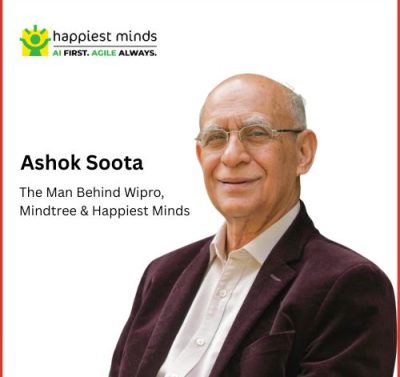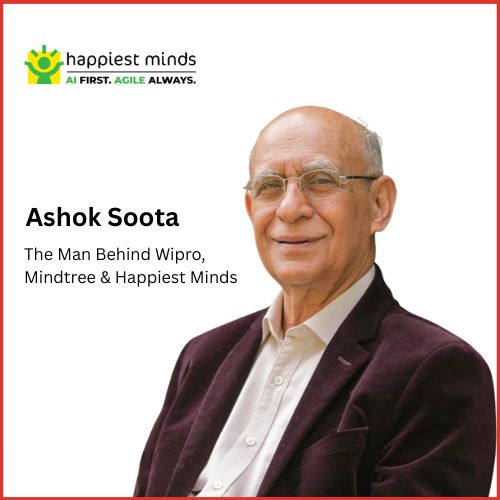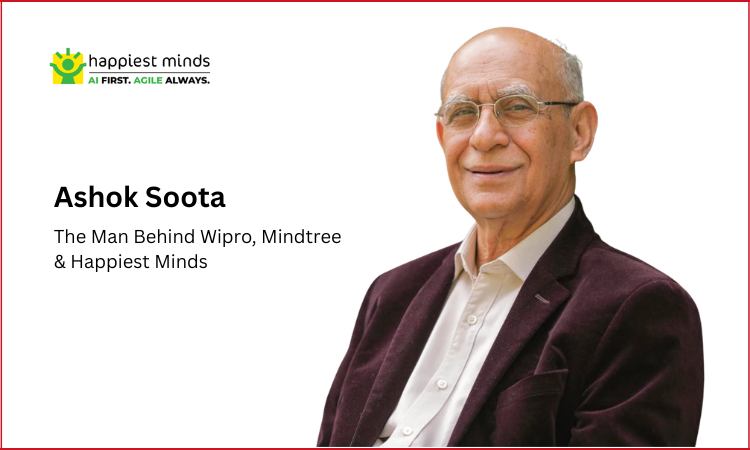
In April 2011, a 69-year-old engineer walked away from three decades of building India’s IT industry and started over nine partners, a leased office in Bangalore, and a company he named Happiest Minds. Nine years later, its IPO would be oversubscribed 151 times. That kind of second act is rare in Indian business. It’s also the reason the Ashok Soota success story keeps resurfacing in founder conversations long after most of his generation retired to boardrooms and advisory panels.
He built Wipro’s IT arm from a rounding error into a national name, co-founded Mindtree, and then, at an age when most executives are winding down, built a third company from scratch. Few careers in Indian technology carry that kind of range. Understanding Ashok Soota’s career means treating these as three separate chapters, not one long tenure with a single employer’s name on the door.
Who Is Ashok Soota?
Ashok Soota was born in what is now Pakistan’s North-West Frontier Province, into a Hindu family from Dera Ismail Khan that crossed over during Partition when he was five, according to a 2010 Livemint interview cited by Forbes India in 2024. He studied electrical engineering at the University of Roorkee, now IIT Roorkee and later added an MBA from the Asian Institute of Management in the Philippines.
That academic grounding matters less than what he did with it. Over more than five decades, he ran the IT arm of one of India’s largest conglomerates, co-founded a second company that went public to strong investor demand, and then built a third from nothing at an age when most founders are retiring. Any honest Ashok Soota biography has to hold Wipro, Mindtree, and Happiest Minds as three distinct careers rather than a single straight line.
Ashok Soota’s Companies At A Glance
| Full Name | Ashok Soota |
| Education | B.Tech (Electrical Engineering), University of Roorkee; MBA, Asian Institute of Management, Philippines |
| Wipro Infotech | President, 1984–1999 |
| Mindtree | Co-founder and Chairman, 1999–2011; IPO in February 2007 |
| Happiest Minds Technologies | Co-founder, 2011–present; IPO in September 2020 |
| Forbes Recognition | Ranked #2448 on Forbes’ 2022 Billionaires list |
| Philanthropy | Founded SKAN Research Trust (2021) for aging and neurological-disorder research; Ashirvadam Trust (2011) for environmental and welfare work |
How Ashok Soota’s Career Took Shape
The Wipro Years
Soota started out at the Shriram Group in 1965. The defining chapter began later, when a mutual contact, Anand Koka, introduced him to Azim Premji, who was looking for someone to run a fledgling IT business inside what was still largely a vegetable-oil and soap company. From 1984 to 1999, as President of Wipro Infotech, Soota is credited in the company’s own leadership records with growing that division from roughly $2 million to a $500-million run-rate. Fifteen years, one product line, a 250x swing in scale. Few executives in Indian IT from that era can point to a comparable single-company run.
Building Mindtree
By 1999, Soota wanted to build something of his own. He left Wipro with nine former colleagues and co-founded Mindtree the same year. The Ashok Soota Mindtree chapter is often told only as a founding story, but the fuller arc matters more: the company went public in February 2007 on strong investor demand, and Soota stayed on as chairman until January 2011, when internal disagreement over acquisition strategy and slowing growth targets pushed him to step down.
Mindtree was later absorbed into Larsen & Toubro through a hostile takeover in 2019 – a chapter Soota had no part in by then. That exit is worth including precisely because most retellings skip it. Real business journeys have messy middles, not just clean beginnings and triumphant endings.
Starting Over With Happiest Minds
One month after leaving Mindtree, at 69, Soota co-founded Happiest Minds Technologies with a group that included Joseph Anantharaju, Puneet Jetli, and Salil Godika. The company launched formally in August 2011, built around cloud computing, analytics, and what was then loosely called digital transformation categories most competitors still treated as side projects. Soota bet the company on them early enough that, a decade on, they had become the industry’s baseline, not its edge.
Real-World Examples: What Actually Happened
Wipro Infotech, 1984 – 1999. When Soota took charge, Wipro’s IT arm was a rounding error against the parent company’s soap-and-vanaspati roots. By the time he left, it had grown into what several company profiles describe as India’s largest computer business at the time. The lesson for today’s operators: a founder-run conglomerate can build a genuine technology arm if it hands the P&L to someone who runs it like an independent company, not a side bet.
Happiest Minds Technologies, 2020 IPO onward. Soota took the company public in September 2020, mid-pandemic, when most Indian boards were freezing capital plans rather than accelerating them. The issue drew heavy demand. Five years on, the company opened its FY27 fiscal year reporting quarterly revenue of ₹629 crore, up 14.3% year-on-year, according to its own investor communications published in 2026. That’s not startup-style hypergrowth, but it is multi-year compounding, achieved without the founder needing to raise fresh outside capital to keep operations running. The lesson: timing a listing around conviction in the underlying business – not market sentiment can work, provided growth holds up for years after the listing week, not just during it.
Benefits And Opportunities
Several parts of the Ashok Soota business journey translate directly into advice for founders and operators building today, not just historical trivia.
- Sector depth compounds across ventures – the enterprise-technology fluency he built at Wipro shaped how Mindtree and Happiest Minds were positioned from day one.
- Reputation capital shortens the fundraising and hiring runway – co-founders and early employees joined Happiest Minds partly on the strength of what he had already built twice before.
- Listing during conviction, not consensus, can still work – the 2020 IPO happened when peer boards were retreating, not expanding.
Factors To Consider Before Applying These Lessons
Soota’s path is instructive, but it isn’t a template to copy line for line. A few practical filters matter before drawing lessons from it.
- Personal risk tolerance at a later career stage – starting Happiest Minds at 69 required financial and reputational cushioning most first-time founders don’t have.
- Co-founder alignment on growth strategy – the Mindtree exit traces back to disagreement on acquisitions, not market failure.
- Sector timing – cloud and analytics were still emerging categories in 2011; entering a saturated category with the same playbook carries different odds.
- Capital structure – Happiest Minds’ 2020 IPO worked because the underlying unit economics were already sound, not because the listing created them.
Common Mistakes, Risks, And Challenges
Two risks stand out clearly enough in this record to be worth naming directly, rather than softened into generic caution.
First, unresolved disagreement among co-founders on strategy is a slow-moving but serious risk. Soota’s Mindtree exit in January 2011 followed friction over acquisition decisions and growth targets, not a market downturn, not a product failure. Founders who treat governance disputes as background noise often find they compound faster than any competitive threat.
Second, treating IPO oversubscription as proof of a business model is a trap. A 151-times oversubscribed issue earns headlines for a week; it says nothing about year six. Happiest Minds had to keep delivering double-digit growth for years after 2020 to justify that number in hindsight, and that work happened quietly, off the front page.
Key Takeaways
- The Ashok Soota success story spans three distinct companies – Wipro Infotech, Mindtree, and Happiest Minds – not one continuous role.
- He grew Wipro’s IT business from roughly $2 million to a $500-million run-rate across fifteen years as President of Wipro Infotech.
- His exit from Mindtree in 2011 followed internal disagreement on acquisition strategy, a detail most retellings of Ashok Soota’s achievements leave out.
- Happiest Minds, founded when he was 69, went public in 2020 with heavy investor demand and has since sustained double-digit revenue growth.
- Among Ashok Soota’s companies, the common thread is category timing Infotech services in the 1980s, outsourcing in 1999, and digital transformation in 2011.
- He is also a recognised Indian IT entrepreneur in philanthropy, having founded the SKAN Research Trust for medical research on aging and neurological disorders.
Conclusion
Strip away the awards and the billionaire-list ranking, and what’s left is a fairly simple pattern: build real depth in one category, leave cleanly when the strategic disagreement becomes irreconcilable, and be willing to start again even when starting again looks unreasonable on paper. Most Indian IT entrepreneur profiles cover the founding of one company well. Soota’s record is unusual because it holds up across three, each in a different era of the industry’s growth. That’s the part worth studying, not the IPO oversubscription number, but the decision-making underneath it.
Frequently Asked Questions
1. What is Ashok Soota best known for?
He is best known for leading Wipro’s IT business through its highest-growth years, co-founding Mindtree in 1999, and founding Happiest Minds Technologies in 2011 at age 69. Each role is a distinct part of the Ashok Soota success story rather than a single continuous career.
2. What was Ashok Soota’s role at Wipro?
He served as President of Wipro Infotech from 1984 to 1999, during which the division’s revenue grew from around $2 million to a $500-million run-rate. This period forms the foundation of most accounts of Ashok Soota’s Wipro years.
3. Why did Ashok Soota leave Mindtree?
He resigned as chairman in January 2011 following internal disagreement over acquisition strategy and growth targets. Mindtree was later acquired by Larsen & Toubro in a 2019 hostile takeover, well after his departure.
4. When did Ashok Soota found Happiest Minds, and how did the IPO go?
He co-founded Happiest Minds Technologies in April 2011, with the company launching formally that August. It went public in September 2020 to strong investor demand and has since maintained double-digit revenue growth, per its own investor communications.
5. Is Ashok Soota involved in philanthropy?
Yes. He founded the SKAN Research Trust in 2021 to fund research on aging and neurological disorders, and the Ashirvadam Trust in 2011 for environmental and welfare work. He has also been named to Forbes Asia’s list of top philanthropists.
6. What can founders learn from Ashok Soota’s business journey?
The clearest lessons are to build genuine category depth before founding a company, resolve co-founder disagreements on strategy early, and treat a public listing as a milestone to sustain rather than a finish line patterns visible across all three of Ashok Soota’s companies.