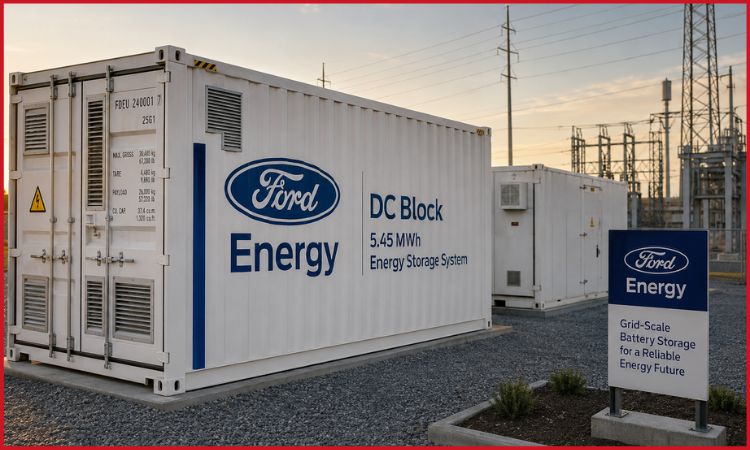
Ford Motor Company has formally launched Ford Energy, a wholly owned subsidiary that will manufacture battery energy storage systems for utilities, data centres, and large industrial customers.
The new business is targeting at least 20 GWh of annual deployment, with first customer deliveries planned for late 2027 from a repurposed manufacturing site in Glendale, Kentucky.
Ford has committed roughly $2 billion to the venture and confirmed an agreement with Kentucky covering at least 2,100 new jobs at the Glendale operation. Ford’s stock surged 14% on May 13, closing at $13.57 — its biggest single-day gain in more than six years.
Going beyond vehicles: From EVs to energy storage
The launch is the culmination of a pivot that began with a dissolution. In December 2025, Ford and SK On agreed to unwind their $11.4 billion BlueOval SK joint venture, with Ford taking full ownership of the Kentucky battery plants. Ford’s Model e EV division had lost $5.1 billion in 2024, following a $4.7 billion loss in 2023. Rather than abandon the manufacturing infrastructure, Ford repurposed it.
Ford Energy’s flagship product, the Ford Energy DC Block, is a 5.45 MWh system in a standardised 20-foot container built around 512 Ah lithium iron phosphate prismatic cells.
Two configurations are available: the FE-250, a two-hour system, and the FE-450, offering four hours of dispatch — both engineered for a 20-year service life.
Ford Energy president Lisa Drake, appointed in January, said the team had spent the better part of a year “executing — securing supply chains, readying our manufacturing sites and aligning our technology with the massive demand for domestic energy storage.”
On what the business is solving for, she says: “The convergence of data centre growth, renewable energy integration, and grid resilience requirements has created a gap in the market.”
Morgan Stanley adds fuel
The stock surge was amplified by a Morgan Stanley note from analyst Andrew Percoco, who wrote that Ford Energy could generate a 25% gross margin and EBIT of $346 million by 2028, arguing that investors were missing the value in its ability to improve profitability within Ford’s Model e segment.  The stock’s jump positioned Ford as “a hidden data centre beneficiary,” with AI infrastructure demand now a central tailwind for grid-scale storage.
A market growing faster than the grid
The US is expected to add 24 GW of new utility-scale battery storage in 2026, nearly double the record set in 2025, with over 600 GWh projected on the US grid by 2030.
India is tracking a near-identical trajectory. Installed battery storage in India is expected to jump from around 200 MWh in 2025 to roughly 5 GWh by the end of 2026, with 69 tenders totalling 102 GWh issued in 2025 alone.
The India BESS market, valued at approximately $2.19 billion in 2025, is projected to reach $19.45 billion by 2035 at a CAGR of 24.3%. India’s National Electricity Plan puts the demand case starkly: national energy storage requirements are projected to grow from 82.37 GWh in 2026-27 to 411.4 GWh by 2031-32.