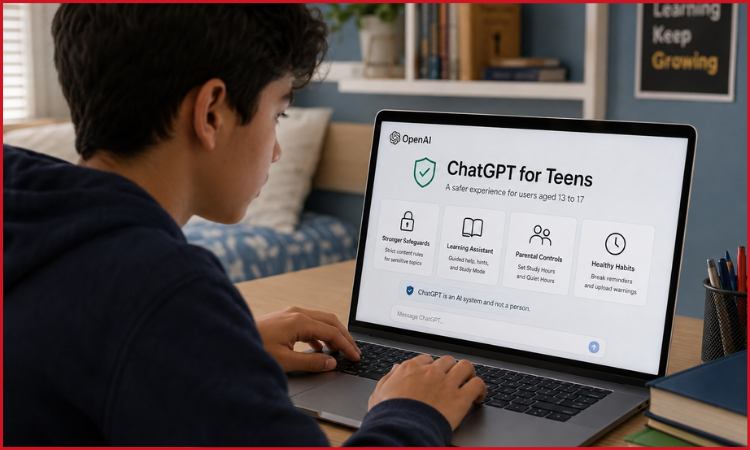
OpenAI is rolling out ChatGPT for Teens, a version of its chatbot designed for users between the ages of 13 and 17. The experience includes stricter content safeguards, parental controls and learning tools intended to discourage students from using the chatbot simply to complete homework.
The teen experience uses the same underlying ChatGPT technology but applies additional age-based restrictions. OpenAI said the controls are meant to reduce exposure to harmful material without preventing younger users from asking questions, exploring ideas or working on educational projects.
The protections will apply automatically when users identify themselves as under 18 during registration. OpenAI will also use an age-prediction system to identify accounts that are likely to belong to teenagers.
Stronger Controls for Sensitive Topics
ChatGPT for Teens has stricter rules covering self-harm, eating disorders, violence, dangerous activities and explicit or graphic material.
Responses involving these subjects will be handled differently from those provided through the standard experience. The chatbot may limit the information it gives, redirect the conversation or offer safer guidance when it detects a high-risk request.
OpenAI’s broader guidance for AI services used by minors calls for age-appropriate content filters, responsible-use disclosures and systems for monitoring potentially dangerous interactions.
The teen version also changes how ChatGPT communicates. It will avoid romantic or overly affectionate language when speaking with younger users. It will also be more direct about not having real emotions, personal awareness or a human identity.
OpenAI has said users should understand that they are interacting with an artificial intelligence system. Teen accounts will therefore receive periodic reminders that ChatGPT is an AI tool rather than a person.
Learning Tools Aim to Reduce Homework Shortcuts
Education is a major part of the new experience. OpenAI is positioning ChatGPT for Teens as a learning assistant rather than a tool that provides ready-made homework answers.
The chatbot will guide students through questions in stages and encourage them to understand how an answer is reached. Depending on the subject, it may ask follow-up questions, provide hints or introduce short quizzes.
Study Mode will be available within the teen experience. The feature is designed to support step-by-step learning by asking students to engage with the material instead of immediately displaying a completed response.
Learning-focused prompts will also be used to direct students towards the reasoning behind a problem. For example, a student may be asked to attempt part of a calculation, explain a concept in their own words or select an answer before the chatbot provides further guidance.
These controls do not prevent teenagers from using ChatGPT for schoolwork. They change the way the system responds when it identifies a request that appears to be aimed at skipping the learning process.
Parents Can Set Study and Quiet Hours
OpenAI is adding parental controls that allow families to adjust how teenage accounts use ChatGPT.
Parents, guardians and teenagers can activate Study Hours. During these periods, new conversations will automatically open in Study Mode, keeping the interaction focused on guided learning.
You can use Quiet Hours to restrict access to ChatGPT at specific times. This may allow families to block use during sleep hours, meals, study breaks or other periods they choose.
The controls give families more involvement in how the chatbot is used without providing details of every conversation. OpenAI has not announced additional monitoring features beyond those included in the teen-account settings.
The company has also not disclosed whether the complete set of controls will become available to all users at the same time or be introduced in phases.
ChatGPT Will Suggest Breaks During Long Sessions
Teen accounts will receive more prompts related to healthy usage habits.
ChatGPT may suggest taking a break after 90 minutes of continuous activity within a three-hour period. These reminders are intended to reduce prolonged use and draw attention to the amount of time spent on the platform.
The chatbot will also display warnings before teenagers upload images that may contain private or sensitive information. This is meant to give users another opportunity to reconsider sharing the material.
The warning does not confirm that every sensitive image will be blocked. It adds a prompt before the upload is completed.
Reminders about ChatGPT being an AI system will appear periodically during conversations. The company is using these messages to reduce the chance that teenagers treat the chatbot as a human friend or believe it has genuine feelings.
Age Prediction Will Help Apply Teen Settings
The teen experience will apply to users who provide an age below 18 when creating an account. OpenAI’s age-prediction technology will also assess whether an existing or new account is likely to belong to a minor.
When the system estimates that a user is under 18, the stronger safety settings will be applied. OpenAI has not provided technical details about the signals used to make this estimate.
The company has also not specified how users can challenge an incorrect age classification or what verification may be required to move an account out of the teen experience.
ChatGPT for Teens is being introduced as an account-level safety framework covering content, learning habits and usage time. The rollout combines stricter responses with family settings rather than removing access to ChatGPT for younger users.