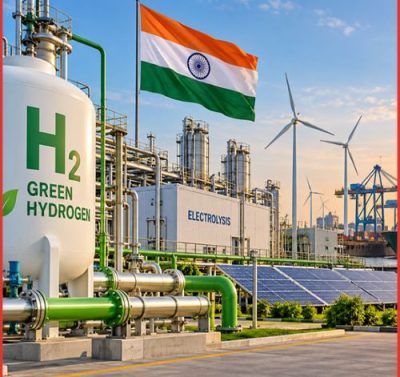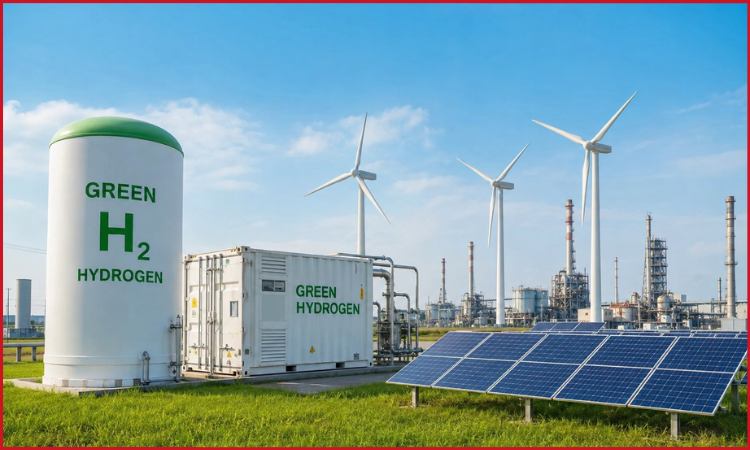
Green hydrogen is hydrogen produced by splitting water using renewable electricity, leaving no carbon footprint at the production stage. It has moved from a niche climate idea to a global energy priority as countries look for ways to decarbonise industries that solar and wind cannot reach on their own – steel, fertiliser, refining and shipping among them. Nowhere is this shift more visible than in green hydrogen projects India is currently rolling out at scale.
India has staked a clear claim in this race. With abundant sun and wind, a large industrial base that needs decarbonising, and a government mission built specifically around hydrogen, the country is positioning itself as both a producer for its own industries and an exporter to energy-hungry markets abroad. This is the backbone of the clean energy transition India is now pursuing, and it is reshaping how renewable energy India generates is put to work.
What Is Green Hydrogen?
Green hydrogen is hydrogen gas produced by splitting water into hydrogen and oxygen using an electrolyser powered entirely by renewable electricity. Unlike hydrogen made from natural gas or coal, no fossil fuel and no carbon emissions enter the process which is exactly why green hydrogen production sits at the centre of the country’s decarbonisation agenda.
How Green Hydrogen Is Produced
Production rests on three linked pieces: cheap renewable power, electrolyser capacity, and a buyer willing to pay a premium over fossil-based hydrogen. Renewable power, usually solar or wind, is often co-located with the electrolyser to cut transmission costs, a model that depends heavily on the pace of renewable energy India capacity addition. The electrolyser then splits water into hydrogen and oxygen alkaline electrolysers dominate on cost today, while PEM electrolysers are gaining ground where flexibility matters more than upfront price. The hydrogen, or its derivative green ammonia, is typically sold under a long-term supply contract to a fertiliser plant, refinery or export buyer, forming the earliest links of the broader hydrogen economy India is trying to establish.
Why Green Hydrogen Matters for India
Reducing Carbon Emissions
Green hydrogen offers a route to decarbonise refineries, fertiliser plants and steel mills sectors that are hard to electrify directly and where solar and wind alone cannot substitute for the chemical role hydrogen plays. This is a core pillar of the clean energy transition India is undergoing.
Enhancing Energy Security
India imports most of its crude oil and a large share of its natural gas. Green hydrogen, produced domestically from India’s own sun and wind, chips away at that import dependence over time, strengthening the case for renewable energy India producers to scale up alongside electrolyser manufacturing.
Supporting Sustainable Economic Growth
A domestic hydrogen ecosystem creates opportunities across manufacturing, renewable power development and export infrastructure, rather than leaving India as a price-taker in global energy markets, a key reason green hydrogen projects India continue to attract fresh investment.
The Current State of Green Hydrogen in India
Market Overview
India had commissioned just 8,000 tonnes of green hydrogen capacity by February 2026, against a government target of five million tonnes a year by 2030 a gap that explains why the sector remains one of the most contested bets in Indian energy, and why green hydrogen production at scale is still a work in progress.
India’s Renewable Energy Advantage
Cheap, abundant solar and wind resources give India a structural cost edge in electrolysis compared with countries that must import renewable power or build it at higher cost. This natural advantage is central to why renewable energy India generates is increasingly viewed as a feedstock, not just a power source.
Growing Demand Across Industries
Refiners, steelmakers, shipping lines and fertiliser units are all evaluating green hydrogen, even as investors continue weighing whether the economics justify the wait, a dynamic playing out across nearly every major green hydrogen projects India initiative today.
Key Government Incentives
The National Green Hydrogen Mission works mainly through the SIGHT scheme, split into two components:
| Component | Outlay |
| Electrolyser Manufacturing Incentive | Rs 4,440 crore |
| Green Hydrogen Production Incentive | Rs 13,050 crore |
SIGHT sits inside a total mission outlay of Rs 19,744 crore through FY2029–30, with associated investments projected to exceed Rs 8 lakh crore – underscoring how central the National Green Hydrogen Mission is to India’s broader energy strategy.
Major Green Hydrogen Projects in India
- Reliance Industries is building a green hydrogen and derivatives ecosystem at Jamnagar, backed by an announced $10 billion new-energy commitment, aiming to control electrolyser manufacturing, solar modules and battery capacity within the same site.
- Adani Group, through Adani New Industries, is among the companies furthest along in combining renewable power generation with electrolyser manufacturing and hydrogen production plans at scale.
- Indian Oil Corporation (IOCL), As one of India’s largest refiners, IOCL represents the kind of anchor offtake buyer the sector needs; refineries are among the first industrial users expected to absorb green hydrogen at scale.
- NTPC is pursuing green hydrogen projects that lean on its existing power generation footprint, pairing renewable capacity addition with hydrogen production pilots.
- Larsen & Toubro (L&T) is involved in engineering, procurement and construction for hydrogen and electrolyser projects, positioning itself as an infrastructure partner across multiple developers’ plants.
- ACME Group is among the early movers in green hydrogen and green ammonia project development, with export-oriented capacity as part of its strategy.
Of all these, JSW Energy’s plant at Vijayanagar in Karnataka stands out as the country’s largest operating green hydrogen facility, supplying roughly 3,800 tonnes a year to JSW Steel. Because production, buyer and end use sit inside a single group, it avoids the offtake risk that stalls most other green hydrogen projects India currently face.
How Renewable Energy Powers Green Hydrogen Production
Solar parks, particularly in high-irradiance states like Gujarat and Rajasthan, are the most common power source feeding electrolysers today, making renewable energy India capacity the single biggest determinant of future hydrogen costs. Wind, often paired with solar for a more consistent power profile, plays a growing role in feeding round-the-clock electrolyser operation still rare, which is why most plants run below full capacity. The electrolyser itself remains the technological core of the entire chain: alkaline units are cheaper and dominate current capacity, while PEM units cost more but offer flexibility that suits variable renewable power supply.
Benefits of Green Hydrogen in India
- Lower Greenhouse Gas Emissions: Producing hydrogen without fossil fuel inputs removes a significant emissions source from hard-to-abate industries.
- Reduced Fossil Fuel Imports: Domestic green hydrogen production reduces reliance on imported natural gas used to make conventional hydrogen.
- Employment Generation: Building electrolyser manufacturing, renewable capacity and export infrastructure at the scale the mission envisions creates jobs across construction, manufacturing and operations.
- Export Opportunities: Europe and Japan are potential buyers of Indian green hydrogen and green ammonia, and export demand could reshape project economics faster than domestic offtake alone.
Challenges Facing Green Hydrogen Production
- High Production Costs: Green hydrogen produced under the mission’s competitive bidding currently costs around Rs 397 a kilogram delivered to refineries well above grey hydrogen, and the central constraint on faster green hydrogen production adoption.
- Infrastructure Requirements: Pipelines, storage and transport infrastructure for hydrogen are still nascent, adding cost and complexity to every project.
- Water Availability: Electrolysis requires significant water input, a consideration in water-stressed regions where large-scale plants are sited.
- Technology and Manufacturing Challenges: Domestic electrolyser manufacturing capacity is still scaling up, and cost reduction depends on manufacturing maturing at the pace incentives assume.
- Scaling Industrial Adoption: Announced green hydrogen production capacity in India already runs to roughly 2.5 times the 2030 target, yet firm, paid offtake contracts remain scarce across most green hydrogen projects India supply has sprinted ahead of buyers.
Green Hydrogen vs Grey Hydrogen
| Aspect | Green Hydrogen | Grey Hydrogen |
| Cost Comparison | Several times costlier today than grey hydrogen; gap expected to narrow as electrolyser costs fall and renewable power gets cheaper | Currently the cheaper option in absolute production cost |
| Environmental Impact | Carries no fossil-fuel emissions footprint at production, provided the electricity feeding it is genuinely renewable | Carries a full fossil-fuel emissions footprint at production |
| Future Growth Potential | Cost gap matters less as carbon border taxes tighten in markets like Europe, especially for buyers hedging future compliance costs | Advantage erodes for buyers hedging future compliance costs, though it still appeals to buyers focused purely on near-term price |
Conclusion
None of this makes green hydrogen a bad bet it makes it a slow one. The National Green Hydrogen Mission has built genuine policy scaffolding: incentives, auctions, manufacturing support and a clear 2030 marker to plan around. But commissioned capacity is still a fraction of the target, and cost, not technology, remains the binding constraint on green hydrogen production.
India’s long-term vision is ambitious: five million tonnes of annual production, a domestic electrolyser manufacturing base, and a credible shot at exporting to Europe and Japan. Getting there depends less on enthusiasm for the mission and more on discipline around offtake contracts the real bottleneck standing between today’s 8,000 tonnes and 2030’s five million, and the true test of whether the hydrogen economy India envisions can move from policy to production.
Frequently Asked Questions (FAQs)
- What is Green Hydrogen in India?
It is hydrogen produced domestically using renewable electricity to split water, intended to decarbonise refineries, fertiliser plants, steel mills and other hard-to-electrify industries as part of the wider clean energy transition India is pursuing.
- What is the National Green Hydrogen Mission?
A government programme approved in January 2023 with an outlay of Rs 19,744 crore, aimed at making India a global hub for green hydrogen production, use and export by 2030, driven mainly through the SIGHT scheme.
- Which companies are investing in green hydrogen projects in India?
Reliance Industries, Adani New Industries, JSW Energy, NTPC and Larsen & Toubro are among the furthest along, each combining renewable energy India capacity, electrolyser manufacturing or offtake contracts differently.
- How is green hydrogen produced?
Renewable electricity powers an electrolyser that splits water into hydrogen and oxygen, with no fossil fuel input and no carbon emissions at the production stage.
- Why is green hydrogen important for India’s clean energy transition?
It offers a way to decarbonise industries that renewable electricity alone cannot reach, while also reducing India’s dependence on imported fossil fuels and strengthening the domestic hydrogen economy India is working to build.