Every successful startup you can name Airbnb, Uber, or homegrown names like Flipkart and Zepto went through the same basic journey: a series of funding rounds that took them from a raw idea to a company the world recognizes.
If you’re an entrepreneur, an investor, or just someone who follows the startup world, understanding these stages isn’t optional; it’s the difference between making informed calls and guessing. Whether you’re about to raise your first round or you’re simply trying to make sense of how venture capital actually works, this knowledge pays off.
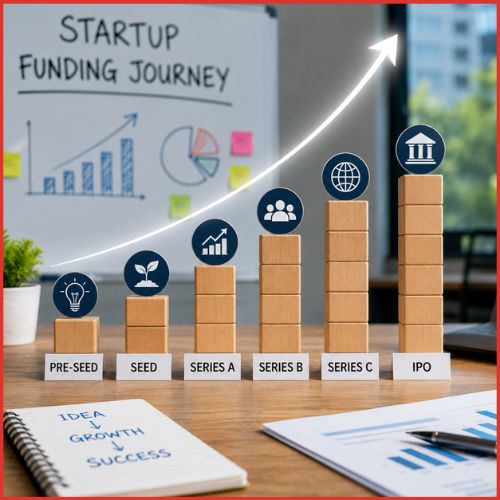
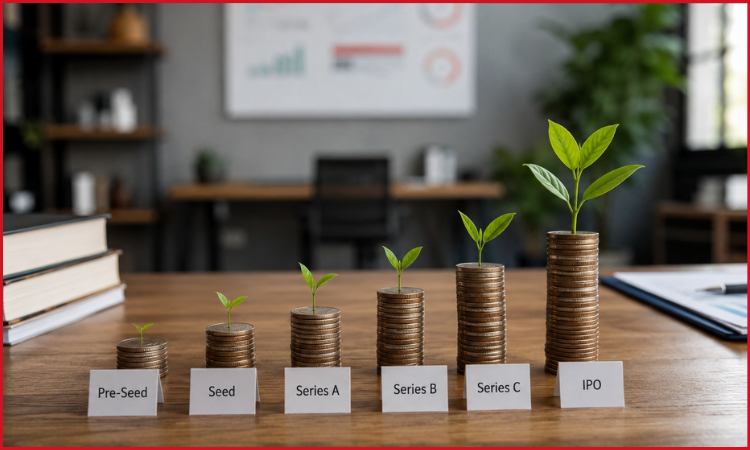
Here’s a full breakdown of every stage a startup typically passes through, from that first pre-seed cheque all the way to an IPO: who writes the cheques, how much usually changes hands, and what a startup needs to prove before it earns the next round.
What Are Startup Funding Stages?
Funding stages are the rounds a startup raises capital in as it grows, each tied to a different level of risk, proof, and valuation. Instead of raising everything upfront, founders raise in phases, each unlocked by hitting key milestones.
Staging exists so investors can price risk correctly: a pre-seed investor bets on a team and idea, while a Series C investor bets on a proven, scaling business.
Valuation rises at each stage as risk is removed; a startup might go from a few crore at pre-seed to hundreds of millions of dollars by Series C.
Why Do Startups Raise Multiple Funding Rounds?
Founders don’t go back to the fundraising table repeatedly because it’s enjoyable — pitching investors is time-consuming, and every round dilutes ownership. They do it because growing businesses have real, recurring capital needs:
- Product development: engineering, R&D, and iterating the product based on user feedback
- Hiring talent: turning a founding team into functional departments
- Marketing and customer acquisition: paid channels, brand building, and sales infrastructure
- Business expansion: entering new cities, states, or countries
- Scaling operations: logistics, technology infrastructure, and compliance as the company grows
Each of these needs shows up at a different point in a company’s life, which is exactly why funding rounds for startups are staggered instead of bundled into one giant round.
Stage 1 – Pre-Seed Funding
What Is Pre-Seed Funding?
Pre-seed funding is the earliest capital a startup raises, often before there’s a finished product. It’s less about business metrics and more about whether investors trust the founder and the problem being solved.
Who Invests?
● Founders (personal savings)
● Friends & Family
● Angel investors
● Incubators & accelerators
Typical Funding Amount
Pre-seed rounds generally range from $25,000 to $500,000, though this varies by sector and geography.
Goals At This Stage
● Build a minimum viable product (MVP)
● Validate the core idea with early users
● Conduct basic market research
Stage 2 – Seed Funding Round
What Is Seed Funding?
A seed funding round is raised once a startup has something people can actually use, even if it’s an early version. The goal shifts from “does this idea make sense” to “do real users want this?”
Investors Involved
● Angel investors
● Seed-stage VC firms
Typical Investment Size
Seed rounds typically fall between $500,000 and $3 million, depending on the market and traction already shown.
Key Milestones
● Early signs of product-market fit
● A base of early, engaged customers
● Initial revenue, even if modest
Stage 3 – Series A Funding
What Is Series A Funding?
Series A funding is usually the first big institutional round. By now, a startup needs to show its business model works repeatedly, not just once, with a lucky customer or a viral moment.
Role of Venture Capital Firms: Venture capital firms step in heavily at this stage, replacing individual angels as the primary source of capital and bringing structured due diligence, board seats, and follow-on funding expectations.
Investment Size
Series A funding rounds commonly range from $2 million to $15 million in the current Indian market.
Business Goals
● Scale the product to more users or markets
● Build out the core team beyond founders
● Expand marketing and demand generation
● Improve operational efficiency
Stage 4 – Series B Funding
What Is Series B Funding?
Series B funding is about taking a business that already works and making it significantly bigger. The core product and market fit are established; the job now is execution at scale.
Investor Expectations
Investors at this stage care less about whether the idea works and more about growth rate, unit economics, and how efficiently the company can deploy capital.
Typical Funding Amount
Series B rounds typically range from $15 million to $50 million.
Growth Objectives
● Geographic expansion into new cities or countries
● Significant team growth across departments
● Heavier investment in technology and infrastructure
Stage 5 – Series C Funding
What Is Series C Funding?
By Series C funding, a company is usually a recognised name in its category. Capital here often funds acquisitions, new product lines, or entry into new countries rather than basic scaling.
Investors At This Stage
● Late-stage venture capital firms
● Private equity funds
● Institutional investors
Funding Size
Series C rounds are typically $50 million or more, and can run into hundreds of millions for capital-intensive sectors.
Expansion Strategies
● Global expansion into new markets
● Acquisitions of smaller competitors or complementary businesses
● Launch of new products or business lines
Series D, E & Beyond
Not every startup stops at Series C. Some raise Series D, E, or later rounds because they need more runway to reach profitability, want to fund a major acquisition, or are deliberately delaying an IPO to keep growing as a private company. Neysa’s $600 million round, for instance, functioned much like a late growth-stage raise despite not carrying a traditional Series letter.
Late-stage funding objectives usually centre on one thing: preparing the business, financially and operationally, to withstand the scrutiny of public markets. Companies use this period to clean up governance, strengthen financial reporting, and build the leadership bench an IPO will demand.
Understanding Startup Valuation
Startup valuation is the market’s estimate of a company’s worth at a given time, shaped by revenue growth, market size, competition, team strength, and investor appetite.
Pre-money valuation is the company’s worth before new investment; post-money is that value plus the new round. So a $50M post-money round with investors taking 20% implies a $40M pre-money valuation.
This ties to dilution: each new share issued shrinks existing shareholders’ stake, founders included. Controlling dilution round to round is an underrated fundraising skill.
IPO – The Final Funding Stage
An Initial Public Offering is when a company sells shares to the public for the first time, shifting from private to public ownership. It’s the final stage on the ladder, though far from every successful startup reaches it.
Benefits of going public include access to large pools of public capital, liquidity for early investors and employees, and enhanced brand credibility. It also brings real challenges: heavier regulatory compliance, quarterly earnings scrutiny, and far less operating privacy than a private company enjoys.
Not every company should aim for an IPO. Acquisitions and mergers remain common, often preferable, alternatives, particularly for startups where the founders would rather exit through a strategic sale than manage the ongoing demands of public markets. Zomato’s 2021 IPO remains the reference point most Indian founders still cite as proof the full ladder is climbable, even if it’s rare.
Comparison Table: Startup Funding Stages
| Funding Stage | Typical Investors | Funding Amount | Primary Goal |
| Pre-Seed | Founders, Friends & Family | $25K–$500K | Build MVP |
| Seed | Angel Investors, Seed VCs | $500K–$3M | Validate Product |
| Series A | Venture Capital Firms | $2M–$15M | Scale Business |
| Series B | Growth Investors | $15M–$50M | Market Expansion |
| Series C | PE, Institutional Investors | $50M+ | Global Growth |
| IPO | Public Investors | Varies | Raise Public Capital |
Conclusion
The path from pre-seed funding to an IPO is rarely a straight line, and most startups don’t complete every rung of it. What matters is understanding funding rounds explained stage by stage, so each raise is sized to what the business has actually proven, not what the founder hopes it will prove.
Choosing the right funding stage and the right investors for it shapes a company’s trajectory as much as the product itself. For founders preparing to raise capital in 2026, the lesson from Neysa, Smallcase, and CityMall alike is the same: capital follows proof, and proof is built one funding round for startups at a time.
FAQs
1. What are the startup funding stages?
Startup funding stages are the sequence of capital-raising rounds a company moves through as it grows, typically pre-seed, seed, Series A, Series B, Series C, and sometimes Series D or later, before a possible IPO. Each stage is tied to a different level of proof and startup valuation.
2. What is the difference between pre-seed and seed funding?
Pre-seed funding typically comes before there’s a working product, often from founders, family, or a single angel. A seed funding round follows once there’s early traction, a prototype, a waitlist, or first paying customers and usually involves more structured investors.
3. How much funding is raised in Series A?
Series A funding rounds in India commonly range from $2 million to $15 million, though this varies by sector. Founders typically give up 15–25% equity at this stage, depending on valuation and round size.
4. What do venture capital firms look for before investing?
Venture capital firms generally look for a scalable business model, strong founding team, clear traction, and a large enough market to justify their expected returns. At later stages, they also weigh unit economics and capital efficiency closely.
5. What happens after Series C funding?
After Series C funding, startups may raise further growth rounds (Series D, E, and beyond) to fund acquisitions or delay going public, or they may begin preparing directly for an IPO by strengthening governance and financial reporting.
6. How does an IPO benefit a startup?
An IPO gives a startup access to large pools of public capital, provides liquidity for early investors and employees, and boosts brand credibility. It comes with trade-offs too, including regulatory compliance and reduced operating privacy.
Read also: How Startups Raise Funding in India: A Complete Guide for Founders