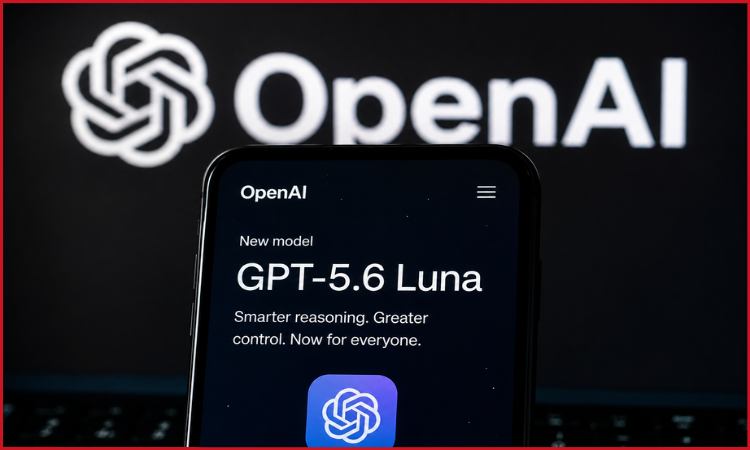
OpenAI is widening access to its newest model family by making GPT-5.6 Luna the default ChatGPT model for Free and Go users. The company is also giving Plus and Pro subscribers more control over GPT-5.6 Sol, allowing them to decide whether an answer should arrive quickly or receive more reasoning time.
What Free Users Will Receive
The rollout has two stages. GPT-5.6 Luna is scheduled to become the default for Free and Go accounts during the week of the announcement. Unlimited text conversations and a new Think button are expected to follow the next week.
The Think button gives Luna more time for harder questions, including planning, mathematics and analysis, where a considered answer matters more than a rapid reply.
“Unlimited,” however, applies specifically to text chats and remains subject to abuse guardrails. OpenAI says limits will continue to apply to file uploads, image generation and other tools. In other words, the change removes the ordinary text-chat rate limit; it does not make every ChatGPT feature unrestricted.
How Access Differs By Plan
| Plan | Default Or Model Access | New Control | Timing |
| Free and Go | GPT-5.6 Luna | Think button | Default this week; expanded access next week |
| Plus and Pro | GPT-5.6 Sol | Reasoning slider | Available from August 6 |
For Plus and Pro members, the slider works on web, mobile and desktop. Users can keep the setting low for everyday questions or move it higher for research, writing, coding, planning and decisions that benefit from more deliberation.
OpenAI has also brought its Instant and Thinking experiences closer together. The same Sol model now handles both modes for eligible subscribers, which should make tone and behaviour more consistent when a conversation moves from a quick reply to deeper analysis.
Reliability Claims Carry The Biggest Numbers
OpenAI says the revised models are more dependable with dates, figures, sources, rules and assumptions. In an internal evaluation covering financial, medical and legal questions that required factual detail, answers containing at least one factual error were:
- About 62% less common with GPT-5.6 Luna than with GPT-5.5 Instant.
- About 68% less common with GPT-5.6 Sol than with GPT-5.5 Instant.
These are company-reported results, not an independent audit. Still, they show OpenAI’s stated priorities: factual reliability, tighter answers and better effort matched to difficulty.
The scale of the audience makes even modest changes significant. OpenAI says one billion people use ChatGPT every week for searches, advice, research, planning and complex decisions.
What Industry Leaders Have Said
Feedback published during the GPT-5.6 launch focused strongly on efficiency. Qodo co-founder and CEO Itamar Friedman called GPT-5.6 “the strongest model we evaluated on our agentic code-review tests.” He said it beat GPT-5.5 on his company’s benchmarks while using roughly three times fewer tokens per pull request and delivering about twice lower median latency.
That comment concerned professional code-review testing, not the free-user rollout. Even so, it captures the family’s broader pitch: fast, affordable Luna for routine work and Sol for harder problems.
Why The Update Matters
For free users, GPT-5.6 Luna removes a familiar interruption: reaching a text limit just as a conversation becomes useful. The Think button also makes reasoning a visible choice instead of an invisible system decision.
Paid subscribers gain another kind of flexibility. They can save time on simple requests, then deliberately increase effort for complex or consequential work as needed during the day.
What To Expect Next
Users should watch for a staged rollout rather than expect every feature immediately. Free and Go accounts are due to receive Luna first, followed by unlimited text and the Think button next week. Plus and Pro users can begin testing the slider now.
The real test will be whether broader access produces consistently useful answers outside OpenAI’s evaluations. Speed, factual accuracy and sensible use of reasoning will matter more than model names. If those gains hold up, this update could make advanced AI feel less like a scarce premium feature and more like an everyday utility.