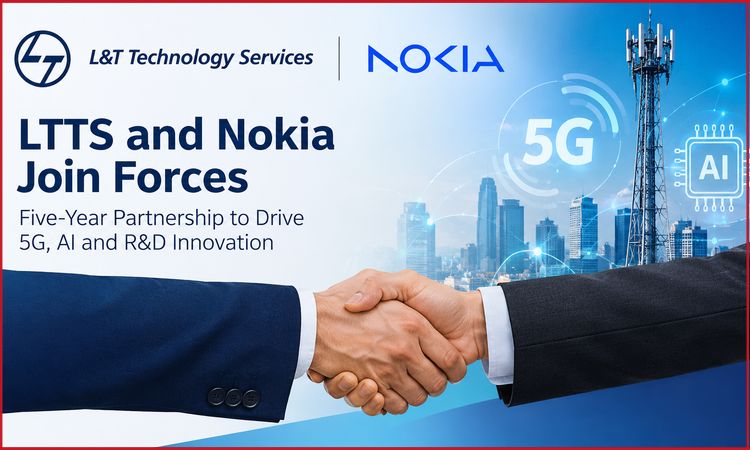
L&T Technology Services has signed a five-year agreement with Nokia that will put a dedicated engineering team in India to work on telecom research, 5G networks, artificial intelligence and next-generation computing.
The LTTS Nokia deal covers product engineering, software development, embedded systems, system integration and ongoing product support. LTTS will also establish a dedicated Offshore Development Center in India for Nokia’s engineering and R&D programmes.
LTTS shares moved higher after the announcement. The stock was trading at ₹3,938 on Monday morning, up 0.71% from the previous close of ₹3,910.30. The move was relatively modest, but it arrived only a week after the engineering-services company reported stronger Q2 margins and more than $200 million in large deal wins.
A Dedicated India Centre Will Support Nokia
The centre planned under the agreement is not simply an outsourced software desk.
LTTS says the Offshore Development Center will work on Nokia’s broader engineering and research programmes, bringing together telecom technology and data-centre-grade computing.
The work will include next-generation compute and AI infrastructure, areas that LTTS has increasingly highlighted as part of its growth strategy.
A separate engineering team will also support Nokia’s global Technology Center from India. Its remit includes 5G engineering, intelligent automation, AI-driven network operations and infrastructure designed to support artificial-intelligence workloads.
The five-year duration gives the relationship more weight than a short project contract. Engineering programmes often take years to move from early development through testing, deployment and continuing support.
That creates room for the engagement to deepen if Nokia shifts more work into the centre.
Nokia Is Expanding R&D Around the AI Supercycle
Nokia has been positioning itself increasingly around networking infrastructure for AI and cloud computing.
Vivek Jaiswal, Nokia’s Senior Vice President of Engineering, said continued R&D investment is important as connectivity technologies evolve around what the company calls the AI supercycle.
India is an important part of that plan.
Nokia already has a sizeable engineering presence in the country, while LTTS provides access to a pool of product engineers and software specialists without requiring Nokia to build every capability internally.
For LTTS, the attraction is equally clear.
Telecom infrastructure is becoming more software-heavy at the same time that AI is increasing computing requirements across networks and data centres.
That puts AI infrastructure engineering close to the areas where an engineering-services company can add more specialised work than traditional application outsourcing.
The Work Goes Beyond Ordinary Telecom Support
The agreement covers research and development, new product development, embedded systems and product support.
Those are different from the more routine IT services contracts often awarded by large enterprises.
Engineering R&D work sits closer to the product itself.
An LTTS engineer may be working on software inside network equipment, integration between hardware and software, intelligent automation or the underlying infrastructure required to run AI workloads.
That is why engineering-services firms often try to build longer relationships with customers. Once teams become familiar with a client’s architecture and development process, replacing them is not always straightforward.
The five-year Nokia contract gives LTTS time to build that familiarity.
The Deal Fits Directly Into Lakshya 31
LTTS has been tying many recent investments to its Lakshya 31 strategy.
One of its major focus areas is next-generation compute and AI infrastructure.
The Nokia centre sits directly inside that theme.
Alind Saxena, LTTS Executive Director and President for Strategic Initiatives and Growth Markets, said the engagement reflects customer confidence in the company’s Engineering Intelligence approach and deep-technology capabilities.
That matters because LTTS is trying to move beyond being seen simply as a supplier of engineering manpower.
Its newer pitch is built around platforms, AI tools, specialist engineering and more complex product-development work.
The company wants those capabilities to increase both deal sizes and the amount of revenue generated from newer technology areas.
Q2 Already Showed Stronger AI Deal Activity
The timing of the Nokia announcement is useful.
LTTS reported Q2 FY27 revenue of ₹3,040.4 crore, up 12.1% year on year and 3.4% sequentially. EBIT margin improved 60 basis points from the previous quarter to 16.3%.
The company also won more than $200 million of large deals during the quarter.
More than half of that value came from AI-related contracts.
Its annualised revenue from Engineering Intelligence-led solutions reached approximately $120 million, and management said the order backlog and pipeline had both improved from the previous year.
The LTTS AI business is therefore starting to show up in actual contract values rather than remaining purely a strategy presentation.
Nokia adds another recognisable technology customer to that push.
AI Networks Need More Than Chips
Much of the public discussion around AI infrastructure still focuses on GPUs.
Networks are becoming equally important.
Large AI systems need enormous amounts of data to move between servers, accelerators, storage systems and, increasingly, separate data centres.
Telecom networks themselves are also becoming more intelligent.
Operators are using automation to manage traffic, identify faults and optimise network resources. At the same time, 5G networks are being designed to support connected devices and industrial applications that require lower latency.
The combination creates work across hardware, software and system integration.
That is exactly where the LTTS Nokia partnership is positioned.
It connects Nokia’s networking technology with LTTS engineering teams that can work on products from development through deployment.
India Becomes More Important as an Engineering Base
India’s role in global technology companies has also been changing.
Multinationals once used the country heavily for lower-cost software development and support.
Increasingly, global teams are placing product ownership, engineering design, AI development and research functions in Indian centres.
Nokia’s decision to create a dedicated programme with LTTS fits that wider trend.
The work will support global operations rather than being limited to products sold in India.
For LTTS, that creates the possibility of expanding a local engineering centre into a much broader international relationship.
The contract value has not been disclosed, so it is too early to estimate exactly how much revenue the Nokia engagement could contribute.
The Bigger Test Is How the Contract Scales
A five-year agreement sounds substantial, but duration alone does not determine financial impact.
What matters is how many engineers eventually work on the programme, how quickly projects ramp up and whether Nokia expands the scope.
LTTS has already shown that larger deals can improve growth visibility.
Its Q2 large-deal wins included one $75 million contract, one worth more than $30 million, one $25 million engagement and six deals above $10 million each.
The Nokia announcement does not disclose a comparable contract value.
Even so, the strategic fit is fairly clear.
LTTS wants more revenue from AI infrastructure and advanced engineering. Nokia wants additional R&D capacity around 5G, automation and AI networking.
The LTTS five-year Nokia deal puts both companies on the same programme for long enough to see whether that combination can scale.