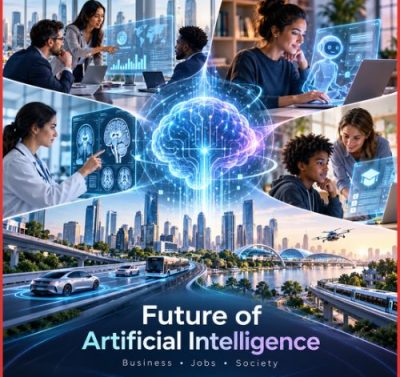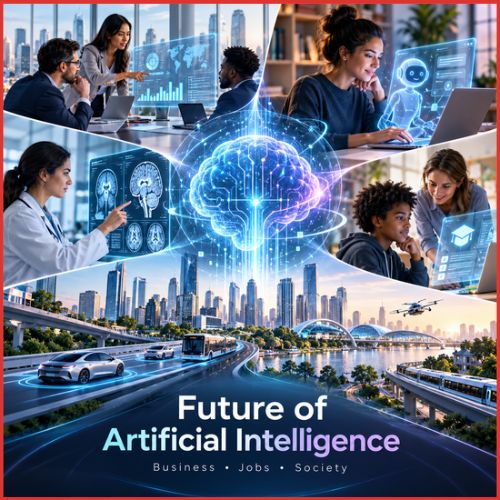
A decade ago, most executives treated artificial intelligence as a research curiosity buried inside university labs and a handful of technology giants. That has changed faster than almost anyone predicted. Boardrooms, classrooms, hospitals, and government offices are now asking the same question: what does the Future of Artificial Intelligence actually look like for the way we work, earn, and live?
Nobody has a complete picture yet, but the direction of travel is getting clearer every quarter. AI future trends now point toward a workplace where generative AI, machine learning, and autonomous AI agents sit alongside human judgement rather than replacing it outright. This article looks at what is realistic, what is overhyped, and what businesses, employees, and policymakers should actually be preparing for.
Quick Glance
| Dimension | What the data shows | Why it matters |
| Business productivity | 88% of organisations use AI in at least one business function (McKinsey, 2026) | Automation of routine tasks frees teams for higher-value work |
| Jobs and employment | WEF’s Future of Jobs Report 2025 projects 170 million roles created and 92 million displaced by 2030 | Net job creation still leads, but the transition is uneven across sectors |
| Enterprise scaling | Only around 21% of adopters have redesigned a workflow around AI (McKinsey, 2026) | Adoption without redesign limits real productivity returns |
| Global exposure | Nearly 40% of jobs worldwide are exposed to AI-driven change (IMF, January 2026) | Advanced economies face the steepest near-term exposure |
| Human-AI collaboration | 66% of AI-using U.S. businesses use AI to augment tasks, not replace staff | Augmentation, not elimination, is the dominant pattern in 2026 |
The Future of Artificial Intelligence
Strip away the marketing and the Future of Artificial Intelligence is less about humanoid robots and more about software that gets better at specific tasks every few months. Generative AI models now write code, draft contracts, summarise meetings, and generate marketing copy in a fraction of the time a human team would need.
AI agent systems that can plan, use tools, and complete multi-step tasks with limited supervision are the next layer of this shift. Analysts expect task-specific AI agents to appear in roughly 40% of enterprise applications by the end of 2026, which is really what the future of AI technology comes down to at this stage: narrower, more capable tools stacking on top of one another.
None of this means every job disappears overnight. It means the boundary between ‘human work’ and ‘AI-assisted work’ keeps moving, and companies that track artificial intelligence trends 2026 closely tend to adapt faster than those that wait for certainty that is unlikely to arrive.
How AI Will Change Business
The clearest place to see the Future of Artificial Intelligence take shape right now is inside day-to-day business operations.
AI and Business Productivity
The clearest AI impact on business so far is productivity. McKinsey’s State of AI research found that 88% of organisations now use AI in at least one business function, up from 78% a year earlier. Most of that use is still narrow: drafting text, summarising documents, automating customer queries, but even narrow automation compounds over time.
A support team that resolves routine tickets through an AI agent frees senior staff for complex escalations. A finance team that automates reconciliation spends more time on forecasting instead of data entry. The productivity gain rarely comes from one dramatic overhaul; it comes from dozens of small, unglamorous tasks quietly handed to software.
Personalised Customer Experiences
Recommendation engines, dynamic pricing, and AI chatbots have moved from novelty to default. Retailers use machine learning to personalise offers in real time, and customer service teams increasingly route first-contact queries to AI agents before a human ever gets involved.
Done well, this shortens wait times and improves resolution rates. Done poorly, it frustrates customers who feel funnelled through a script with no way out. The businesses getting this right treat AI as a first filter, not a replacement for a human safety net.
AI-Powered Decision-Making
Executives increasingly use AI-generated forecasts, risk scores, and scenario models to support decisions that used to rely on gut instinct and static spreadsheets. This does not remove human judgement from the process; it changes what that judgement is applied to.
Instead of manually building a demand forecast, a manager now reviews and adjusts one, then decides how to act on it. That shift, repeated across thousands of decisions a year, is a quiet but significant part of digital transformation inside large organisations.
New AI-Based Business Models
Some companies are going further and building entire products around AI rather than adding AI to existing ones. Subscription tools that offer an AI co-pilot for a specific profession legal research, radiology review, code review are growing quickly because they solve a narrow, well-defined problem better than a general-purpose chatbot.
That kind of AI impact on business rarely shows up in a single flashy launch. It shows up gradually, as one vertical AI tool after another chips away at a task that used to need a specialist and several hours. Expect more industry-specific AI products through 2026 and beyond, rather than one dominant do-everything assistant.
How AI Will Change Jobs
AI and jobs is the part of this conversation that understandably worries people most, and the honest picture is mixed rather than catastrophic.
Automation and Job Displacement
The World Economic Forum’s Future of Jobs Report 2025 projects that AI and related technologies could lead to significant job losses, displacing around 92 million roles globally by 2030 while creating approximately 170 million new jobs.
Goldman Sachs’ 2026 analysis found the U.S. losing a net 16,000 jobs a month to AI, a meaningful number but far from a labour-market collapse. What is more consistent across research is that data on AI and jobs increasingly shows suppressed hiring rather than mass firing; companies are slower to post entry-level roles, particularly in software development and back-office finance, even where existing staff are not let go.
New AI-Related Careers
Roles that did not exist five years ago prompt engineers, AI governance specialists, machine learning operations staff, and AI ethics reviewers are now standard job postings at mid-sized companies, not just at big technology firms.
LinkedIn data cited by the World Economic Forum shows the global economy added 1.3 million new AI-related jobs over a two-year period. These roles reward people who understand both the technology and the business problem it is solving, which is a different skill set than pure software engineering.
AI Skills and Reskilling
AI skills and literacy are becoming as basic a workplace expectation as spreadsheet literacy was two decades ago.. Employers increasingly expect staff to know how to prompt, verify, and edit AI output rather than write everything from a blank page.
Critical thinking matters more, not less, in this environment, because someone still has to catch the AI’s mistakes. Communication, creativity, and leadership skills the ones AI still struggles to replicate convincingly are becoming the difference between employees displaced by workforce transformation and those promoted because of it.
The Rise of Human-AI Collaboration
The most realistic reading of the data is that most workplaces are heading toward augmentation rather than replacement. Research on U.S. businesses using AI found that 66% use it solely to support existing tasks, and only about 2% report AI-related headcount reductions.
That does not mean displacement is not happening in specific roles. Customer support, junior coding, and basic content writing have all seen real pressure, but at an economy-wide level, human-AI collaboration is the dominant pattern in 2026, not human replacement. The most effective teams treat AI as a fast, tireless junior colleague: good at drafts, data pulls, and repetition, but still needing a human to set direction, catch errors, and take responsibility for the outcome.
How AI Will Change Society
Beyond the office, AI in society is already showing up in hospitals, classrooms, and daily commutes, often in ways people barely notice.
Healthcare
AI already supports diagnostic imaging review, drug discovery, and administrative workloads inside hospitals, and physician adoption of AI tools has crossed the halfway mark in several health systems. The realistic near-term impact is fewer diagnostic errors and faster paperwork, not AI doctors replacing human ones.
Education
Education has one of the highest generative AI adoption rates of any sector, driven by tools that help students draft, summarise, and self-test. Teachers are using AI to prepare lesson plans and personalise material for different learning speeds, though concerns about over-reliance on AI-written work remain a live debate in most school systems.
Transportation
Autonomous and semi-autonomous vehicle technology continues to expand in pilot cities, and AI-driven logistics is already reducing delivery times and fuel costs for large fleets. Full driverless transport at scale is further out than some coverage suggests, but AI-optimised routing and fleet management are already mainstream.
Everyday Life
Voice assistants, AI-generated recommendations, and automated scheduling tools are now background infrastructure for millions of people rather than novelties. The future of AI technology in daily life looks less like dramatic new gadgets and more like existing apps quietly getting smarter.
Risks and Challenges of Artificial Intelligence
This is the part of the Future of Artificial Intelligence that deserves a balanced look rather than either panic or dismissal.
| Risk area | What it looks like in practice | Who feels it most |
| Job displacement & inequality | Entry-level hiring slows faster than senior roles are cut | Early-career workers, roles heavy in routine cognitive tasks |
| Privacy | AI models trained on large datasets raise questions about consent and data use | Consumers, regulated industries like healthcare and finance |
| Misinformation & deepfakes | Synthetic video, audio, and text make fabricated content harder to detect | The public, journalists, election systems |
| AI bias | Models trained on skewed historical data can replicate discrimination in hiring, lending, and policing | Marginalised groups, HR and credit decisions |
| Cybersecurity | AI lowers the skill barrier for phishing and social engineering attacks | Businesses of all sizes, especially smaller firms with limited security budgets |
Conclusion
Let’s skip the extremes. AI isn’t going to wipe out every job, and it’s not going to remain some background curiosity either. What the evidence actually points to is messier and slower: a gradual, uneven reshaping of business, work, and society. Routine tasks get automated, yes, but new AI-related roles keep emerging, and things like judgement, creativity, and accountability end up mattering more, not less.
Companies that start building AI literacy now, put real governance in place, and run practical pilots will simply be ahead of those still waiting for a clarity that isn’t coming. And the businesses paying attention to where AI is heading today will be in a far better spot than the ones scrambling to catch up later.
The real shift happening in society isn’t that machines are replacing people; it’s that working alongside them is becoming normal. Not humans versus machines. Humans and machines, figuring out the same problems side by side.
Frequently Asked Questions
1. Will AI replace most jobs in the future?
Most credible research, including the World Economic Forum’s Future of Jobs Report 2025, points to a net job gain by 2030, with AI displacing some roles while creating others, largely around AI oversight, data, and hybrid technical-business skills.
2. What is the future of artificial intelligence in business?
Expect deeper integration into everyday workflows customer service, forecasting, content drafting rather than one dramatic overhaul. The businesses seeing real returns are the ones redesigning processes around AI, not just adding it on top of old ones.
3. Which jobs are most at risk from AI?
Roles heavy in repetitive, rules-based cognitive tasks entry-level coding, basic content writing, routine data entry, and first-line customer support face the most pressure, while jobs needing physical presence or complex human judgement are more resistant.
4. What skills will matter most in an AI-driven workplace?
AI literacy, critical thinking, communication, creativity, and leadership are consistently cited as the skills that complement rather than compete with AI, since these remain hard for AI systems to replicate convincingly.
5. Is AI regulation actually happening?
Yes. The EU’s AI Act, sector-specific rules in the U.S., and voluntary safety commitments from major AI developers are all active efforts, though the specifics still vary significantly by country and industry.