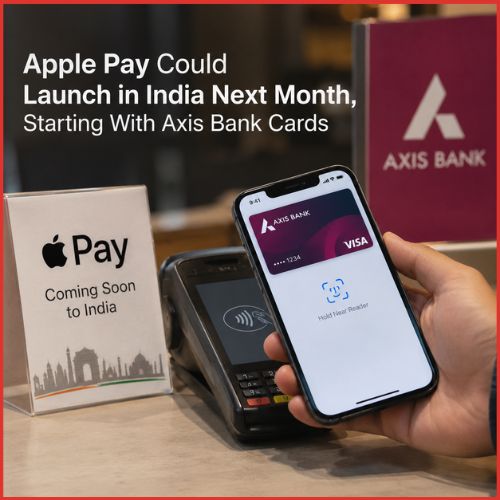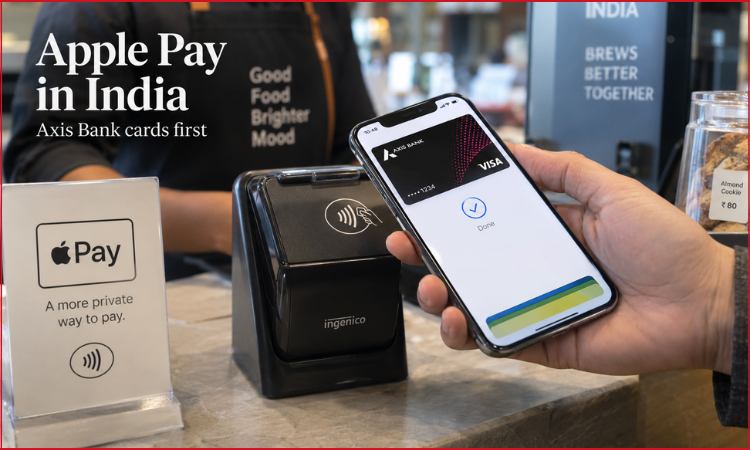
Apple may finally be ready to bring its contactless payment service to India, more than a decade after Apple Pay first launched in the United States. The service could make its Indian debut as early as October 2026, with Axis Bank credit cards expected to be among the first supported payment options.
The move would give iPhone and Apple Watch users another way to pay at shops equipped with contactless terminals. Instead of opening a payment app or scanning a QR code, users would be able to hold their device near a compatible terminal and confirm the transaction through Face ID, Touch ID or the device passcode.
An Apple Pay India launch has been discussed for years, but the latest reports suggest the company is now much closer to entering the country’s crowded digital payments market.
Axis Bank Could Be the First Banking Partner
Apple is reportedly preparing to begin with Axis Bank credit cards before adding more banking partners later.
That would give the company a relatively controlled way to introduce the service rather than trying to support a large number of banks from day one. Apple has used a similar phased approach in other markets, adding banks and card issuers gradually after launch.
Discussions are also said to be continuing with HDFC Bank and ICICI Bank. If those negotiations are completed, the number of Indian customers able to use Apple Pay could expand significantly.
Axis Bank itself already has a large credit-card customer base, making it a useful starting partner. The bank had more than 16 million active credit cards as of July, giving Apple access to a substantial pool of potential early users.
Payments Would Work Through Tap-to-Pay
The main experience should feel familiar to anyone who has used Apple Pay overseas.
A user first adds an eligible card to Apple Wallet. When making a purchase, the iPhone or Apple Watch communicates with the merchant’s payment terminal through near-field communication, better known as NFC.
The transaction can then be approved using biometric authentication.
This makes contactless payments on iPhone different from the QR-led payment experience that dominates India. Instead of opening an app and pointing the camera at a code, a user can simply tap the device against the terminal.
Card details are also not passed directly to the merchant in the usual form. Apple Pay relies on tokenisation, where a device-specific payment credential is used during transactions rather than repeatedly exposing the actual card number.
That combination of convenience and tokenised card payments has been one of Apple Pay’s main selling points in international markets.
UPI Support May Come Later
The bigger question for India is UPI.
India’s digital payments market looks very different from many countries where Apple Pay is already established. UPI dominates everyday mobile payments, with consumers accustomed to scanning QR codes at everything from large retail chains to neighbourhood shops.
Reports suggest the first version of Apple Pay in India may concentrate on card-based payments.
Apple has also explored UPI integration, although that part of the service appears less certain for the initial rollout.
Adding UPI would make Apple Pay considerably more useful in India because users would then be able to access the payment method already accepted across a huge number of merchants.
Without it, Apple Pay would depend largely on businesses that have NFC-enabled card terminals.
For many iPhone users, that would still be useful, particularly at supermarkets, restaurants, malls, airports and other organised retail locations. It would not immediately replace the QR-code experience used for everyday low-value transactions.
India Has Already Expanded Tap-Based UPI Payments
Apple’s arrival also comes just as India’s own payments infrastructure is becoming more focused on contactless transactions.
UPI recently gained a tap-and-pay option that allows supported phones to make payments at compatible NFC terminals.
That means Apple will enter a market where contactless payments are already becoming easier even outside traditional card networks.
The difference is that Apple Pay India would sit directly inside Apple’s Wallet ecosystem, giving users a payment experience integrated with the iPhone and Apple Watch rather than requiring them to rely only on third-party applications.
Whether that convenience is enough to drive widespread adoption will depend heavily on bank support and merchant acceptance.
UPI already processed more than 24 billion transactions in August alone, which shows the scale Apple is entering.
Apple Has a Larger Indian User Base Than Before
Timing may also be working in Apple’s favour.
India has become a much more important market for the company over the past few years. iPhone sales have grown, Apple now operates its own retail stores in the country, and local manufacturing has expanded considerably.
That gives Apple a larger base of customers who could actually use the payments service.
Apple Pay may also strengthen the wider appeal of Apple Wallet in India. In markets where the service is already established, Wallet acts as a central location for payment cards and other digital passes.
Bringing payments into that ecosystem would remove one of the more noticeable differences between the Indian iPhone experience and what customers receive in several other major markets.
Google Pay and PhonePe Face a Different Kind of Rival
Apple Pay will inevitably be compared with Google Pay and PhonePe, but the competition may not be as direct as it first appears.
Google Pay and PhonePe built their Indian businesses around UPI. They work across a wide range of Android phones and iPhones and have enormous acceptance because QR codes are inexpensive for merchants to deploy.
Apple Pay takes a more hardware-driven approach.
Its strongest use case is tapping an iPhone or Apple Watch at a compatible payment terminal using stored cards. That may appeal particularly to customers already comfortable paying by credit card.
If UPI integration is eventually added, the competitive picture could change significantly.
Apple would then be able to combine India’s dominant payment rail with the convenience of Wallet and the company’s tightly controlled hardware ecosystem.
October Could Mark the Start of a Gradual Rollout
Apple has not publicly confirmed an October launch date, so the timeline could still change.
If the rollout happens as reported, it is likely to begin relatively narrowly with selected cards before expanding to additional banks and payment methods.
That would make October the beginning of Apple Pay’s Indian journey rather than the arrival of every feature available in mature markets.
For users, the practical question will be simple: which cards work, where they can tap and whether UPI eventually becomes part of the service.
After years of speculation, however, the possibility of Apple Pay India launching next month is more concrete than it has been before.
With Axis Bank expected to provide the initial card support and conversations with other large banks continuing, Apple appears to be preparing for a gradual entry into one of the world’s busiest digital payment markets.