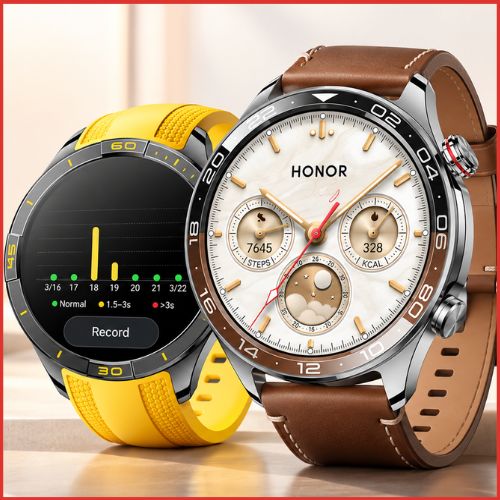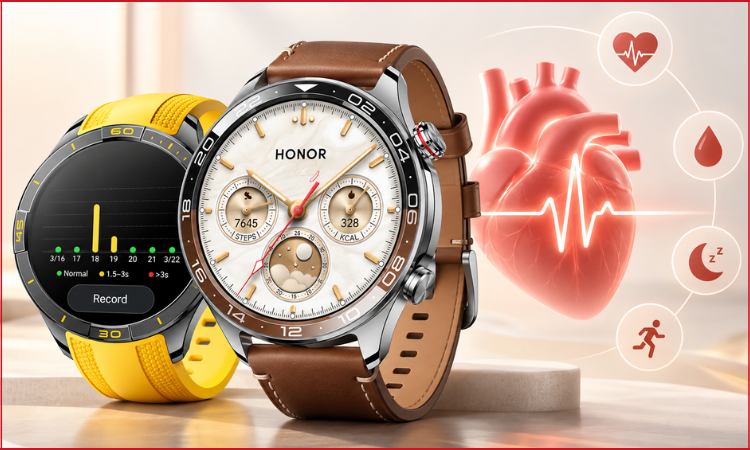
Honor is preparing to give its next premium smartwatch a much stronger health focus. The upcoming Honor Watch 6 Pro will introduce cardiac arrest monitoring, alongside upgraded blood pressure tracking and a new sensing system designed to collect more detailed health data from the wrist.
The smartwatch is set to launch on September 28. Its headline addition is a new cardiac arrest monitoring feature that can watch for potentially serious changes in heart activity and trigger alerts when the system detects an unusually high-risk situation.
It marks a notable step for Honor’s wearable business, where health monitoring is becoming just as important as fitness tracking, notifications and battery life.
Honor Makes Heart Monitoring the Main Upgrade
The new watch is being positioned as a device focused heavily on heart and blood pressure health.
Its cardiac arrest monitoring system is designed to work continuously in the background after the user joins the relevant health-research programme. The watch analyses signals collected from the wrist and can move through different alert stages when it identifies a potentially serious event.
If the risk level becomes extremely high, the watch can attempt to contact pre-selected emergency contacts. It can also display AED-related guidance on the screen and issue alerts intended to attract the attention of people nearby.
That makes the feature more active than a normal heart-rate warning, which typically tells the wearer that a reading has moved outside a chosen range.
Honor is trying to use the smartwatch as part of the emergency-response process rather than simply recording data after the event.
Four-Level Alert System Responds to Risk
The Watch 6 Pro uses what Honor describes as a four-level safety-response system.
The system begins by evaluating heart activity in the background. If it continues to detect signals associated with a possible cardiac arrest, the watch moves towards stronger warnings, including noticeable vibration.
The response then becomes more urgent if the device considers the situation to be particularly serious.
Emergency contacts can be called in sequence, provided the necessary permissions, phone connection and emergency-contact settings have been configured beforehand.
This is an important practical detail. Features built around emergency communication depend on users setting them up correctly before an emergency occurs.
The watch itself also cannot guarantee that every event will be recognised.
Honor says wrist positioning, sweat, water and other factors can affect the readings. The company also makes clear that the watch is not a medical device and should not be treated as a replacement for professional diagnosis or emergency medical care.
New Sensing System Supports Health Features
The Honor Watch 6 Pro also introduces a new sensing platform that plays a central role in its health functions.
Honor calls it the Smart Eye Sensing system. It uses a distributed sensor arrangement and multiple wavelengths to collect physiological signals through the skin.
The technology supports both heart monitoring and blood pressure monitoring, allowing Honor to use the same broader hardware platform for several health measurements.
Smartwatch manufacturers have spent years improving optical sensors because reliable health monitoring depends heavily on signal quality.
Movement, loose watch straps, skin conditions and environmental factors can all influence wrist-based readings.
A more advanced sensing system could therefore become just as important as the software used to interpret the information.
Blood Pressure Monitoring Gets an Upgrade
Blood pressure is another major part of the Watch 6 Pro’s health pitch.
The watch includes an upgraded version of Honor’s continuous blood pressure feature, referred to as Blood Pressure 2.0.
Rather than presenting readings in isolation, the system can connect changes in blood pressure with factors such as activity, rest patterns and emotional state. AI-based interpretation is then used to help users make sense of those changes over time.
The feature is designed more around long-term monitoring than replacing a conventional medical blood pressure measurement.
Users are also required to join Honor’s blood-pressure health programme before using the feature, and the company lists several groups for whom the functionality is not intended.
That qualification matters because wearable health features can sometimes appear more medically capable than they actually are.
The value of blood pressure monitoring on a smartwatch may lie primarily in identifying trends and encouraging users to pay closer attention to changes rather than providing a final medical conclusion.
Watch 6 Pro Tracks More Than the Heart
Honor is adding several other health tools to the watch.
These include continuous heart-rate variability tracking, blood oxygen monitoring, sleep analysis and cardiovascular risk assessment.
The watch can check HRV at regular intervals throughout the day to provide information related to recovery, fatigue and stress.
There is also a feature designed to screen for potential sudden-cardiac-risk signals using heart-rate deceleration measurements.
In addition, the watch can connect with compatible continuous glucose-monitoring hardware to display glucose information and combine it with other daily activity data.
Taken together, the smartwatch health features show how far wearables have moved from their earlier role as simple step counters.
The watch is increasingly becoming a single location for several streams of personal health information.
1.5-Inch OLED Display and Up to 18 Days of Battery
Health technology is the main attraction, but the Watch 6 Pro is also getting hardware upgrades elsewhere.
The smartwatch uses a 1.5-inch dual-layer OLED display. Honor claims peak brightness can reach 5,500 nits under certain conditions, while the new display structure is designed to improve outdoor visibility.
Some versions will also use ceramic materials alongside stainless steel.
Battery life varies considerably depending on which health features are active.
Under lighter Bluetooth usage, Honor claims up to 18 days. Typical use is rated at around 10 days, while enabling the always-on display reduces that figure to about seven days.
Using the full set of health-monitoring functions continuously can bring expected battery life down to around four days.
That difference highlights the power cost attached to constant health sensing.
Honor Pushes Wearables Deeper Into Health Monitoring
The arrival of cardiac arrest monitoring shows where premium smartwatches are heading.
Brands are no longer competing only on screen quality, sports modes and battery endurance. Health monitoring is becoming one of the main areas where manufacturers try to stand apart.
For Honor, the Watch 6 Pro combines that strategy with more aggressive emergency features.
The concept is useful, but the limitations are equally important. A smartwatch can provide another layer of monitoring and may help alert users or contacts when something appears wrong, but it cannot reliably detect every medical emergency.
That distinction will matter as these devices take on more advanced health functions.
The Honor Watch 6 Pro nevertheless represents a significant expansion of what Honor expects a smartwatch to do. Its September 28 launch should provide a clearer picture of how the new monitoring system works in everyday use, along with pricing and wider availability details.