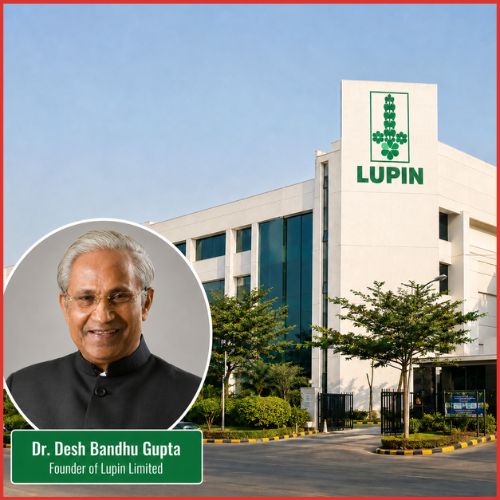
In 1948, a father in a Rajasthani village carried his ten-year-old son on his shoulders for three hours because there was no hospital nearby, and no money for one closer. That boy grew up to build one of India’s biggest pharmaceutical companies from a rented Mumbai flat. This Lupin Success Story traces how Desh Bandhu Gupta, a chemistry professor with no business background, turned a ₹5,000 loan from his wife into a global generics major. His path from classroom to boardroom is a working case study in how scientific credibility and patient bets on affordable healthcare can compound over five decades. Gupta founded Lupin in 1968, named after a wildflower that enriches poor soil rather than depleting it. Today, the company he started sells medicines in over 100 countries and trades at a market capitalisation above ₹1,00,000 crore. For founders and investors, the real lesson isn’t the billions Gupta eventually made, but the sequence of decisions, some cautious, some risky, that got him there.
Quick Glance
| Founder Name | Dr. Desh Bandhu Gupta |
| Company | Lupin Limited |
| Founded Year | 1968, Mumbai |
| Sector | Pharmaceuticals (Generics, APIs, Biotechnology) |
| Key Stat | FY2026 revenue of ₹27,958 crore, up 23% year-on-year (Lupin, 2026) |
| Current Status | Publicly listed (NSE: LUPIN); market cap near ₹1,09,187 crore as of mid-2026 (Screener.in, 2026) |
Who Was Desh Bandhu Gupta?
Early life and education: Gupta was born on 8 February 1938 in Rajgarh, Alwar district, Rajasthan, the eldest of five siblings in a family of modest means. He earned a master’s degree in chemistry, a scientific grounding that set him apart from most first-generation pharma founders of his era.
Career as a teacher: Rather than head into industry, Gupta chose to teach, joining the Birla Institute of Technology and Science (BITS) in Pilani as a chemistry professor. It sharpened his scientific rigour but gave him no direct exposure to running a company.
His interest in science and healthcare: The classroom left Gupta convinced that chemistry could do more good outside it. A childhood memory of an injured relative carried for hours because no affordable hospital was nearby stayed with him, shaping how seriously he took the gap between Indian science and what patients could actually access.
The vision that motivated him to enter pharmaceuticals: His core belief was simple. India was importing most of its medicines at prices ordinary households couldn’t sustain, and a country with enough scientific talent had no reason to stay dependent. That conviction pulled a tenured academic out of BITS Pilani and into a rented setup in Mumbai.
The Beginning of Lupin
Lupin’s founding in 1968: Gupta founded Lupin in Mumbai in 1968, naming it after a wildflower known for enriching poor soil rather than depleting it, a nod to the company’s intended purpose.
Initial challenges and limited resources: There was no factory, no distribution network, and no pharma pedigree to draw on. Gupta started with ₹5,000 borrowed from his wife, Manju Gupta, who remains associated with the company as its chairperson today (Lupin, Our Story). Early funding from the Central Bank of India then let the company set up its first line, producing folic acid and iron tablets for India’s maternal and child health programme.
Early focus on tuberculosis medicines: Lupin’s real breakthrough came through TB drugs. At its peak, the anti-TB segment made up as much as 36% of company sales, and Lupin became recognised as the world’s largest manufacturer of TB medicines, a category most larger players had little commercial interest in at the time.
Building the company’s foundation: That single-minded focus on an underserved therapy area gave a small company room to build manufacturing depth before competing on breadth, setting a template Gupta repeated for decades: pick a genuine public-health gap, then out-execute on quality.
How Lupin Became a Pharmaceutical Giant
Expansion of product portfolio: From TB drugs, Lupin broadened into branded and generic formulations, APIs, and eventually biosimilars, well beyond its original single-category focus.
Entry into different therapeutic segments: The company built market share across cardiovascular, diabetology, asthma, paediatrics, gastro-intestinal, and anti-infective therapies, alongside global leadership in anti-TB and cephalosporin drugs, per its own manufacturing disclosures.
Investment in manufacturing and technology: Gupta pushed early investment into plants benchmarked to international standards, seeking approvals from regulators including the US FDA, UK’s MHRA, and Australia’s TGA, a regulatory-first approach that let Lupin export into markets most Indian generics makers couldn’t enter.
Building Lupin’s reputation in India: Domestically, the company built credibility through consistent quality rather than aggressive marketing, becoming a founding member of the Indian Pharmaceutical Alliance in 1999 and climbing among India’s largest pharma companies by revenue.
Lupin’s Focus on Affordable Healthcare
Gupta’s philosophy of accessible medicines: Gupta framed quality healthcare as something every Indian was entitled to, not a privilege reserved for those who could pay import prices. That philosophy pushed Lupin toward affordable generics and public-health categories like TB and maternal care before those became commercially fashionable.
Importance of affordable pharmaceuticals in India: In a country where out-of-pocket spending still drives most healthcare costs, a domestic manufacturer capable of producing WHO-benchmarked medicines at Indian price points had an outsized public impact, not just a commercial one.
Balancing social impact with business growth: Gupta institutionalised that balance in 1988 through the Lupin Human Welfare & Research Foundation, a rural development arm that ran alongside the company’s commercial expansion, predating its peak profitability rather than following it.
Growth & Turning Points
| Year | Milestone |
| 1968 | Lupin founded in Mumbai as a vitamin and API manufacturer |
| 1988 | Lupin Human Welfare & Research Foundation launched as the company’s rural CSR arm |
| 1999 | Lupin joins the Indian Pharmaceutical Alliance as a founding member |
| 2015 | Acquires Gavis Pharmaceuticals and Novel Laboratories in the US for $880 million |
| 2017 | Gupta passes away; leadership transitions to his wife and children, Vinita and Nilesh Gupta |
| 2026 | FY2026 revenue crosses ₹27,958 crore, up 23% year-on-year, on strong US and India growth (Lupin, 2026) |
Challenges or Setbacks
Regulatory risk in the US market has repeatedly tested Lupin. In March 2019, the US FDA flagged quality lapses at some manufacturing plants and warned it could withhold approvals for pending drug applications, a reminder that scale doesn’t make a generics maker immune to compliance failures.
Heavy dependence on the US generics business has also cut both ways. Pricing pressure there squeezed margins for years before a turnaround, showing how a single-geography bet can swing earnings sharply in either direction.
Key Takeaways
● A scientific background, not a business degree, was Gupta’s real edge in an industry where regulatory trust decides who gets to sell where.
● Starting with ₹5,000 borrowed capital shows that in pharma, credibility and patience can substitute for a large opening war chest.
● Betting early on US FDA-grade compliance turned a domestic generics maker into an exporter of scale, but it also raised the cost of any quality miss.
● Succession planning mattered as much as the founding idea. Lupin’s continuity after 2017 depended on family leadership already embedded in operations for years.
Conclusion
Lupin’s arc from a one-room Mumbai operation to a company generating close to $3 billion in annual revenue is less a rags-to-riches tale and more a lesson in sequencing: build scientific credibility first, chase regulated markets second, and let quality systems compound trust over decades rather than quarters. The teacher to entrepreneur story behind Lupin also shows that founder background can shape a company’s risk appetite long after the founder is gone, visible in how current leadership still weighs compliance and export markets the way Gupta did from day one.
Frequently Asked Questions
1. Who founded Lupin and when?
Dr. Desh Bandhu Gupta founded Lupin in Mumbai in 1968, starting with vitamin manufacturing before moving into tuberculosis drugs and broader generics.
2. What was Desh Bandhu Gupta’s background before Lupin?
He held a master’s degree in chemistry and taught at BITS Pilani before leaving academics to start his own pharmaceutical company at age 30.
3. How big is Lupin today?
Lupin reported FY2026 revenue of ₹27,958 crore, up 23% year-on-year, with a market capitalisation of roughly ₹1,09,187 crore as of mid-2026 (Lupin, 2026; Screener.in, 2026).
4. What made Lupin’s growth model different from other Indian pharma companies?
Lupin paired an early push into US FDA-regulated markets with a domestic focus on affordable TB and cardiovascular drugs, spreading risk across geographies.
5. Who leads Lupin after Desh Bandhu Gupta’s death?
After Gupta’s death in June 2017, his wife Manju Gupta became chairperson, while children Vinita Gupta and Nilesh Gupta lead the company as CEO and Managing Director.
6. What risks does Lupin still face as an Indian pharma success story?
Regulatory action from agencies like the US FDA and pricing pressure in its largest export market remain Lupin’s two biggest risks, as seen in past plant-quality warnings.
Read also: Murali Divi Net Worth, Success Story & How Divi’s Laboratories Became a Global Pharma Giant