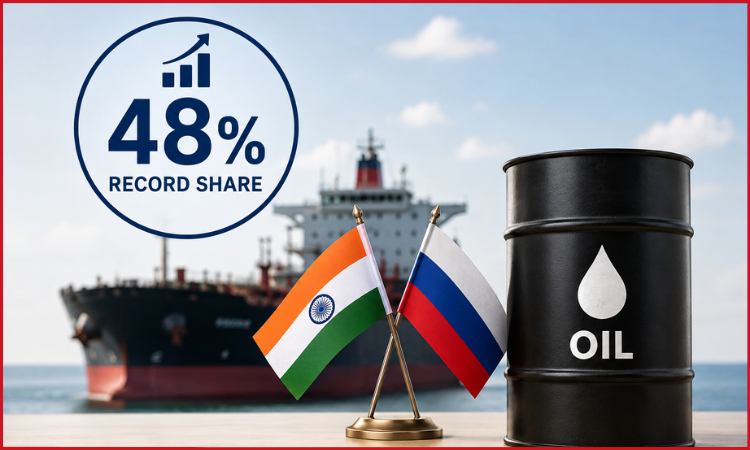
India’s Russian oil imports have climbed to a new high, with Moscow reportedly accounting for 48% of the country’s crude purchases. The rise comes at a politically sensitive time, as the United States moves ahead with legislation that could allow tariffs of up to 100% on major buyers of Russian energy.
The numbers show how strongly India’s oil strategy is being shaped by immediate commercial and supply concerns. Russian barrels remain competitively priced, while disruption around the Strait of Hormuz has made supplies from some traditional West Asian producers less predictable.
Russia’s Share in India’s Oil Imports Reaches 48%
Russia’s share of India’s crude oil basket has reached an all-time high of 48%, according to industry data cited in reports. The milestone is significant because Russian oil had only a marginal presence in India’s import mix before the Ukraine conflict began in 2022.
That changed after Western buyers reduced purchases from Moscow and Russian exporters started offering crude at attractive prices to Asian customers. Indian refiners gradually increased orders, helping Russia overtake Iraq and Saudi Arabia as the country’s biggest oil supplier.
Different tracking agencies may report slightly different percentages because of cargo arrival dates and calculation methods. Preliminary Kpler data, for example, showed India receiving around 2.78 million barrels per day of Russian crude in July against total imports of approximately 4.96 million barrels per day.
Why Russian Crude Still Makes Commercial Sense
Price remains one of the strongest reasons behind India’s continued purchases. Even when Russian discounts narrow, the crude can remain attractive for domestic refiners that have already adjusted their operations, shipping arrangements and payment systems to handle these supplies.
Indian refineries are also designed to process several varieties of crude. This flexibility allows companies to compare Russian grades with barrels from Iraq, Saudi Arabia, the UAE, the US, Africa and Latin America before finalising orders.
Established supply chains matter too. Refiners have spent more than three years building relationships with traders and arranging tankers, insurance and payment channels for Russian crude oil. Walking away from those arrangements immediately would raise procurement costs and could disturb refinery planning.
Key Factors Behind the Record Russian Oil Share
Several commercial and geopolitical developments have pushed India’s Russian oil imports higher:
- Competitive prices: Russian grades have generally remained cheaper than several comparable alternatives available to Indian refiners.
- Supply reliability: Russia has been able to deliver large volumes while shipments from parts of West Asia faced delays.
- Fewer Iraqis arriving: Iraq’s share fell sharply following pricing disputes and transport problems affecting supply.
- Refinery compatibility: India’s sophisticated refineries can process the heavier, high-sulfur grades that Russia supplies.
- Procurement planning: Oil cargoes are booked weeks ahead so an immediate reaction to political statements is not easy.
- Domestic fuel security: Refiners should be able to supply petrol, diesel and aviation fuel reliably whatever short-term diplomatic pressure.
What the US 100% Tariff Threat Means
The US tariff threat comes from the Lindsey O. Graham Sanctioning Russia Act of 2026. The measure would give the US president authority to impose tariffs of up to 100% on exports from countries identified among the leading purchasers of Russian energy.
The bill has cleared the US Senate and now requires further action in the House of Representatives. India, China and Türkiye are considered potential targets because of their purchases of Russian oil and gas.
The proposed tariff would not directly increase the price of Russian crude entering India. Instead, it could make Indian products exported to the US significantly more expensive, potentially hurting sectors that depend heavily on American demand.
The final impact will depend on whether the bill becomes law, how the administration identifies targeted countries and whether exemptions or waivers are offered.
Risks India Faces If the Tariffs Are Imposed
India’s record reliance on Russian supplies offers immediate benefits, but it also creates several risks:
- Indian exports could become less competitive in the US market if a broad 100% duty is imposed.
- New sanctions could complicate banking, insurance and tanker arrangements for refiners.
- India may face pressure to buy more expensive crude from the US or other producers.
- A sudden change in suppliers could increase freight costs and affect refinery margins.
- Reduced Russian purchases could raise India’s import bill and add pressure to inflation.
- Trade negotiations between New Delhi and Washington may become more difficult.
India’s Changing Crude Oil Import Mix
| Supplier or Factor | Current Position | Key Reason |
| Russia | Largest supplier; reported 48% share | Competitive pricing and reliable volumes |
| UAE | Among the leading Gulf suppliers | Alternative export routes reduce Hormuz exposure |
| Saudi Arabia | Recovering after a recent decline | Higher availability and revised pricing |
| Iraq | Supplies have fallen sharply | Strait disruption and commercial disagreements |
| Venezuela | Emerging alternative supplier | Heavy crude suits Indian refineries |
| United States | Smaller share in recent months | Longer shipping route and higher delivered costs |
What Happens to India’s Oil Strategy Next?
India is unlikely to stop buying Russian oil immediately. Refiners will first need clarity on the US legislation, its implementation and the possibility of exemptions. Any major shift would also depend on whether West Asian supplies return to normal and whether alternative producers can offer enough crude at competitive prices.
A gradual reduction is more realistic than a complete withdrawal. India may increase purchases from Saudi Arabia, the UAE, the US, Venezuela and African producers while keeping Russia as an important part of its crude basket.
Bottom Line
The record 48% share of India’s Russian oil imports reflects a practical calculation involving price, availability and energy security. For refiners, reliable crude supplies are an immediate requirement, while the proposed American tariffs remain a developing political risk.
However, the equation could change if Washington turns the US tariff threat into enforceable trade action. India may then have to balance the savings from Russian oil against possible damage to its exports and wider relationship with the US.
Stay tuned to BusinessOutreach.in for the latest updates on India’s oil imports, global crude prices and the proposed US sanctions legislation.