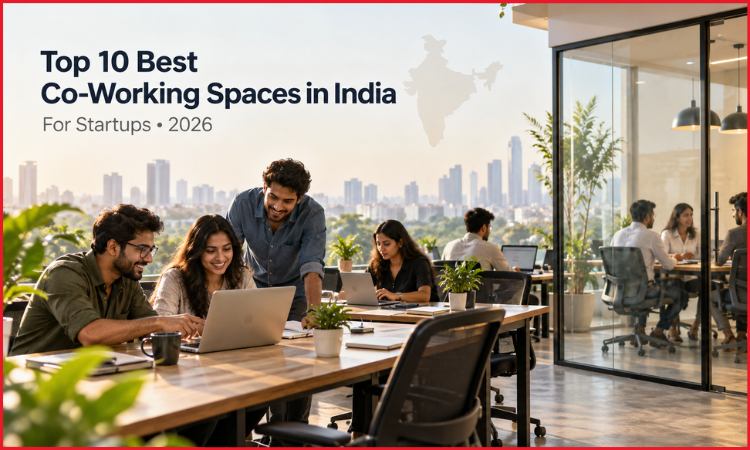
Picking the right workspace can genuinely make or break how a startup functions. It shapes everything from day-to-day productivity to who you end up meeting, who you’re able to hire, and how fast you grow. The best coworking spaces in India for startups in 2026 have moved well past the old “just rent a desk” model. Today they come with flexible memberships, meeting rooms you can book on demand, private cabins for when you need to shut the door, community events that actually lead to real connections, business support services, and addresses that lend your young company some instant credibility.
India’s coworking boom is driven by startups ditching rigid office leases for flexible space – and many now happily pay a premium for the polish and consistency of national chains over independent operators.
So whether you’re a freelancer just getting a business off the ground, a startup hiring your first few employees, or a company scaling into new cities, finding the Best Co-Working Spaces in India for Startups 2026 can help you keep costs in check while still giving your team a workspace that feels professional and credible.
How We Ranked
No single metric decides this list. A seed-stage team and a Series B company need different things, so the ranking weighs seats and city coverage alongside pricing, community programming, and enterprise reliability. Some entries are coworking brands built for founders from day one; others are managed-office platform startups that graduate into later stages. That mix is intentional: coworking space for entrepreneurs spans a spectrum, from ₹75 day passes to ₹17,000 private cabins.
Quick Glance
| Name | Founded | Sector / Focus | Key Metric | Core Strength | Best Use Case | Regional Presence |
| Awfis | 2015 | Pan-India coworking | 1.7 lakh+ seats, 250+ centres | Widest footprint, budget to premium | Bootstrapped, seed-stage startups | 18 cities |
| Smartworks | 2016 | Managed enterprise campuses | 369,000+ seats, 66 centres | Large branded campuses | Scaling startups needing 300+ seats | 15 cities plus Singapore |
| WeWork India | 2017 | Premium flexible workspace | 126,900 desks, 86.9% occupancy | Grade-A addresses, brand pull | Funded startups courting enterprises | 8 metros |
| IndiQube | 2015 | Managed green campuses | 212,000 seats, 130 properties | Modular “continuous office” model | Startups expanding multi-city | 17 cities |
| 91Springboard | 2012 | Founder-first coworking | Among India’s oldest coworking brands | Mentorship, investor office hours | Early-stage founders, co-founder search | Noida, Gurgaon, Bengaluru, Mumbai, Goa |
| BHIVE Workspace | 2014 | Budget-to-enterprise coworking | Day passes from ₹75 | Extreme affordability | Freelancers, pre-seed founders | Bengaluru, Mumbai, Delhi |
| CoWrks | 2016 | Premium managed workplace | Brookfield Properties-backed | Collaborative, corporate-grade design | Startups scaling toward enterprise clients | 8 major cities |
| Innov8 | 2015 | OYO-owned premium coworking | 1 million+ sq ft under management | Y Combinator pedigree, design-led | Startups wanting a branded, tech-first address | 13+ cities |
| The Executive Centre | 1994 globally, India since 2014 | Premium Grade-A private offices | 89 centres, 14 cities, 7 countries | CBD locations, executive privacy | Late-stage startups needing investor-facing offices | Mumbai, Delhi CBDs |
| DevX | 2017 | Coworking plus accelerator | 14,144 seats, 28 centres | Built-in accelerator and venture fund | Tier-2 founders wanting funding access | 11 cities including Ahmedabad, Jaipur |
1. Awfis
Amit Ramani started Awfis in 2015 betting flexible workspace could scale as an asset-light lease-and-franchise model. That bet built India’s largest network by seat count: over 1.7 lakh seats across 250-plus centres in 18 cities, with FY26 revenue tracking toward ₹1,600 crore (company filings, 2026). Dedicated seats start near ₹6,500 monthly. It tops this list on scale, affordability, and Tier-2 depth combined.
2. Smartworks
Neetish Sarda and Harsh Binani built Smartworks around leasing entire buildings and branding them for enterprises and scaling startups alike. It manages over 369,000 seats, including four of India’s five largest leased centres. Revenue crossed ₹1,409 crore in FY25, growing at a near-39% CAGR since FY23 (company DRHP, 2025). For a startup closing a Series B that needs 300 seats fast, this name comes up first.
3. WeWork India
Karan Virwani turned WeWork India into the country’s largest flexible workspace operator by revenue for three straight years, per CBRE. FY26 closed with 126,900 desks across 76 centres in eight cities, at a record 86.9% occupancy. Pricing runs premium, near ₹16,700 per seat monthly, suiting funded startups over pre-revenue teams; enterprise clients now supply 77% of core revenue.
4. IndiQube
Rishi Das and Meghna Agarwal built IndiQube around a “continuous office” model, taking over entire buildings rather than scattering hot desks. FY26 revenue hit ₹1,469 crore, up 37% year-on-year, with 212,000 seats across 130 properties in 17 cities. Fresh entries into Bhubaneswar, Indore, and Kolkata track the same Tier-2 cities where startups are opening satellite offices.
5. 91Springboard
91Springboard focuses on creating well-designed office spaces that make the work experience better for its customers. After opening its first dedicated flexible workspace in Delhi in 2012, the company has grown to 46 hubs across nine cities, including Bengaluru, Mumbai, Delhi, Hyderabad, Gurugram, Noida, Chennai, Pune and Goa.
Today, 91Springboard offers flexible workspace solutions with around 37,000 desks for businesses of different sizes and industries, including IT, Fintech, EdTech, Healthcare, Fashion and E-commerce. Its community includes large enterprises, GCCs, startups, freelancers and MSMEs. The company also offers a mobile app that makes workspace access and bookings simple and convenient.
6. BHIVE Workspace
BHIVE, founded in Bengaluru in 2014, undercuts almost everyone else on price without skimping on infrastructure. Day passes start around ₹75, among the lowest nationally, while its managed-office arm serves corporates and growing SMEs on the same platform. Bengaluru remains its stronghold, though it has extended into Mumbai and Delhi.
7. CoWrks
Now backed by Brookfield Properties, CoWrks sits at the premium end, with design built around collaboration zones rather than rows of desks. It operates across eight major cities and increasingly courts large enterprise tenants, evidenced by an 80,000 square foot lease to Cashfree Payments for its Bengaluru headquarters in March 2026. It suits a startup wanting a corporate-grade address, not necessarily a first office.
8. Innov8
Ritesh Malik built Innov8 out of a heritage building in Delhi’s Connaught Place in 2015, took it through Y Combinator, and sold it to OYO in 2019 for roughly ₹220 crore. Under OYO, it now manages over a million square feet across 13-plus cities and reported profit after tax of ₹62 crore in FY24, up sharply from ₹2.5 crore a year earlier. Its centres lean design-forward, a hangover from its startup roots.
9. The Executive Centre
The Executive Centre plays a different game. It does not chase startup foot traffic; it targets Grade-A CBD addresses, think Nariman Point in Mumbai, priced between ₹9,000 and ₹17,000 per seat monthly. As of FY25, its portfolio sat within an 89-centre, 14-city, seven-country network, and it has since filed for a ₹2,600 crore IPO, suiting the Series C-plus company needing a boardroom-ready address.
10. DevX
Parth Shah, Rushit Shah, and Umesh Uttamchandani built DevX in Ahmedabad in 2017 around pairing coworking with an actual startup accelerator and venture fund. It runs 28 centres and roughly 14,144 seats across 11 cities, spanning Ahmedabad, Jaipur, Surat, and GIFT City, with FY25 revenue of ₹178.9 crore. DevX went public in September 2025, oversubscribed roughly 64 times.
What These Companies Have In Common
Every operator here is racing to solve the same problem: India’s startup base is spreading into Tier-2 cities faster than office supply can follow. Most have expanded into at least one non-metro market in the past eighteen months and now offer tiered pricing that lets a company grow from a hot desk to a branded floor without switching providers. The split between coworking brands and managed-office platforms reflects how differently a two-person team and a 200-person scale-up experience the same word, coworking.
Key Takeaways
- Bootstrapped founders get the best value from Awfis, BHIVE, or 91Springboard, priced well under ₹9,000 a seat.
- Multi-city expansion favours IndiQube or Awfis for combined Tier-1 and Tier-2 depth.
- Series B-plus companies chasing enterprise clients benefit from WeWork India, Smartworks, or CoWrks.
- DevX stands apart for founders wanting funding access bundled with a desk.
- Occupancy across the sector now sits above 84% at most listed operators, so booking ahead in dense micro-markets matters more.
- Tier-2 cities including Jaipur, Indore, Kochi, and Coimbatore are seeing 35 to 40 percent year-on-year growth in coworking supply, per a 2026 Stylework market report.
Conclusion
Choosing among the startup office spaces in India comes down to matching stage to provider, not chasing the most recognisable name. A pre-seed team burning cash needs BHIVE’s ₹75 day pass more than WeWork’s skyline views; a startup closing an anchor enterprise client needs the opposite. What has changed is the range of shared office spaces in India now built around that spectrum, from accelerator-linked coworking in Ahmedabad to Grade-A suites in South Mumbai. The market’s growth, projected to reach USD 8.7 billion by 2031 per Mordor Intelligence, suggests this range only widens from here.
Frequently Asked Questions
1. What is the best coworking space in India for a pre-seed startup on a tight budget?
Generally, the most economical options are BHIVE Workspace and 91Springboard, with day passes and desks also priced lower than market rate, and community programming that provides for early networking.
2. What is the cost of a Coworking space in India for 2026?
The price per seat is approximately ₹5,000 to ₹17,000 per month, depending on the city and the operator’s tier, with tier-1 cities being priced higher than tier-2 cities, and CBD pricing higher than other cities.
3. What is the best coworking brand for a start-up looking to expand to other cities in India?
As offices open up in other cities, IndiQube and Awfis have the largest Tier-1 and Tier-2 footprint to ease the transition.
4. Do these rankings only reflect revenues or number of seats?
No. The list is full of considerations such as seats and city coverage, pricing, startup programming and enterprise reliability, because a two-person team wants certain things from a workspace that a scaling company wants differently.
5. Do co-working spaces in India have advantages for startups as well, such as access to accelerators?
Yes. DevX also has its own Accelerator and Venture fund, along with Coworking centres, and Innov8 and 91Springboard have Investor and Mentorship events.
6. Does a startup in India spending in the initial stages end up paying more when they are in a co-working space as compared to a regular office?
Generally yes. Coworking not only avoids any upfront deposits, which can go up to ₹500,000 in conventional offices, but also allows startups to pay between ₹3,000 and ₹8,000 per seat per month, according to Mordor Intelligence’s report on India in 2026.