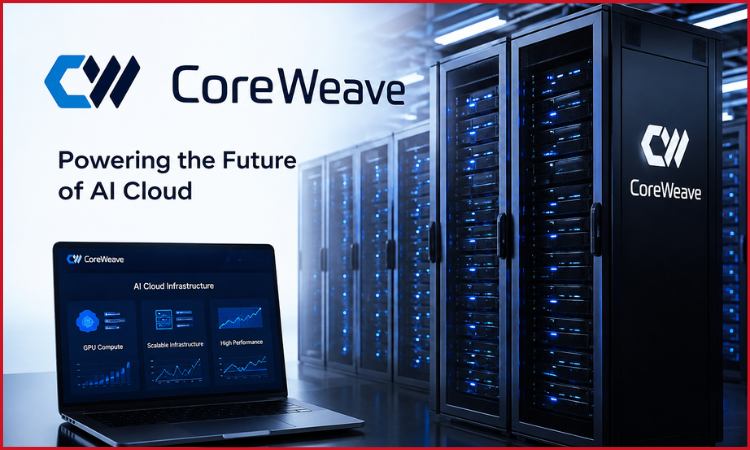
Over the past few years, the world of computing has been quietly splitting in two. On one side sits the general-purpose cloud we’ve relied on for decades. On the other, a newer breed of infrastructure has emerged, built from the ground up for artificial intelligence. CoreWeave has become one of the clearest examples of that shift.
So what does the company actually do? In simple terms, it builds and runs high-performance infrastructure that powers AI training, inference, and other compute-heavy workloads. Think of it as the engine room behind many of the AI systems people interact with every day, even if they never see CoreWeave’s name.
The business model itself isn’t complicated, at least conceptually. CoreWeave sells access to AI-optimized cloud infrastructure, along with proprietary software and managed services layered on top. Customers can lock in capacity through multi-year committed contracts, or they can simply pay as they go. As it turns out, most of the money flows from those committed contracts, which gives CoreWeave a clearer picture of future revenue while letting customers reserve serious amounts of compute in advance.
What CoreWeave Actually Sells
GPU compute sits at the heart of everything CoreWeave does.
According to the company’s SEC filings, revenue comes from access to AI infrastructure, proprietary managed software, and application services delivered through the CoreWeave Cloud Platform.
Customers mainly pay for compute capacity based on usage. This includes GPU-based infrastructure. Storage and other cloud services are priced separately.
The company also offers committed capacity under multi-year contracts. These are typically structured on a take-or-pay basis. On-demand services run alongside them.
This setup makes CoreWeave fundamentally different from a traditional software company. Customers aren’t just buying code or a subscription. They’re buying access to physical computing infrastructure, plus the software layer needed to run it efficiently.
The underlying stack includes bare-metal GPU systems, high-performance networking, storage, workload orchestration, and monitoring. It’s built to support model training, fine-tuning, synthetic data generation, and inference.
Why does this distinction matter? AI customers aren’t shopping for generic “cloud.” They need large numbers of GPUs. They need fast interconnects. They need infrastructure that stays reliable and software that keeps everything running smoothly at scale.
Why Customers Choose CoreWeave
CoreWeave has deliberately positioned itself as an AI-focused cloud provider, not a general-purpose one. Everything about its strategy is oriented around the specific demands of accelerated computing and large-scale AI workloads, rather than trying to be all things to all customers.
The company argues that this narrow focus is actually its edge. By specializing, CoreWeave can bring the latest GPU systems to market faster and tune the surrounding infrastructure specifically for AI. In its 2025 annual report, it points to speed to market with new GPU generations, proprietary software and orchestration, security standards, and total cost of ownership as the pillars of its competitive position.
That speed claim isn’t just marketing talk, either. Back in February 2025, CoreWeave became the first cloud provider to make NVIDIA GB200 NVL72-based instances generally available, systems that pair NVIDIA Grace Blackwell processors with high-speed NVLink and InfiniBand networking for large-scale AI workloads.
For teams training large AI models, this kind of infrastructure edge can translate directly into shorter training times and better compute efficiency. The real economic value here isn’t necessarily the lowest price per GPU hour. It’s the total time and cost required to actually finish a workload, which is a very different calculation.
CoreWeave’s Competitive Advantage
When you zoom out, CoreWeave is competing against some genuinely massive players: AWS, Microsoft Azure, and Google Cloud, along with a handful of other specialized providers. What sets it apart is that, unlike the major hyperscalers, it’s laser-focused on accelerated computing and AI workloads specifically.
That focus is really where its potential advantage comes from. CoreWeave gets to design its infrastructure, networking, storage, and software stack entirely around the needs of GPU-intensive workloads, rather than stretching itself thin to support the sprawling range of applications a general-purpose cloud platform has to handle.
The company points to several supporting factors: fast access to new GPU generations, proprietary software and orchestration tools, high-performance infrastructure, strong security capabilities, and the ability to serve AI workloads at very different scales. Its 2025 annual report calls out its purpose-built AI platform and speed to market as the standout advantages here.
There’s also an operational payoff to this specialization. Large AI training jobs need thousands of GPUs communicating efficiently with one another. Networking bottlenecks, clumsy scheduling, or underutilized infrastructure can quietly turn expensive GPU capacity into wasted spend. CoreWeave’s platform is designed to optimize not just the GPUs themselves, but everything happening around them.
The company has kept pushing forward on next-generation NVIDIA hardware too. Beyond its GB200 NVL72 rollout, CoreWeave has expanded its Blackwell portfolio and continues developing rack-scale systems built for large AI workloads.
None of this guarantees CoreWeave beats every hyperscaler on cost or performance across the board. AWS, Azure, and Google Cloud bring enormous infrastructure footprints, deep enterprise relationships, and huge resources to their own AI investments. CoreWeave’s real differentiation comes down to its narrower focus and its ability to optimize specifically for accelerated computing, rather than any single across-the-board advantage.
How CoreWeave Makes Billions in Revenue
CoreWeave generates revenue primarily through committed contracts for cloud computing capacity, supplemented by on-demand usage.
The business model has three closely connected components.
First: large committed contracts. AI labs, enterprises, and hyperscalers reserve substantial computing capacity for multiple years. This gives CoreWeave revenue visibility. It also lets the company plan infrastructure investments around known demand.
Second: on-demand capacity. Customers pay for resources as they use them. No long-term reservation required. This adds flexibility, plus another stream of usage-based revenue.
Third: continual expansion. More GPUs. More data-center capacity. More available power. Each addition lets CoreWeave support more contracts and sell more compute.
The results speak for themselves.
CoreWeave reported $5.131 billion in revenue in fiscal 2025. $1.915 billion in 2024. That’s roughly 168% year-over-year growth.
2026 kept the momentum going. First-quarter revenue hit $2.078 billion, up from $982 million in the same quarter a year earlier. [SEC Form 10-K for annual figures and the official Q1 earnings release for quarterly figures.]
But revenue isn’t profit.
CoreWeave reported a $1.167 billion net loss in 2025. A $740 million net loss followed in the first quarter of 2026. High infrastructure costs. Depreciation. Interest expense. Continued investment in expansion. All of it weighs heavily on earnings.
This distinction matters. CoreWeave has proven it can generate billions in revenue. Whether it can convert that revenue into sustainable free cash flow, and attractive returns on the enormous capital required to build AI infrastructure, remains the open question.
Backlog Provides Visibility Into Future Revenue
One of the clearest signals of future demand: revenue backlog.
$66.8 billion at December 31, 2025. Up from $30.1 billion just six months earlier. By March 31, 2026, that figure had climbed to $99.4 billion.
CoreWeave defines revenue backlog as remaining performance obligations plus other amounts it expects to recognize as revenue from committed customer contracts, subject to delivery and service requirements. So backlog isn’t cash in hand. It isn’t guaranteed profit either. It’s contracted future revenue, still dependent on CoreWeave’s ability to actually deliver the infrastructure and services promised.
Still, the scale of it says a lot about how fast demand for AI infrastructure has expanded.
The Customer Concentration Story
A large share of CoreWeave’s growth traces back to a small number of very large customers.
Microsoft was the biggest of them in both 2023 and 2024, accounting for 35% of revenue in 2023 and 62% in 2024. That level of concentration says two things at once: it shows how strong CoreWeave’s relationship with major tech companies really is, and it highlights the risk of leaning so heavily on so few customers.
Since then, CoreWeave has worked to widen its base.
In March 2025, it announced an agreement with OpenAI: up to approximately $11.9 billion through October 2030, subject to delivery and availability requirements. That relationship grew further in September 2025 with an additional agreement worth up to $6.5 billion, pushing the total value of the OpenAI agreements to roughly $22.4 billion.
Meta joined the picture too. A new agreement in September 2025 had Meta initially committing up to approximately $14.2 billion through December 2031, with an option to extend the commitment through 2032.
These contracts give CoreWeave real demand visibility. They also underscore just how capital-intensive this business is — CoreWeave has to build and finance infrastructure capable of actually delivering on what it has promised.
Why the Business Model Is Capital Intensive
CoreWeave is not a lightweight software company.
Its growth demands large investments: GPUs, data-center capacity, networking equipment, power, infrastructure. All of it, before the revenue those assets generate can be fully recognized.
Financing, then, becomes central to the whole model. GPUs and data centers are expensive. The contracts that pay for them stretch across years.
The first quarter of 2026 shows the scale involved. CoreWeave surpassed 1 GW of active power. It had more than 3.5 GW of contracted power. The target: more than 8 GW by 2030. To support that expansion, it secured an $8.5 billion delayed-draw term loan facility.
The economic mechanism underneath all of this is fairly simple to state, even if it’s expensive to execute:
Capital → GPUs and infrastructure → contracted AI capacity → revenue
When demand is strong and infrastructure runs at high utilization, this model can produce substantial growth. But if demand softens, GPUs sit underused, or financing costs climb, the economics get a lot harder.
CoreWeave’s 2025 annual report also flags risks tied to data-center availability, power, infrastructure failures, competition, and the rapid pace of change in AI hardware.
The Main Risks Investors Should Understand
The same traits that make CoreWeave attractive also create its biggest risks.
Customer concentration
A large percentage of revenue has historically come from a small number of customers. Losing a major customer, or seeing a significant pullback in spending from one, could materially affect revenue and infrastructure utilization.
Capital requirements
CoreWeave must continually invest in GPUs, data centers, networking, and power capacity. This creates substantial financing requirements and exposes the company to interest rates, equipment costs, and access to capital.
GPU depreciation and technology cycles
AI hardware evolves quickly. New GPU generations can make previous systems less attractive or economically competitive. CoreWeave needs to manage its hardware fleet carefully and maintain high utilization throughout the equipment lifecycle.
Power and data-center availability
AI infrastructure requires enormous amounts of electricity. Securing sufficient power and suitable data-center capacity is a fundamental constraint on expansion.
Competition
AWS, Microsoft Azure, Google Cloud, and other specialized providers are all investing heavily in AI infrastructure. CoreWeave must keep improving performance, availability, pricing, and software capabilities to maintain its position.
Competitive Analysis and Risk Scenarios
Rather than assigning unsupported probability estimates to these outcomes, the following scenarios show how changes in the company’s key economic variables could affect the business.
| Scenario | What changes | Potential impact |
| Strong AI demand | Higher GPU utilization and continued contract growth | Better infrastructure utilization and stronger revenue growth |
| Moderate slowdown | Slower customer bookings and capacity expansion | Lower growth and potentially weaker utilization |
| Severe slowdown | Significant reduction in AI compute demand | Underutilized GPUs, weaker revenue growth and greater pressure on cash flow |
| Higher GPU costs | More expensive infrastructure deployment | Higher capital requirements and potentially lower returns |
| Higher financing costs | More expensive debt-funded expansion | Greater interest expense and pressure on profitability |
| Combined shock | Lower demand alongside higher infrastructure and financing costs | Significant pressure on expansion economics |
These are qualitative stress scenarios. Their purpose is to show which variables matter most: demand, utilization, hardware costs, power availability, financing. The table discusses the potential outcome of these risk/stress scenarios on the company
Why CoreWeave Matters in the AI Cloud Era
CoreWeave’s business model reflects a broader shift happening across cloud computing. Traditional hyperscalers built general-purpose infrastructure capable of supporting everything from websites and databases to enterprise software. AI workloads have created demand for something different: infrastructure centered on GPUs, high-speed networking, large-scale clusters, and specialized software.
CoreWeave is betting that specialization can carve out a durable position in that market.
The strategy has produced exceptional revenue growth and a rapidly expanding backlog, while large commitments from companies such as Microsoft, OpenAI, and Meta demonstrate the scale of demand for AI computers. At the same time, the company’s losses and capital requirements show that rapid growth doesn’t automatically translate into profitability.
For founders, CoreWeave illustrates the potential value of focusing deeply on a rapidly growing technical niche.
For investors, the more important question is whether CoreWeave can sustain high utilization and strong customer demand while generating sufficient returns on the capital required to build and finance its infrastructure.
Conclusion
CoreWeave’s business model is built around selling access to specialized AI infrastructure through long-term committed contracts and on-demand cloud services. Its revenue has grown rapidly as AI labs, enterprises, and hyperscalers seek access to large amounts of GPU capacity.
$5.131 billion in revenue in 2025. $99.4 billion in revenue backlog by March 31, 2026. But that scale of opportunity comes with equally significant requirements for capital, power, GPUs, and data-center capacity.
That’s the central tension in CoreWeave’s model: extraordinary demonstrated demand for its infrastructure, set against the challenge of turning that demand into durable profitability through disciplined expansion, high utilization, and continued access to capital.
Frequently Asked Questions
What is CoreWeave’s business model?
CoreWeave sells access to AI-optimized cloud infrastructure, proprietary software, and managed services. Most of its revenue comes from multi-year committed contracts, while it also offers on-demand, usage-based services.
Why is CoreWeave growing so fast?
CoreWeave is benefiting from strong demand for AI compute, large multi-year customer commitments, and a platform designed specifically for GPU-intensive workloads. Revenue increased from $1.915 billion in 2024 to $5.131 billion in 2025, while revenue backlog reached $99.4 billion by March 31, 2026.
Who are CoreWeave’s biggest customers?
Microsoft was CoreWeave’s largest customer in 2023 and 2024. The company has since expanded major relationships with OpenAI and Meta, including agreements worth up to approximately $22.4 billion with OpenAI and $14.2 billion with Meta under agreements announced in 2025.
Is CoreWeave profitable?
Not on a GAAP net-income basis. CoreWeave reported a $1.167 billion net loss in 2025 and a $740 million net loss in the first quarter of 2026. Its rapid expansion requires significant infrastructure investment and financing.
What is the biggest risk in CoreWeave’s business model?
The key risks include customer concentration, high capital requirements, GPU technology cycles, power and data-center availability, financing costs, and competition from larger cloud providers. These factors can affect both growth and the returns CoreWeave earns on its infrastructure investments.