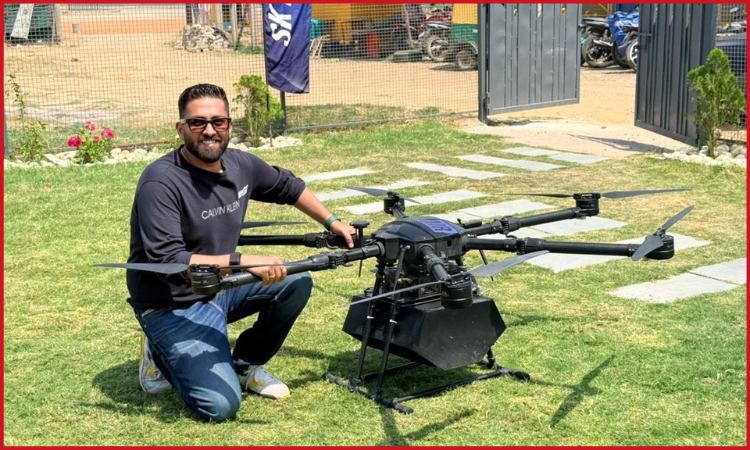
Skye Air Mobility, the hyperlocal drone delivery startup founded by Ankit Kumar in November 2019, is everything its name has — sky, air and moving goods on a different plane altogether.
The homegrown drone startup has crossed 4 million autonomous deliveries across Delhi NCR and Bengaluru as of March 2026, ferrying everything from smartphones to nine-kilo mattresses within a seven-minute window.
An idea born from a broken delivery
The company did not start with a flash of inspiration. In 2019, Kumar placed orders on several e-commerce platforms just to live the delivery experience as a customer would.
“What I found was that the experience was deeply fragmented and time-consuming, from tracking to actually receiving the shipment. Every step felt broken,” Ankit Kumar, founder and CEO, told Business Outreach in an interview.
“Somewhere in the middle of all that waiting, I kept looking at the sky. It was completely clear. And I thought, why is everything we move still tied to the ground?”
Before founding Skye Air, Kumar spent nearly a decade advising over 50 multinational corporations on market entry and growth strategy, after starting his career at Mahindra & Mahindra. That grounding in manufacturing and supply chains, he said, shaped what he eventually built more than anything from a classroom.
Part of the motivation was scale. “India has approx. 7.7 million gig workers navigating roads in extreme heat, monsoons, and winter fog, rushing packages through gridlock at risk to their own safety. That’s not a bug, for millions of people, that’s the entire operating system,” he said.
Skye Air Mobility: Drone delivery regulations
There was also real legal uncertainty. DGCA’s blanket restrictions on civil drone use had been in place since 2014, and commercial drone delivery sat in a regulatory grey zone through 2018 and 2019. “Rather than wait for the rules to catch up, we decided to build the technology stack, operations, and business relationships in parallel, so that the moment the window opened, we’d be ready to walk through it immediately,” Kumar said.
The 2021 rule change that opened the sky
Skye Air was incorporated in 2019 but spent its first two years building quietly, with no legal framework yet in place for the business it was building. That changed with the Drone Rules 2021.
“The regulatory turning point was the Drone Rules 2021, it arrived like a watershed,” Kumar said. Ninety per cent of India’s airspace opened up as Green Zones, the Digital Sky platform launched, GST on drones was cut from 18 to 28 per cent down to just 5 per cent, and a Rs 120-crore production-linked incentive scheme was announced.
“Because we’d already spent two years building in anticipation of exactly that moment, we were positioned to move faster than any competitor, and that’s how we became the first company in India to execute a BVLOS drone delivery, in 2021,” he said.
The technical build was as demanding as the regulatory one. Kumar said Skye Air was assembling what he calls a Physical AI network, an integrated layer combining autonomous drones, airspace management, ground infrastructure and robotics, with no existing playbook to follow.
Inside the hub-pod-rover chain
A Skye Air delivery starts at a ‘Skye Pod’, an operational hub. The company now runs more than 15 active hubs in Delhi NCR.
An autonomous drone takes off from the port and flies its route without a human touching the controls, navigating not by camera but through the Skye Tunnel, a GPS and LiDAR-based system operating inside a virtual 10-metre-wide air corridor. Throughout the flight, the company’s proprietary airspace management system, Skye UTM, manages route allocation, altitude and collision avoidance in real time.
The drone lands at a Skye Pod, an automated neighbourhood collection point. Skye Air has installed pods across more than 65 active societies, each opening automatically to receive a package the moment a drone arrives.
From the pod, a gig worker, or walker, completes the final stretch to the customer’s doorstep using an OTP to open the box. “That human-in-the-loop step at the very end is a deliberate design choice, not a limitation. It gives us high delivery success rates, a better customer experience, and keeps us compliant within current regulatory boundaries,” Kumar said, adding that the company is also testing autonomous ground rovers to eventually take over that leg.
Package weight on the network averages 500 grams to a kilogram, though the company has carried heavier loads. “We have lifted about nine kilos of a mattress as well. We do from groceries to iPhones to mattresses to shaving kits to anything and everything that people order in general,” Kumar said. Dangerous goods, contraband and anything over 10 kg stay off the delivery network.
Healthcare has become a significant vertical. Skye Air’s partnership with AIIMS under the PMJAY scheme now has ten of India’s premier national hospitals trusting the company with blood products and time-sensitive medicines, alongside regular e-commerce runs for platforms including Flipkart and Amazon.
Scaling on patents, partnerships and capital
By March 2026, Skye Air had raised $9 million in a Series B round led by IAN Alpha Fund, with AVNM Ventures, Faad Capital and Bajaj Capital participating, taking its total funding to $11 million across three rounds. Early backers Chiratae Ventures and Mount Judi Ventures had invested before India’s BVLOS regulatory framework even existed.
The company was also onboarded onto the NVIDIA Inception Programme in early 2026. Kumar called it recognition that Skye Air is building something globally competitive, not just a domestic logistics play.
Asked what separates Skye Air from global peers such as Zipline, Kumar pointed to integration rather than any single piece of hardware. “We’ve assembled a full-stack Physical AI ecosystem. In my view, no domestic competitor has assembled all of that into a single system,” he said, citing more than 30 patents filed across drone hardware, navigation and delivery infrastructure.
He framed the opportunity in macro terms. “India’s logistics costs sit at 14 per cent of GDP, nearly double the global benchmark, and last-mile delivery alone accounts for about 50 per cent of total transportation costs,” he said.
Expansion is deliberately sequenced. Skye Air spread too thin early on, Kumar admitted, before doubling down on density in Gurugram and NCR first. The company has since added Bengaluru, and, through a partnership with India Post, has begun operations in Himachal Pradesh and Assam covering 150 planned routes. Chennai, Hyderabad and Kolkata are next on the list this year.
This year, Skye Air Mobility closed its Series B funding round, securing $9 million. This investment was led by the IAN Alpha Fund. On investor enthusiasm for drone and deep-tech startups, Kumar does not expect it to fade soon. “I think it’s going to continue for a very long time right now… at least for a period of next 10 years, at least a decade, we do see this to continue,” he said.