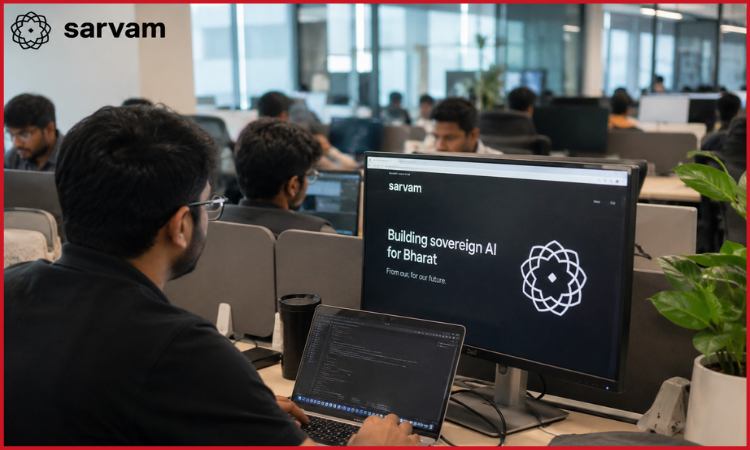
The rapid evolution of the global artificial intelligence landscape has created a strategic challenge for the Indian corporate sector. Relying entirely on foreign large language models (LLMs) means that Indian enterprises, commercial banks, and state government bodies export critical user data and substantial subscription capital to overseas technology ecosystems. Historical trends within the domestic technology market demonstrate that long-term operational success belongs to companies that thoroughly localize their infrastructure for regional ground realities.
Sarvam AI is applying this exact methodology to generative artificial intelligence.
Rather than developing a superficial consumer wrapper application, the company is building a comprehensive, sovereign AI platform engineered specifically for the Indian market. Financial markets have responded with significant institutional backing. In June 2026, Sarvam AI officially entered the unicorn club, achieving an estimated $1.5 billion post-money valuation following a major capital raise.
An examination of the Sarvam AI business model, its strategic financial milestones, and its operational architecture reveals how a startup founded in late 2023 has scaled rapidly to challenge global technology hyper-scalers.
The Founders’ Profile and Domain Expertise
Building the foundational layers of any AI system from the ground up requires a combination of advanced technical capability coupled with an in-depth knowledge of the domain. Dr. Vivek Raghavan and Dr. Pratyush Kumar founded Sarvam AI in August 2023. Both thrive in their respective knowledge domains of digital infrastructure and open-source linguistic research as applied to the Indian sub-continent.
Dr. Pratyush Kumar had stints in IBM and Microsoft Research before co-founding the AI4Bharat Research Lab at the IIT Madras. This program was aimed at developing tools and technologies for Indian languages and building open-source datasets. In his stint with the UIDAI as a Deputy Director, Dr. Vivek Raghavan had designed the Biometric Identity Infrastructure at the scale of 1.3 billion.
Their combined expertise has focused on a vital structural void. AI models that are predominantly trained on data from the West tend to fail badly when dealing with the multilingual, multi-context, and multi-modal communication that is typical to India. The diversity of Indian languages, thousands of regional dialects and interference languages such as “Hinglish”, “Tamilish”, etc., are particularly challenging.
Models that are built on English, found to be increasingly hallucinating and at an exorbitant cost for language processing, tend to be prohibitive for the task. The founders of Sarvam AI consider that for AI to operate at the scale of 1.4 billion people, it should be built natively.
The Technical Barrier: The Vernacular “Tokenization Tax”
The primary economic barrier preventing Indian companies from adopting Western LLMs is a structural optimization issue known as the “tokenization tax.”
Before any large language model can process text, it must break words down into smaller mathematical units called tokens. Because major Western models are trained primarily on English characters, one English word typically translates to roughly one token.
However, when these same models process Indian regional scripts like Hindi, Bengali, or Telugu, their tokenizers struggle. A single vernacular word is frequently broken into multiple distinct tokens.
| Language | Typical Token Count Per Word | Relative Cost Factor |
| English | 1.0 – 1.2 Tokens | 1.0x (Baseline) |
| Hindi | 3.5 – 4.5 Tokens | 3.5x – 4.5x Cost Multiplier |
| Telugu | 5.0 – 6.2 Tokens | 5.0x – 6.2x Cost Multiplier |
| Bengali | 4.0 – 5.2 Tokens | 4.0x – 5.2x Cost Multiplier |
(Source: Independent Industry Benchmarks on Western LLM Tokenization Overhead, 2026)
This structural inefficiency imposes a severe financial penalty on domestic enterprises. Because global cloud provider APIs bill clients directly per token processed, running a vernacular automated customer interaction system on a Western platform can cost up to four to six times more than running the exact same system in English. This cost asymmetry severely undermines the financial viability of mass-market AI deployments in India.
Sarvam AI neutralized this fundamental flaw by designing custom tokenizers optimized natively for Indian scripts. By ensuring that Indian regional languages require significantly fewer tokens to process, the company systematically reduced the computational overhead and inference latency of vernacular applications. This algorithmic efficiency forms a primary competitive moat for the Sarvam AI business model.
Capitalization Strategy and Financial Metrics
Training frontier foundational models demands substantial capital expenditure, particularly for securing high-throughput graphics processing units (GPUs) and specialized data center allocations. Sarvam AI has systematically executed a robust corporate funding strategy to fuel its computational requirements.
In December 2023, the startup secured a $41 million Series A funding round. According to formal financial filings reported by TechCrunch, this initial round was led by Lightspeed Venture Partners, with active participation from Peak XV Partners and Khosla Ventures. This capital was deployed to build early core computing infrastructure and recruit specialized machine learning talent from global technology hubs.
The defining financial milestone for the company occurred on June 15, 2026. Sarvam AI formally announced a $234 million transaction representing the first close of an ongoing $300 million Series B funding round. This institutional capital injection propelled the company’s post-money valuation to $1.5 billion, marking it as one of the largest deep-tech funding events in the Indian startup ecosystem.
A regulatory filing submitted to the stock exchanges by Indian IT services multinational HCLTech revealed that they acted as the lead strategic investor, infusing $150 million in exchange for a 10.46% equity stake in Axonwise Private Limited, the operating entity of Sarvam AI. Elite global venture capital firm Bessemer Venture Partners joined the cap table as a major institutional backer, alongside follow-on capital from existing investors Peak XV and Khosla Ventures.
Institutional Capital Structure
| Funding Event | Date Realized | Capital Infused | Primary Institutional Investors | Post-Money Valuation |
| Series A Round | December 2023 | $41 Million | Lightspeed Venture Partners, Peak XV Partners, Khosla Ventures | Undisclosed |
| Series B Round | June 2026 | $234 Million | HCLTech (Strategic Lead), Bessemer Venture Partners, Peak XV, Khosla | $1.5 Billion (Unicorn Status) |
(Source: Compiled from HCLTech Stock Exchange Disclosures and Venture Capital Deal Sheets, 2026)
This corporate partnership with HCLTech provides Sarvam AI with a direct B2B distribution channel. HCLTech intends to integrate Sarvam’s sovereign models directly into its international enterprise transformation services, granting the startup immediate access to global enterprise software procurement pipelines.
According to audited financial indicators disclosed by corporate partners in June 2026, Sarvam AI’s monetization strategy has yielded rapid top-line growth. The company’s annualized revenue experienced an extraordinary expansion, scaling from negligible levels in FY24 to ₹1.5 crore in FY25, and surging to ₹45.10 crore in the fiscal year ending March 2026. This financial velocity demonstrates that the entity is successfully transitioning from a pure research venture into a highly commercialized enterprise software provider.
The Product Architecture Stack
Sarvam AI avoids the strategic vulnerability of relying on a single consumer application by deploying a multi-layered, full-stack enterprise product matrix.
1. Foundational Open-Weight Models
At the New Delhi AI Summit, Sarvam AI introduced its flagship large language models trained completely from scratch on localized domestic hardware:
- Sarvam 105B: A massive 105-billion parameter model utilizing a state-of-the-art Mixture-of-Experts (MoE) architecture. It activates approximately 9 billion parameters per token and features an expansive 128K context window. This model is engineered for complex corporate workloads, advanced software engineering synthesis, and deep analytical data processing.
- Sarvam 30B: A highly optimized 30-billion parameter model designed for real-time inference and edge computing. This model allows mid-sized corporations to host and run high-throughput language tasks locally on standard corporate servers without incurring volatile third-party cloud compute fees.
2. Multimodal Vision and Speech Engines
Recognizing that the mass market in India interacts predominantly through voice and physical documentation, Sarvam developed specialized multi-modal tools. Their proprietary voice models, including Saaras V3 and Bulbul V3, handle automatic speech recognition (ASR) and text-to-speech (TTS) across multiple regional languages. These voice systems process over 500,000 hours of noisy, localized audio every month.
Simultaneously, the Sarvam Vision model is engineered to read and interpret handwritten and printed regional text. It has successfully digitized over 35 million pages of legacy insurance records and land documentation for institutional partners.
The fundamental trade-offs and operational capabilities of Sarvam’s core models can be evaluated through the following data interface:
Monetization Mechanics: How Sarvam Generates Cash Flow
The Sarvam AI business model utilizes a diversified revenue strategy optimized for three distinct market segments: software developers, large corporate enterprises, and public sector organizations.
1. Consumption-Based Developer API Marketplace
For independent software developers, digital native brands, and mid-market software companies, Sarvam offers a self-service developer platform. Clients access Sarvam’s multi-lingual speech and text models via cloud APIs, paying on a strictly consumption-based model billed per thousand tokens. Because Sarvam’s native tokenization engine lowers the computational cost of regional scripts, the company can price its APIs highly competitively compared to global hyper-scalers while retaining strong software gross margins. The platform currently processes over 10 million API calls daily.
2. Private Enterprise Cloud Deployments (The B2B Strategy)
The core financial engine of Sarvam AI resides in its private enterprise engagements. Large organizations in highly regulated sectors—such as banking, financial services, insurance (BFSI), and healthcare. These are legally prohibited from routing sensitive user data through public international cloud nodes.
Sarvam addresses this constraint through its proprietary “Arya” platform, which enables secure on-premise, private cloud, or completely air-gapped model deployments. The company deploys specialized engineers to fine-tune its models directly on an enterprise’s internal data, including proprietary transaction histories, underwriting handbooks, and customer relationship management logs.
These implementations are structured under multi-year, recurring corporate software licenses. Sarvam’s growing enterprise client base includes major financial institutions such as State Bank of India (SBI) Life Insurance, the Life Insurance Corporation of India (LIC), IDFC First Bank, Tata Capital, and financial technology platform CRED (Source: Financial Express).
3. Population-Scale Public Tech (The B2G Strategy)
The Government of India has committed substantial capital under the federal ₹10,000-crore IndiaAI Mission. Because Sarvam controls its entire data training pipeline and guarantees complete data residency within national boundaries, it serves as a primary technology provider for public sector contracts. The company secures high-value government tenders to build backend multi-lingual conversational systems, automated public grievance platforms, and national agricultural information networks.
Enterprise Implementations and Measured ROI
Use cases of Sarvam AI show they are not an exception when it comes to demonstrating the value of AI to business operations. Working with the Ministry of Agriculture and Farmers’ Welfare, Sarvam AI helped the Ministry to describe feedback given to them by farmers who go through the training provided by the Ministry. Farmers speak different Indian regional dialects and many of them have little to no formal education. As a result, simple web forms and their text links fell short of explaining the call to action.
Sarvam AI created a solution that involved developing dialect-sensitive multilingual voice agents that made calls to the target audience, collected their feedback in a structured format, and then transcribed the calls. The feedback provided was then used to fill policy gaps. The solution enabled the Ministry to collect feedback from over 17 million farmers in its efforts for better policymaking.
Another example includes a large insurance company that used the voice system provided by Sarvam for policy renewal. The system interacted with the company’s policy holders (about 45 million) in ten Indian regional languages. The voice system was able to respond to queries given by customers and as a result, the policy renewal rate did not decline despite the company not having a large call center. Sarvam AI’s solution is currently providing customer support to over 2 million customers daily in real time.
Geopolitical Imperatives and Data Sovereignty
Sovereign AI is no longer in the abstract; it has become a business necessity for securing sensitive national data. If public health critical infrastructures, financial services, or defense coordination systems are built on proprietary closed foundational models monopolized by a foreign technology vendor, that nation is compromising its digital sovereignty.
If significant geopolitical alliances change, or international export controls are modified, that nation can lose access to critical cloud-based intelligence services. Moreover, foreign-trainied models can embed foreign-origin cultural and organizational biases into domestic corporate systems.
By only training its models domestically, by putting its software stack on Indian cloud servers within its borders, and by being aligned to the letter with the Digital Personal Data Protection (DPDP) Act of India, Sarvam AI guarantees data residency by delivering it as a built-in feature. Every model weights, logging, and fine-tuning remain completely immune to international regulatory disruptions. For many highly controlled verticals, this level of assurance is a basic requirement for compliance.
Conclusion
It is difficult to create a complete AI system at scale because of IT expenses and steep competition from other large organizations. Sarvam AI has a focused plan by spending less on small models and making a voice-oriented system that is locally focused. With a fresh Series B at $234 million and a 30x forecast for FY26, its new strategic initiatives with HCLTech combined with its proven technology, demonstrate that the company is profitable on its own in the Indian market.
People Also Ask (FAQs)
Who are the founders of Sarvam AI?
Sarvam AI was founded in August 2023 by Dr. Vivek Raghavan and Dr. Pratyush Kumar. Both founders are prominent Indian computer scientists and IIT alumni with extensive backgrounds in building large-scale digital infrastructure, notably through their foundational work with AI4Bharat at IIT Madras and the Aadhaar national identity project.
How much funding has Sarvam AI raised as of 2026?
Sarvam AI has raised over $275 million in cumulative institutional capital. Their milestone financing occurred on June 15, 2026, when they secured a $234 million first close of their Series B funding round. This transaction was led strategically by HCLTech and Bessemer Venture Partners, valuing the company at $1.5 billion.
What is the primary difference between Sarvam’s models and Western LLMs?
Western language models are optimized predominantly for English text, making them computationally inefficient and expensive when processing Indian regional scripts due to a technical phenomenon known as the tokenization tax. Sarvam AI designs custom tokenizers and language models (such as Sarvam 30B and 105B) optimized natively for Indian scripts and voice accents, significantly reducing enterprise deployment costs.
Why is Sarvam AI classified as a “Sovereign AI” platform?
Sarvam AI is classified as a sovereign AI company because its data collection, model training, and core infrastructure deployment take place entirely within India’s national jurisdiction. This architecture guarantees full compliance with domestic data laws like the DPDP Act and eliminates infrastructure dependence on foreign technology providers.
How does Sarvam AI generate revenue?
Sarvam AI utilizes a three-pronged monetization framework: a consumption-based cloud API marketplace for software developers, custom multi-year private enterprise software licenses for secure on-premise deployments (B2B), and large-scale public infrastructure development contracts with government bodies (B2G).