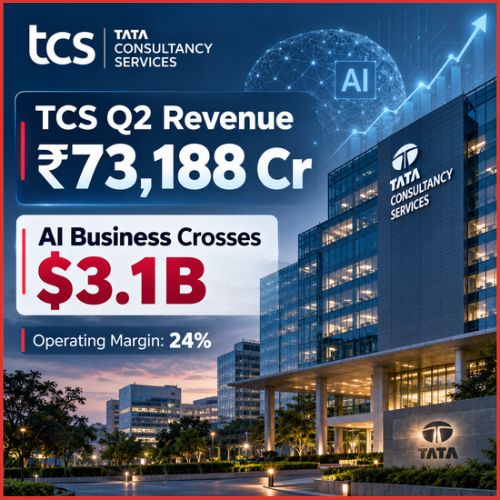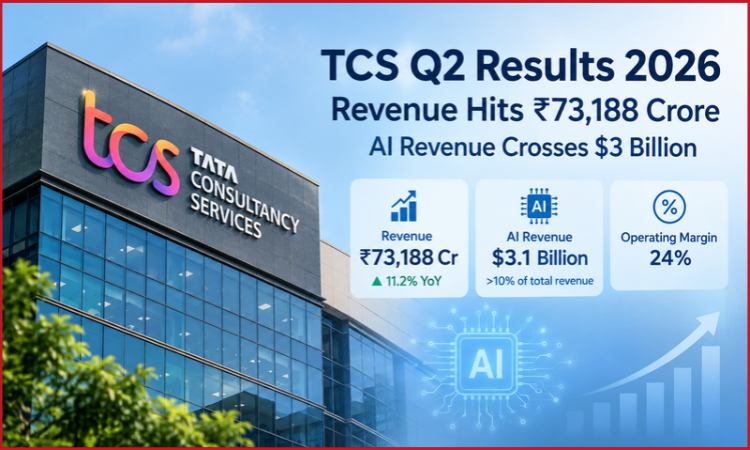
Tata Consultancy Services has started the September-quarter earnings season with a steady set of numbers and one figure that stands out more than the rest: its annualised artificial-intelligence revenue has crossed $3 billion.
The country’s largest IT services company reported TCS Q2 revenue of ₹73,188 crore for the quarter ended September 30, up 11.2% from a year earlier and 1.3% sequentially in rupee terms.
Growth looked softer once currency effects were removed. Revenue increased 0.5% quarter on quarter in constant currency, showing that the demand environment is improving, but not at a dramatic pace.
The more interesting development came from AI. Annualised AI revenue reached $3.1 billion and now accounts for more than 10% of total revenue.
AI Is Becoming a Meaningful Business, Not Just a Pipeline
Large Indian IT companies have spent the past two years talking about generative AI, pilot projects and customer experimentation.
TCS’s latest numbers suggest the conversation is moving beyond that stage.
The company’s TCS AI revenue has now crossed $3 billion on an annualised basis, representing more than one-tenth of the business.
That matters because investors have been waiting for evidence that AI demand can translate into actual billable work rather than simply a long list of demonstrations and proofs of concept.
TCS says demand is growing around AI-native solutions, modernisation of enterprise systems and more autonomous global-business-services operations.
In practical terms, clients are beginning to spend money on projects that use AI to change how existing systems work rather than treating the technology as a separate experiment.
Revenue Growth Was Broad, but Not Everywhere
The quarter was not equally strong across every vertical.
Banking, financial services and insurance remained TCS’s largest business and delivered 2.5% sequential constant-currency growth.
Manufacturing grew 3.1%, as did Technology and Services.
Those were the strongest major sectors during the quarter.
Consumer Business went the other way, falling 0.7% sequentially and 1% year on year in constant currency.
Energy, Resources and Utilities also declined slightly from the previous quarter.
That uneven picture helps explain why overall TCS revenue growth remained relatively modest despite healthy numbers in some segments.
Customers are clearly spending, but the recovery is still selective rather than universal.
International Business Looked Better Than India
TCS’s international business grew 1.2% quarter on quarter in constant currency.
The UK was among the stronger markets, rising 3.5% sequentially. Asia Pacific grew 2%, while Latin America gained 4.3%.
North America, which remains the company’s largest market, grew only 0.4%.
India was the clear weak spot on a sequential basis, falling 10.3% in constant currency.
That decline should be read with some caution because domestic revenue can be affected by the timing of large projects and deals.
Even so, the contrast was noticeable.
For a company of TCS’s scale, stronger growth outside India is useful because international markets contribute the majority of its revenue and remain central to its profitability.
Margins Held at 24%
TCS reported an operating margin of 24%.
That keeps profitability at a level many smaller IT companies would struggle to match, even while TCS continues to invest in AI skills, acquisitions and delivery capabilities.
Net profit came in at about $1.45 billion, with a net margin of 19%.
Cash generation was also strong. Net cash from operations reached $1.48 billion, equivalent to 102.2% of net income.
These numbers matter because IT companies are under pressure to keep investing while clients push for lower costs.
AI creates opportunities, but it also requires spending on training, infrastructure and specialist talent.
Holding TCS operating margin around 24% suggests the company is managing that trade-off reasonably well so far.
The Deal Pipeline Remains Healthy
Total contract value reached $9.6 billion during the quarter.
That is another figure investors will watch closely because new contracts provide an indication of future revenue even if the work does not appear immediately in quarterly numbers.
TCS highlighted two deals in particular.
One is a five-year partnership with Porsche, under which TCS plans to establish an AI Mobility Centre of Excellence and acquire Porsche’s Germany-based MHP management and IT consulting subsidiary, subject to regulatory approval.
The second involves Best Buy’s Global Capability Center in India moving to TCS and being transformed into an AI Capability Center.
Both transactions fit the company’s broader message that customers are no longer looking only for traditional outsourcing.
They want partners to help redesign operations around AI.
Headcount Is Back Above 598,000
TCS ended the quarter with a workforce of 598,056 employees.
Attrition in IT services stood at 13.3% on a last-12-month basis.
That figure remained stable during the quarter.
The company also reported a sharp increase in employee learning activity, with training hours rising 17% sequentially to 17.1 million.
That detail may sound secondary to revenue and profit, but it connects directly with the AI story.
IT companies cannot simply announce new AI services and expect the same skills base to deliver them.
Engineers, consultants and support staff need to learn new tools and delivery methods while continuing to work on existing client systems.
TCS’s scale makes that retraining challenge unusually large.
AI Could Change the Economics of IT Services
The bigger question is what happens to the traditional IT-services model if AI continues growing this quickly.
Historically, Indian IT companies made money by deploying large teams against long-term client projects.
AI can reduce the number of people required for certain tasks.
That creates a potential problem if clients expect the same work to be completed with fewer billable hours.
TCS is trying to answer that by selling higher-value work around AI transformation rather than simply using AI internally to cut costs.
If it succeeds, the company could earn more from business outcomes and automation while becoming less dependent on headcount growth.
The TCS AI business crossing $3 billion suggests that shift is already under way, but it is still early.
The AI Number Is the One Investors Will Remember
The quarter itself was solid rather than spectacular.
Revenue grew, margins held up and the deal book remained healthy. International markets also performed better than the previous quarter.
But the $3.1 billion annualised AI revenue figure changes the conversation.
AI is no longer just being discussed as a future growth driver inside TCS. It is already generating a meaningful share of revenue.
The next question is whether that number can keep expanding fast enough to lift overall growth.
If AI-led projects continue replacing slower traditional work, TCS will need the new business to more than compensate.
For now, the company has crossed an important threshold.
More than 10% of its revenue is now tied to AI, giving investors something much more concrete to measure than enthusiasm alone.
Source:
TCS Reports Q2 Revenue of ₹73,188 Crore as AI Revenue Crosses $3 Billion