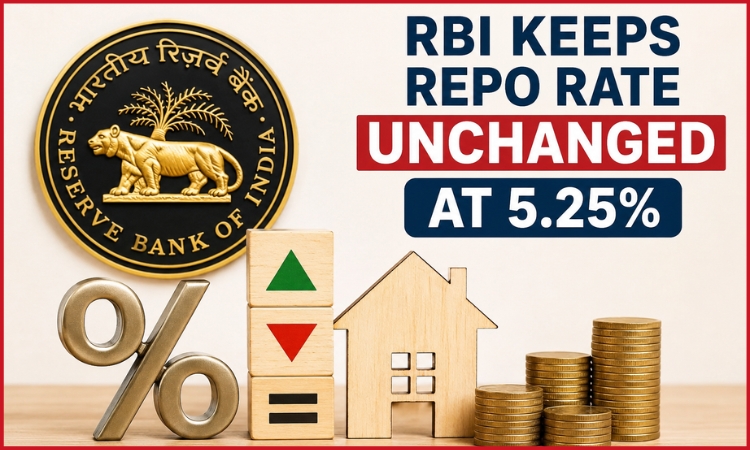
The central bank held its benchmark rate at 5.25% for the third meeting in a row, as geopolitical tensions, rising crude prices, and a weakened rupee kept its hands tied
The Reserve Bank of India’s Monetary Policy Committee kept the benchmark repo rate unchanged at 5.25% on Thursday, Governor Sanjay Malhotra announced, in line with near-unanimous market expectations. The decision, delivered today, ended three days of deliberations that began on June 3.
This is the third consecutive meeting at which the central bank has held its benchmark lending rate steady. Governor Malhotra reiterated the MPC’s commitment to a ‘neutral’ stance, saying the committee continues to balance anchoring inflationary expectations with supporting growth.
Third pause in a row
The hold reflects the RBI’s assessment that the current rate level is appropriate given the balance of risks — with inflation concerns from an Iran war-driven energy shock on one side, and the need to support growth on the other, at a time when India’s FY27 GDP projection stands at 6.9% with downside risks.
Crude oil prices have been climbing, pushed by geopolitical tensions including the US-Iran conflict, adding new pressure on India’s inflation path and putting fresh weight on the rupee. The rupee touched record lows near ₹97 per dollar in May, and foreign portfolio investor outflows have crossed ₹2.47 lakh crore year-to-date.
The RBI has projected CPI inflation at 5.1% and core inflation at 7.4%, flagging upside risks from global supply chain disruptions, uncertainty over monsoon patterns, and the potential impact of El Niño on food prices.
What it means for your EMIs
Simply put: no relief yet. The repo rate is the rate at which the RBI lends to commercial banks — and it directly influences home loan, personal loan, and auto loan interest rates. When the repo rate stays flat, banks have no fresh incentive to cut their lending rates, meaning EMIs are unlikely to ease anytime soon.
The RBI has already reduced the repo rate by a cumulative 125 basis points since February 2025, bringing it down to 5.25%. Borrowers who benefited from that easing cycle will continue to hold those gains, but further transmission depends on banks passing on previous cuts — which has been uneven.
What to watch next
While most economists expect the central bank to continue holding, markets are now watching for hawkish signals that could indicate the possibility of a rate hike if the energy shock deepens or inflation breaches tolerance levels. For now, the RBI appears to be playing a waiting game — watchful of the monsoon trajectory, crude prices, and any further rupee weakness before committing to the next move.