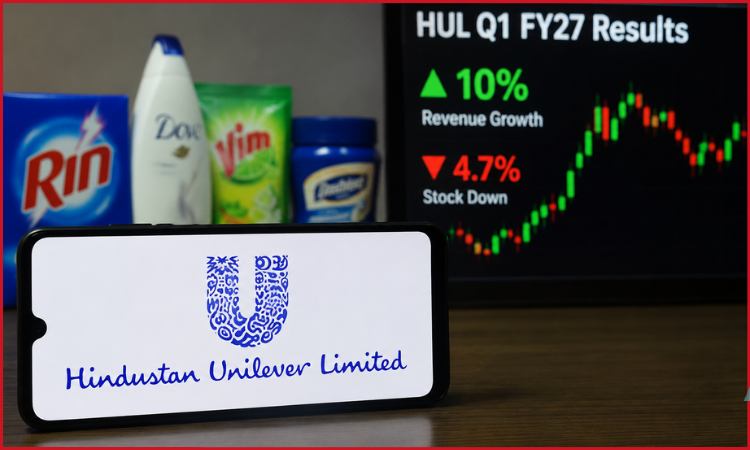
Hindustan Unilever Limited (HUL) reported its strongest sales growth in over three years for the quarter ended June 30, 2026, with revenue up 10% to roughly ₹17,184 crore (about ₹172 billion), even as its stock fell over 4.7% in intraday trade following the announcement.
Strong topline, thinner margins
The company’s core profit measure, EBITDA (earnings before interest, tax, depreciation and amortisation — essentially operating profit), rose 8% to nearly ₹3,950 crore. But EBITDA margin, the share of revenue kept as operating profit, slipped slightly to 23%, down from about 23.4% a year ago, as input costs stayed high.
Profit after tax before one-off items grew 9% to ₹2,731 crore, but the headline (reported) profit figure actually fell 2% to ₹2,680 crore, largely because last year’s number was boosted by a one-time tax credit that didn’t repeat this year.
For investors, the split matters: the underlying business grew strongly, but margin pressure and the base effect from last year’s tax credit explain why reported profit looks weaker than the operational story suggests.
Home Care brands drive the growth
Home Care was the star performer, growing 14% — its fastest pace in three years — with detergent brands like Rin and Wheel and dishwashing brand Vim posting strong volume gains, particularly in liquid formats.
Beauty & Wellbeing, home to brands such as Dove, Pears, Lakmé and the newer Minimalist skincare line, grew 12%, led by premium hair and skin care. Foods, which includes Horlicks, Boost, Bru coffee and Kissan, grew 7%, with Boost crossing the ₹1,000 crore annual sales mark. Personal Care, covering soaps like Lux and oral care brand Closeup and Pepsodent, was the laggard at 4% growth, still weighed down by high palm oil costs.
Management stays cautiously upbeat
CEO and Managing Director Priya Nair said the Indian economy demonstrated resilience, supported by proactive fiscal and monetary policy measures, adding that HUL delivered turnover of ₹17,184 crores and 10% USG, driven equally by volume and price, marking the company’s highest growth in thirteen quarters.
Why the stock still fell
Despite the beat, HUL flagged that commodity costs remain volatile and margin pressure could persist near-term, guiding for EBITDA margin to stay within its current range rather than expand.
For a stock trading on premium valuations, that cautious margin outlook — more than the strong topline — appears to be what spooked investors on the day. The company’s CFO Niranjan Gupta is expected to lay out more details at HUL’s Capital Markets Day on September 4, 2026, which investors will likely watch for clarity on the margin trajectory.