Gold is facing an unusual problem.
Normally, rising geopolitical risk and fears of disruption in global energy markets would encourage investors to buy the metal as a safe haven. This week, expensive oil has done almost the opposite.
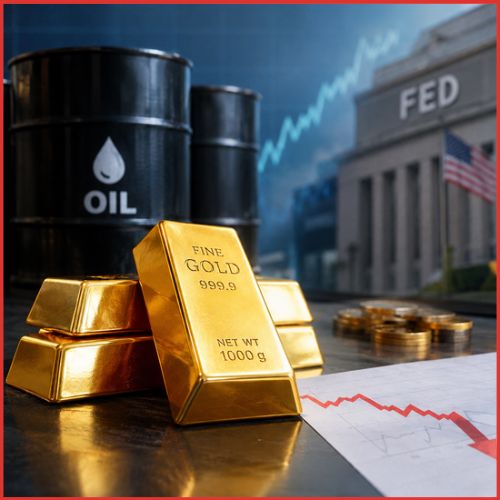
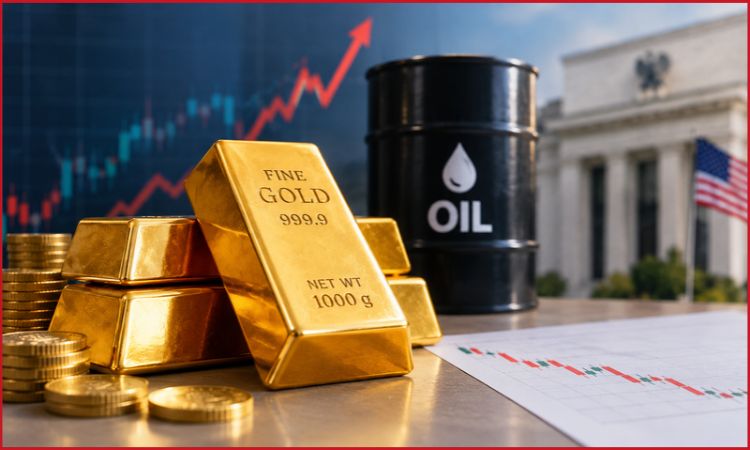
Gold prices settled 1.9% lower at ₹1,43,309 as the crude rally revived inflation concerns ahead of the US Federal Reserve’s October 27-28 meeting. The fall came as Brent crude climbed to its highest level since May, adding to expectations that interest rates may need to remain high for longer.
That has created a difficult setup for gold prices today. Bullion still has long-term support from central-bank buying and physical demand, but short-term traders are increasingly focused on rates.
Gold Lost ₹2,770 in a Single Session
The latest selloff was not minor.
Domestic gold prices dropped ₹2,770 to settle at ₹1,43,309.
Open interest increased slightly at the same time, rising 0.29% to 16,645 contracts. According to Kedia Advisory, falling prices combined with higher open interest point to fresh short positions entering the market rather than traders merely closing older bets.
International prices have shown the same weakness.
Spot gold fell to around $4,014 an ounce during Asian trading on Friday, touching its lowest level since July 20. US gold futures dropped towards $4,032.
Bullion had already fallen 2.8% on Thursday and was heading towards a weekly decline of more than 3.5%.
Oil Has Become Gold’s Biggest Short-Term Problem
Brent crude moved above $114 a barrel after renewed supply concerns involving Saudi Arabia.
That level matters for gold because expensive oil can feed directly into inflation.
Higher energy prices make transportation and manufacturing more costly. Those increases eventually work through to consumer prices and can make it harder for central banks to bring inflation under control.
The Brent crude oil price reached roughly $114 on Friday, a five-month high.
Usually, inflation itself can be supportive for gold.
The problem is what central banks do in response.
If policymakers keep rates high or raise them further, gold faces competition from interest-bearing investments.
Why Higher Rates Can Hurt Gold Even During Inflation
Gold does not pay interest.
An investor holding Treasury bills or bonds can earn a yield while waiting. Someone holding physical gold or a gold futures position generally cannot.
When interest rates rise, that difference becomes more important.
This is why the market is currently treating stronger inflation as negative for bullion rather than automatically buying gold as an inflation hedge.
The stronger the expectation of another US rate increase, the greater the opportunity cost of holding the metal.
That relationship is at the centre of the current gold price decline.
The market is effectively saying that the risk of tighter monetary policy is, for now, more important than gold’s traditional defensive appeal.
US Inflation Has Come In Hotter Than Expected
Recent US inflation numbers have reinforced those concerns.
Both consumer and producer inflation exceeded market expectations.
Energy costs have been a major part of the problem, and oil’s latest move raises the risk that future readings stay uncomfortable.
The Federal Reserve meets on October 27 and 28.
Markets largely expect policymakers to leave rates unchanged at that meeting, but the conversation has already moved towards December.
Kedia Advisory cited market pricing showing an 86% probability of another increase, while Goldman Sachs expects a 25-basis-point hike in December.
Other market pricing later on Friday showed probabilities shifting again, illustrating how sensitive expectations are to every move in oil and inflation data.
Speculative Investors Have Reduced Bullish Positions
Futures positioning also shows some traders becoming less confident.
Speculative net-long positions in COMEX gold declined by 3,741 contracts to 111,079 during the week ended October 13.
A net-long position means traders still hold more bullish than bearish bets overall.
The decline simply shows that some optimism has been taken off the table.
That fits with the price action.
Gold has struggled to hold support above $4,100 several times this month, and the latest fall has taken it to its weakest level in roughly three months.
When an asset repeatedly breaks support, traders who bought earlier in the rally can begin reducing positions simply to protect gains.
Indian Jewellery Demand Has Started to Respond
Lower prices are encouraging buyers in the physical market.
Indian gold premiums have risen to as much as $7 an ounce over domestic benchmark prices as jewellery demand picks up.
That is an interesting contrast with the futures market.
Financial traders have become more cautious because of interest rates, while jewellery buyers are responding to lower prices by purchasing more.
Indian imports were much weaker in September, however.
Gold imports dropped to about $1.8 billion from $9.6 billion in the same month a year earlier.
That comparison comes from an unusually high base, but it still illustrates how expensive gold had previously become for buyers.
A deeper price correction could change that demand picture.
China Is Still Adding Gold
Central banks remain another long-term source of support.
China’s central bank extended its gold-buying streak to 23 consecutive months in September.
Holdings rose to 77.47 million fine troy ounces from 76.73 million ounces in August.
Interestingly, the value of those reserves fell to $323.52 billion despite the increase in physical holdings because gold prices had declined.
Central-bank purchases have been an important part of gold’s longer-term bull case.
Many monetary authorities have been increasing gold exposure as part of efforts to diversify foreign-exchange reserves.
Goldman Sachs Still Sees $5,400 Gold
The near-term correction has not convinced every institution that the longer-term rally is over.
Goldman Sachs has maintained an end-2027 gold price forecast of $5,400 per ounce.
The bank continues to point to central-bank diversification as an important supporting factor.
That outlook sits in sharp contrast to the market’s immediate mood.
Right now, traders are worrying about whether rates go higher in December.
Over a longer horizon, the argument is that continued official-sector gold buying could keep demand structurally strong.
Both things can be true at once.
Gold can suffer a sizeable correction now without necessarily ending its longer-term upward trend.
The Fed Has Replaced Geopolitics as Gold’s Immediate Driver
There is a strange contradiction in the market right now.
Oil is rising because investors fear energy-supply disruption. Ordinarily, the same uncertainty could support gold.
Instead, oil’s inflation impact is making traders more worried about US interest rates.
That is why gold near a three-month low is not behaving like a conventional safe-haven trade.
Physical buying in India is improving. China’s central bank is still accumulating the metal. Goldman Sachs remains bullish over the longer term.
But none of those factors has been enough to stop the current correction.
Until oil cools or rate expectations soften, bullion may continue to struggle against a problem that sounds counterintuitive at first: inflation is rising, yet the inflation hedge is falling.
Source:
Gold Slips as Oil Price Rally Fuels Inflation Fears Ahead of Fed Policy Decision