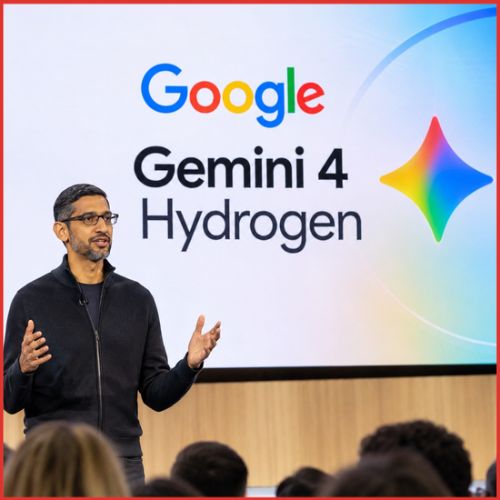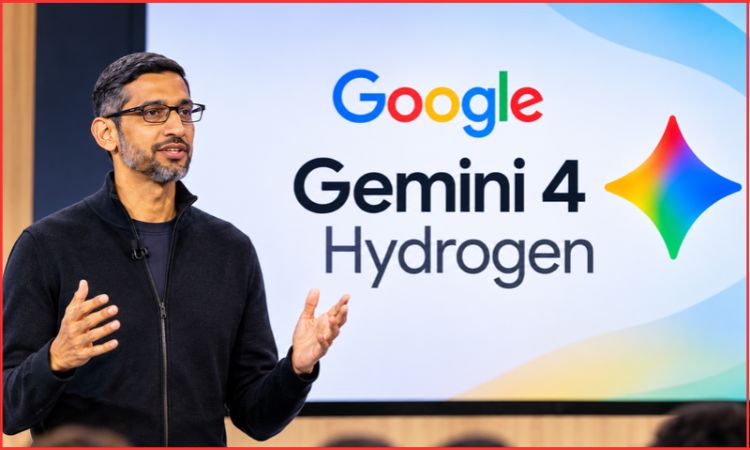
Google has introduced Gemini 4 Hydrogen, adding a model built for faster execution to its growing AI lineup. Announced on November 12, the release targets work that involves repeated actions, including debugging software, processing documents and completing tasks through connected tools.
The launch gives Google a clearer division of labour within the Gemini family. Carbon and Argon handle demanding reasoning and longer assignments, while Hydrogen is positioned to carry out everyday tasks more quickly. It can work independently or alongside those models.
For developers and businesses, the attraction is straightforward: an AI system that reaches a useful result sooner, without requiring the most expensive model at every step.
A Model Built Around Getting Work Finished
Much of the competition between AI companies has centred on reasoning ability. Google’s pitch for Hydrogen puts more emphasis on execution: reading files, finding relevant information, making changes and checking whether those changes worked.
Those steps account for a substantial part of practical AI use. A coding assistant may understand a bug correctly but still spend time searching the wrong files or repeating unsuccessful actions. In a longer workflow, those delays accumulate.
Google says Hydrogen completes tasks around 2.5 times faster than Gemini 3.8 Flash at its default high thinking setting. It also reports a score of 57% on Terminal-Bench 4.1, compared with 18.2% for Flash.
These are company-reported results, and they do not establish how quickly every customer’s workload will run. They do, however, show where Google wants the model to compete: software work that requires useful actions across several steps.
The distinction matters for AI coding tools. Developers need more than a plausible explanation of an error. They need changes that fit the repository, tests that actually run and a clear account of what remains unresolved.
Different Models Take Different Parts Of The Job
Hydrogen also forms part of Google’s effort to make several AI models work together.
Within Google Antigravity, an orchestrator can switch between Carbon and Hydrogen during the same session. A demanding planning or architecture question can go to Carbon, while Hydrogen handles execution.
That arrangement reflects a practical problem with assigning an entire task to one model. Some stages require careful judgement; others involve relatively routine searches, edits or checks. Paying the same computational cost for every stage can be inefficient.
Google reports that its orchestrated approach achieved success close to Carbon’s on Terminal-Bench 4.0 while using 24% less quota and finishing 19% faster.
For a developer, the potential benefit is less manual model selection. Instead of deciding when to change tools, the system handles that allocation as the work progresses.
Whether the handoffs remain useful on unfamiliar projects will depend on performance outside benchmark tasks. A model that executes quickly still needs a sound plan, enough context and a reliable way to recognise mistakes.
Pricing Brings Repeated Tasks Into Focus
Google has set Gemini API pricing for Hydrogen at $1.50 per million input tokens and $7.50 per million output tokens, with flat pricing across its one-million-token context window.
Tokens are the units used to measure the material a model reads and generates. In a business application, the bill therefore depends partly on how much information passes through the system and how much it produces.
The published rate is only one part of that calculation. A workflow that repeatedly retries failed actions can cost more than expected.
This makes execution quality commercially important. Businesses testing agentic AI workflows will need to measure the cost of completed work, alongside the price of individual requests.
A document-processing service, for example, might judge performance by the number of correctly handled files. A software team might examine how many proposed fixes survive review. Those measures connect spending to an outcome people can assess.
Thinking Levels Offer More Control
Hydrogen provides four thinking settings: low, medium, high and xhigh. These give developers a way to adjust the reasoning effort used for different requests.
That flexibility should be useful when an application handles mixed workloads. Extracting a few fields from a standard document may call for a different setting from investigating a failure across several software components.
The developer’s task is to find a setting that produces dependable results within an acceptable response time. More reasoning is not automatically necessary for every request, while too little can leave a complicated task unfinished.
Hydrogen also supports multimodal work involving documents, spreadsheets, charts, audio and video. That broadens its intended use beyond programming.
A business assistant could need to connect figures in a spreadsheet with an explanation in a presentation. The practical test is whether it can follow those relationships accurately enough to save someone time.
Reliability Remains Part Of The Speed Question
Google says Hydrogen reduces fabricated claims by more than five times compared with Gemini 3.8 Flash. It also describes improvements in recovering from failed tool calls and unsuccessful searches.
Those capabilities are closely connected to speed. An assistant that notices a failed action and changes course can avoid wasting several further steps on the same mistake.
For users, the strongest evidence will come from repeated work: whether the system catches errors, reports unfinished actions honestly and produces results that require fewer corrections.
Where Users Can Access Hydrogen
The Gemini 4 Hydrogen rollout spans developer, enterprise and consumer products. Access includes the Gemini API and AI Studio, with availability also extending through supported Google development tools, business offerings and eligible subscriptions.
Google is bringing Hydrogen into the Gemini app and Search as well. Free users may receive automatic model selection for suitable prompts, while paid access provides additional model choices.
The breadth of that release gives Hydrogen several routes into daily use. Its longer-term value will rest on a modest but demanding promise: finishing familiar work faster, at a cost that makes repeated use worthwhile.
Sources: The American Bazaar, Google’s Gemini 4 Hydrogen Announcement, Google’s Developer Announcement.