For the last two years, most Indian businesses have used AI the same way: open a browser, type a question, and wait for an answer from a server sitting thousands of kilometres away. That works fine for drafting an email. It works less well for a bank handling customer records, a district office with patchy internet, or a university that wants an assistant answering students in Hindi.
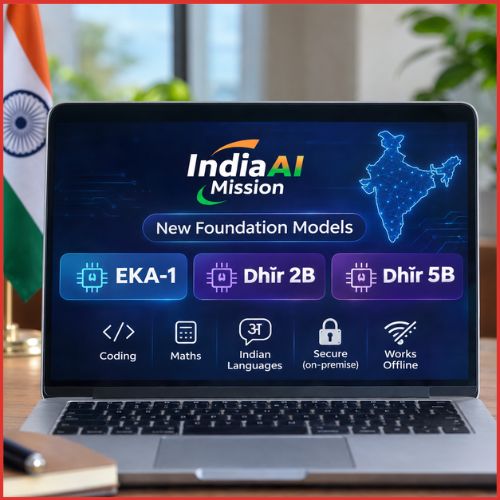
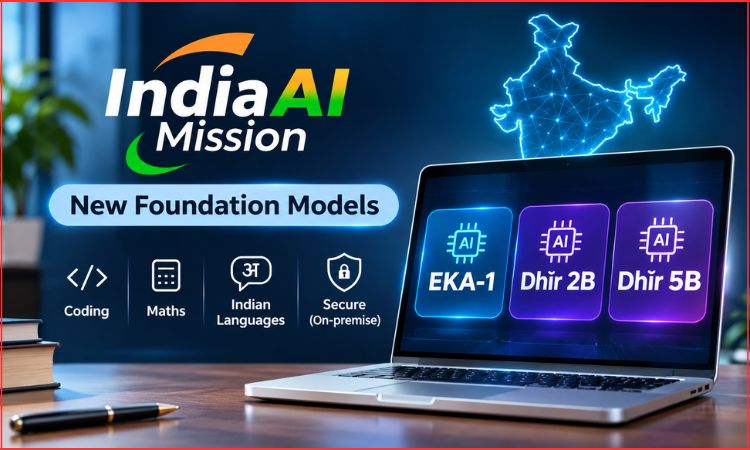
This week, the government put a different option on the table. The IndiaAI Mission EKA-1 Dhīr 2B Dhīr 5B release brings three India-built foundation models into public view. EKA-1 comes from Soket Labs. Dhīr 2B and Dhīr 5B come from ZenteiQ. Speaking at the launch, Electronics and IT Secretary S. Krishnan called the public release an important step towards a strong and strategic AI ecosystem in the country, and pointed out that the models can run in air-gapped environments, meaning systems cut off from the open internet.
That last detail is what makes these India’s indigenous AI models worth a closer look. The story is not simply “India has its own AI now”. It is about who gets to run AI, where, and on whose data.
What are the IndiaAI Mission foundation models?
A foundation model is the engine, not the car. It is a large AI system trained on huge amounts of text and code, which developers then shape into chatbots, search tools, coding assistants or document readers. ChatGPT, Claude and Gemini are all products built on top of foundation models like these.
The three new models were released on 3 November 2026 at an event in New Delhi, under the IndiaAI Innovation Centre pillar, which backs the development of indigenous foundation models and large language models. Soket Labs and ZenteiQ were among the teams picked for it. The selection came with practical help: subsidised national AI computing power and support for research costs. For a startup, that matters more than any press release. Training a model from scratch is expensive, and compute is usually the first wall a small Indian team hits.
So the IndiaAI Mission foundation models are best read as a test of a bigger idea. Can public money for compute, handed to private teams, produce models that Indian organisations will actually use?
EKA-1 AI model features: maths, code and a private-server pitch
Soket Labs built EKA-1 as the heavyweight of the trio. According to the PIB release, it has 26.3 billion parameters, was trained on roughly 7.5 trillion tokens, and covers all 22 scheduled Indian languages along with English. The ministry describes it as an open, sparse hybrid language model made for maths, code, reasoning and agentic work.
The phrase “sparse hybrid” deserves a plain-English note. In general, sparse designs switch on only a part of a model for each piece of text it handles, which keeps running costs lower than a dense model of the same size. Soket has not yet published a technical report explaining its exact design, so that is as far as anyone outside the company can go for now.
Here is what the EKA-1 AI model features add up to in practice:
• Reasoning and maths. It is pitched at problems that need several steps, not one-line answers.
• Coding. ANI’s report says it can handle multi-step tasks and execute code.
• Deployment on your own terms. It is meant to run on private servers, private cloud and air-gapped systems, according to Elets eGov.
• Made in India, end to end. Soket’s co-founder Mayank Singh said data preparation, training and evaluation all happened inside the country.
Who is EKA-1 really for?
Soket’s chief executive Abhishek Upperwal told the launch audience that the model is tailored to India’s banking, financial services and cybersecurity needs. Elets adds defence to that list. Think of a bank that cannot send customer documents to an overseas server, or a security team that wants an assistant reading incident reports inside a closed network. That is the buyer Soket has in mind, and it is a very different customer from someone who just wants help with a LinkedIn post.
MeitY Secretary S. Krishnan made the same point at the launch. Enterprise AI in India, he said, has not really taken off so far, and air-gapped models could change that.
The fine print on EKA-1
Three things to keep in mind before anyone budgets for it.
First, the language claim varies by source. The PIB release says 22 scheduled languages plus English. Transclew notes that the AIKosh listing mentions more than 100 languages, including programming languages, while Soket’s own site says 60 or more. Whichever number holds, nobody has yet shown how well it handles, say, Maithili or Santali compared with Hindi.
Second, performance is unproven in public. The AIKosh page points only to internal evaluations, with results promised in a technical report.
Third, the model is not yet in anyone’s hands. More on that in the availability section below.
Dhīr 2B and Dhīr 5B AI models: small enough to leave the data centre
If EKA-1 is the server-room model, the Dhīr pair is the one built to go where the server room is not. ZenteiQ AiTech Innovations released both as open-source models that support English and 10 Indian languages. The PIB release says they are meant for secure, on-premise, offline-capable use: document-grounded automation, knowledge retrieval, and citizen or enterprise services in defence, government, industry and education, especially where connectivity is poor or the data is sensitive.
The two Dhīr 2B and Dhīr 5B AI models differ mainly in size, as the names suggest. ANI reports that both are mixture-of-experts models trained from scratch on Google Cloud TPUs. ZenteiQ’s chief, Prof. Sashikumaar Ganesan, said they can run across GPUs and TPUs, and that the lightweight design allows deployment directly on mobile phones with no cloud connection, so data stays on the device.
What offline actually means here
This is the part Indian readers will care about, so it is worth being precise. According to Elets eGov, a user downloads the model once, and after that the phone configures it automatically and answers without an internet connection. ZenteiQ is building a free mobile app for Android and iOS, and plans a 9-billion-parameter model in December for researchers working on specialised problems.
Transclew reports ZenteiQ’s own speed figures for compressed 4-bit versions. The files shrink to about 1.21 GB for the 2B and 2.95 GB for the 5B. On a laptop’s built-in graphics they reportedly produce roughly 19 to 21 tokens a second, a comfortable reading pace. On a Raspberry Pi 4 the same models managed under 3. These are company numbers, not independent tests, but they show the range: usable on an ordinary laptop, slow on a hobby-grade board.
Where offline AI models in India could be useful
A few illustrations, to be read as possibilities and not as deployments that exist today:
- A university help desk that answers admission and fee questions from its own approved documents, even when the campus network is down.
- A block-level government office that searches scheme guidelines without sending files to an outside server.
- A factory floor assistant that explains a machine manual to a technician in his own language.
- A field officer who checks a procedure on her phone in an area with no signal.
The model supplies the language skills. The usefulness still depends on the documents fed into it, and on whoever builds the app around it.
One caution on “open”
ZenteiQ says it is releasing the weights under the Apache 2.0 licence, with documentation and evaluation tools, through AIKosh. Transclew’s check on 4 November found the full files for both models on AIKosh, listed at 3.79 GB and 9.50 GB, but marked “Restricted”, meaning a download needs approval from the uploader. So open-source in licence, request-based in practice, at least for now.
EKA-1 vs Dhīr 2B vs Dhīr 5B at a glance
EKA-1 is the larger, enterprise-minded model, while the two Dhīr models trade size for portability. Figures below are the developers’ announced claims, as of 4 November 2026, not independent test results.
| Model | Built by | Size | Languages | Built for | Where it runs | Access on 4 Nov |
| EKA-1 | Soket Labs | 26.3 billion parameters, about 7.5 trillion training tokens | 22 scheduled Indian languages plus English | Maths, code, reasoning, agentic tasks; banking, finance, cybersecurity | Private servers, private cloud, air-gapped systems | Waitlist; weights promised within a month |
| Dhīr 2B | ZenteiQ | About 2 billion parameters; 3.79 GB file | English plus 10 Indian languages | Offline document Q&A, knowledge retrieval, citizen and enterprise services | On-premise, laptops, GPUs, TPUs, mobile phones | Apache 2.0 weights on AIKosh, request needed |
| Dhīr 5B | ZenteiQ | About 5 billion parameters; 9.50 GB file | English plus 10 Indian languages | Same as Dhīr 2B, with more capacity for harder queries | On-premise, laptops, GPUs, TPUs, mobile phones | Apache 2.0 weights on AIKosh, request needed |
Why offline AI models in India matter more than they sound
India has well over a billion internet subscriptions, yet the gap between city and village is still wide. TRAI’s report for the quarter ending June 2026 put rural internet penetration at 49.07 subscribers per 100 people, as reported by Devdiscourse. That figure counts subscriptions, not individual users, so the real picture is patchier still. A tool that needs a stable connection for every question quietly leaves a lot of people out.
Offline AI models in India attack that problem from the other end. Instead of asking the user to find better signal, they bring the model to the device. Once the Dhīr files are on a phone or laptop, the questions and documents never leave it. For a government clerk, a school administrator or a clinic manager, that is a practical benefit before it is a privacy one.
The second reason is control. Krishnan’s remark about air-gapped systems points at a quieter market: banks, defence units and public-sector bodies that have been cautious about pushing sensitive records through any outside service. A model that sits inside their own network removes that objection, at least in principle.
Where offline AI falls short
There are honest limits, and any editor reading this should hold the line on them.
- Smaller models know less. A model that fits on a phone cannot match a large cloud system on difficult reasoning or obscure facts.
- No live information. An offline assistant cannot check today’s mandi price or a new circular unless someone feeds it fresh documents.
- Hardware decides the experience. ZenteiQ’s own numbers show the gap between a laptop and a Raspberry Pi. A budget phone will land somewhere in between.
- Local is not automatically secure. Access controls, encryption and sensible data handling still have to be set up by whoever deploys it.
So the pitch is not “offline beats cloud”. It is that some jobs are better done close to the data, and until now India had very few home-grown models built for exactly those jobs.
Indian AI models vs ChatGPT and Claude
The question every reader will ask is whether these models can take on ChatGPT, Claude or Gemini. It is the wrong question, and the launch documents themselves show why. The PIB release gives sizes, language coverage and intended uses. It gives no benchmark results. ZenteiQ has posted its own average scores across 41 benchmarks, according to Transclew, but the full tables sit in a technical report listed as coming soon, and Soket’s EKA-1 page points to internal evaluations only.
Company-run numbers deserve a pinch of salt in any country. When Sarvam AI launched its 105B model at the February AI Impact Summit, its chief executive said it beat Gemini 2.5 Flash on Indian-language performance, as ETV Bharat reported. That is a claim worth watching, and worth testing, not a settled result.
The more useful way to compare Indian AI models vs ChatGPT and Claude is by job, not by rank. ChatGPT, Claude and Gemini are general-purpose assistants that most people reach through a website or app, with the processing done on the provider’s servers. EKA-1 and Dhīr are building blocks, aimed at teams that want to run a model themselves.
| If the job is | Sensible starting point | Why |
| Everyday writing, research, summarising | ChatGPT, Claude, Gemini | Ready-made apps, broad skills, no setup |
| Q&A over your own documents with no outside server | Dhīr 2B or Dhīr 5B | Built for offline, on-premise use, once access is approved |
| Maths and code inside a closed network | EKA-1 | Designed for private and air-gapped deployment, once weights arrive |
| Hard, open-ended reasoning | Large cloud models | No public test yet shows the new models matching them |
There is also a third group worth a mention. Open-weight models from other countries, such as Meta’s Llama family, already let developers run a model on their own hardware. EKA-1 and Dhīr are India’s entry in that category, with the added pull of Indian-language focus and government backing.
So the honest verdict is this. The new models do not need to beat the global assistants to be useful. They need to be good enough, in the right language, on the right machine, for a specific task. Whether they are will only be clear once independent testers get their hands on the weights.
Availability, open questions and the road ahead
The launch was big. The access story is smaller, and it is the part most coverage skipped.
Transclew checked the AIKosh pages on 4 November. EKA-1 was listed at 30.49 GB, but the only version uploaded held three settings files totalling about 103 KB, with no model weights. Soket’s own site lists the model as coming soon and runs a waitlist. Soket has said it will release the weights openly within a month, which would put them around early December. Dhīr 2B and Dhīr 5B are on AIKosh in full, but all three models carry a “Restricted” tag, so a download needs the uploader’s approval. The licence says Apache 2.0. The practice, for now, is ask and wait.
None of this is scandalous. Launch-day gaps are common in software. But anyone planning a pilot should confirm access first, and anyone writing about “open” Indian models should say what open means on a given day.
Where this sits in the bigger plan
Soket and ZenteiQ are two of the twelve organisations the ministry has named as funded under the mission. In February, Sarvam AI, Gnani.ai and BharatGen showed their models at the AI Impact Summit in New Delhi, so Soket and ZenteiQ make five launches in that group, by Transclew’s count. EKA-1 is also described as the first release from Project EKA, Soket’s larger effort. A Lok Sabha reply cited by Transclew describes that project as a 120-billion-parameter open-source model backed by ₹177.08 crore of government support, mostly for computing. ZenteiQ has ₹206.49 crore for a separate science model called BrahmAI.
The pattern is clear enough. The mission is funding several teams to build different kinds of models and watching which ones people actually use.
What to watch in the next few weeks
- Whether EKA-1’s weights reach AIKosh by early December, and under what access terms.
- Technical reports from both companies, and independent benchmark results.
- ZenteiQ’s free mobile app and its 9-billion-parameter model, promised for December.
- Real pilots: a bank, a university or a district office that names itself as a user.
The measure of success will not be a launch event. It will be a clerk in a block office getting a correct answer in Hindi without a signal.
The bottom line
EKA-1, Dhīr 2B and Dhīr 5B are the clearest sign yet that the IndiaAI Mission’s compute subsidies can turn into working models. EKA-1 aims at maths, code and secure enterprise use. The Dhīr pair aims at offline, on-device and on-premise work in English and ten Indian languages. Between them they cover two very different customers.
What they have not yet done is prove themselves. The weights are partly behind a waitlist and partly behind an approval step, the technical reports are pending, and no independent benchmark exists. For a founder, CXO or investor reading this, the sensible stance is interested and unhurried: watch the December releases, ask for pilots, and judge these India’s indigenous AI models by what they do on real documents in real languages.