Nearly 3 lakh electric vehicles were registered in India in August 2026. But the headline number hides a market that is split across very different vehicle categories.
Electric two wheelers accounted for about 1.83 lakh registrations during the month. Electric passenger vehicles crossed 30,000 units. Three wheelers added another 79,846 electric registrations. Each segment has a different competitive structure, and the companies leading one are not necessarily leading another.
That is why there is no simple answer to the question of which company leads India’s EV market.
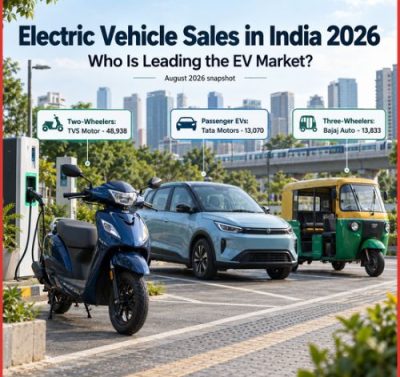
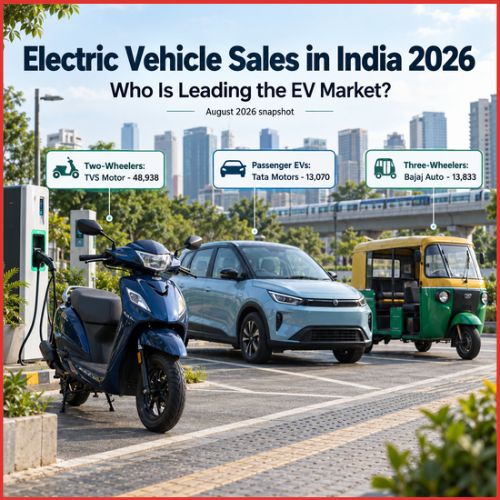
TVS Motor had the highest electric two wheeler registrations in August, with 48,938 units. Tata Motors led electric passenger vehicles with 13,070 registrations. Bajaj Auto was a major player in both electric two wheelers and three wheelers, while Mahindra has been building a stronger position in electric SUVs.
The numbers also need to be read carefully. Vehicle registrations, retail sales and manufacturer dispatches measure different points in the sales process. A monthly ranking therefore shows where the market stood at a particular time, not necessarily which manufacturer will lead the full year.
Electric Vehicle Sales in India: August 2026 Snapshot
The scale of India’s EV market is easier to understand by looking at individual segments.
Electric two wheeler registrations reached 1,83,204 units in August 2026, according to Vahan based data. That was 67.05% higher than the same month a year earlier, although volumes were 10.35% lower than July’s 2,04,362 units.
At around 10.7% of total two wheeler retail sales, electric scooters and motorcycles have moved well beyond the niche stage in several parts of the country. Yet the monthly decline from July also shows why a single month’s growth rate should not be treated as a straight line.
The passenger vehicle market tells a different story.
India recorded around 30,418 electric passenger vehicle registrations in August, about 51% more than in August 2025. EVs represented approximately 7.6% of total car retail sales during the month.
Three wheelers are further ahead. Electric three wheelers accounted for roughly 65.3% of the overall three wheeler market in August, with 79,846 units registered. For commercial mobility, electrification is already much further along than the headline passenger car numbers suggest.
Quick Reference: Segment Leaders in August 2026
| Segment | Market Leader | August 2026 Units | Approx. Market Share |
|---|---|---|---|
| Electric Two-Wheelers | TVS Motor | 48,938 | 26.7% |
| Electric Passenger Vehicles | Tata Motors | 13,070 | 43% |
| Electric Three-Wheelers | Bajaj Auto | 13,833 | — |
TVS Takes the Lead in Electric Two Wheelers
TVS Motor registered 48,938 electric two wheelers in August. That gave it approximately 26.7% of the segment.
A year earlier, the company had registered 25,646 units. The increase is significant because TVS is competing in a market where established manufacturers and specialist EV companies are both fighting for volume.
The iQube has become the centre of TVS’s electric two wheeler range, with the company offering different configurations across price points.
Bajaj Auto was not far behind. Its 41,114 electric two wheeler registrations gave it approximately 22.4% of the market. More striking was the year on year movement: Bajaj’s August registrations were up 235.7% from 12,246 units in August 2025.
The Chetak has put Bajaj directly into the electric scooter market, where the company is now competing with TVS, Ather, Vida and Ola.
Ather Energy recorded 28,757 registrations in August, giving it around 15.7% of the market. Its volumes were nearly 50% higher than a year earlier.
Then came Hero MotoCorp’s Vida, with 19,007 registrations. Ola Electric followed with 13,852.
That order would have looked very different during the earlier stages of India’s electric scooter market. The latest figures show how established motorcycle manufacturers have taken a larger role while specialist EV companies continue to compete for consumers.
Tata Still Accounts for the Largest Share of Electric Car Sales
The electric passenger vehicle market is more concentrated.
Tata Motors registered 13,070 electric passenger vehicles in August, equivalent to about 43% of the segment. Its registrations were approximately 62% higher than in August 2025.
The company’s EV range spans several parts of the mass market, including the Tiago EV, Punch EV and Nexon EV. That breadth gives Tata access to customers who are not necessarily looking for a premium electric car.
Mahindra registered 6,408 electric passenger vehicles in August, putting it at roughly 21% of the segment. Its electric SUV portfolio, including the BE 6 and XEV 9e, has given the company a route into a higher priced part of the market.
There is a useful distinction here between units and revenue.
Mahindra’s FY2025-26 annual report says the company held the No. 1 position in electric SUVs by revenue and ranked first among passenger vehicle manufacturers by EV revenue during the financial year. That does not contradict Tata’s higher August registration volume. The two figures measure different things.
A manufacturer selling fewer vehicles at higher prices can generate more EV revenue than a company selling a larger number of lower priced vehicles.
MG, VinFast and Maruti Add Pressure to the Passenger EV Market
JSW MG Motor registered 4,602 electric passenger vehicles in August. Its share was about 15% of the segment, although registrations were down 18% year on year.
The company’s electric portfolio includes the Comet EV and Windsor EV, giving it exposure to both the smaller city car market and the larger family vehicle segment.
VinFast’s arrival has added another variable. The Vietnamese manufacturer registered 2,198 electric passenger vehicles in August, placing fourth for the month and ahead of Maruti Suzuki, which registered 1,405 EVs.
That monthly result should not be interpreted as a permanent change in the industry’s hierarchy. VinFast is a new entrant, and its sales base is still developing. But its appearance in the monthly data illustrates how the list of manufacturers competing for India’s electric car buyers is expanding.
For consumers, that means the choice is no longer limited to a handful of electric models. Battery capacity, charging speed, vehicle size, financing, warranty coverage and service availability can now differ substantially between products in the same broad price range.
India’s Three Wheeler Market Tells a Different EV Story
The most striking electrification number in India’s August data did not come from cars.
It came from three wheelers.
Electric three wheeler retail sales reached 79,846 units in August, accounting for about 65.3% of the total three wheeler market. Bajaj Auto registered 13,833 electric three wheelers, while the Mahindra Group recorded 12,819.
The reason is partly economic. Commercial three wheelers often have predictable daily routes and high utilisation. Fuel savings can therefore have a more direct effect on operating costs than they do for a private vehicle that is driven occasionally.
This is one reason an analysis based only on electric cars can give an incomplete picture of India’s EV adoption.
What Is Driving Electric Vehicle Sales in India?
There is no single explanation for the increase.
Manufacturers have expanded their electric portfolios. TVS, Bajaj and Hero MotoCorp have brought established two wheeler brands into the electric segment, while Tata and Mahindra have expanded their passenger EV ranges.
Government policy is another factor. The PM E-DRIVE scheme has a total outlay of ₹10,900 crore and has been extended until March 31, 2028. The programme covers several categories, including electric two wheelers, three wheelers and certain commercial vehicles.
The government has also extended the terminal date for eligible electric two wheelers under the scheme to March 31, 2028.
Charging infrastructure remains another part of the equation. An EV is not simply a vehicle purchase. For a private buyer, the practicality of charging at home or at work can matter more than a headline range figure. For commercial operators, access to charging during working hours can directly affect vehicle utilisation.
Are EV Sales in India Growing at the Same Rate Everywhere?
No, and the August figures make that clear.
Electric two wheeler registrations were sharply higher than a year earlier but lower than July. Passenger EV registrations also recorded strong year on year growth, while individual manufacturers moved in different directions.
The same applies to market share. TVS led electric two wheelers, Tata led electric passenger vehicles, and Bajaj and Mahindra had substantial positions in electric three wheelers.
There is also a data issue that readers should keep in mind.
Tata Motors, for example, dispatched 16,549 electric cars to dealerships in August, according to Autocar India, while Vahan based retail data recorded 13,070 Tata electric passenger vehicle registrations. The difference does not necessarily mean one figure is wrong. Dispatches represent vehicles sent to dealers, whereas registrations occur when vehicles are registered for use.
For anyone comparing EV sales by company, using the same measurement across all manufacturers is essential.
What Should Buyers Take From the 2026 EV Sales Data?
Sales numbers can answer one question: how many vehicles a manufacturer is moving through the market.
They cannot answer whether a particular EV is suitable for an individual buyer.
A buyer considering an electric scooter should look at real world range, charging time, battery warranty, service availability and the cost of replacing or repairing components. For cars, home charging arrangements, highway charging coverage, insurance and expected usage can have an even greater effect on ownership costs.
Market share can provide useful context. A high volume manufacturer may have a larger service network or greater parts availability, although those factors still need to be checked for the specific model and location.
The 2026 figures also show that India’s EV market should not be treated as one market. Two wheelers, passenger cars and commercial three wheelers are developing at different speeds and responding to different economic conditions.
Electric Vehicle Market Leaders in India in 2026
The current market picture is therefore segment specific.
TVS Motor led electric two wheeler registrations in August 2026, followed by Bajaj Auto and Ather Energy. Tata Motors led electric passenger vehicle registrations, with Mahindra and JSW MG Motor among the other major manufacturers.
Bajaj Auto and the Mahindra Group were also among the largest manufacturers in electric three wheelers.
The rankings will change as new models arrive, manufacturers expand production and consumer demand shifts between price segments. For that reason, anyone tracking electric vehicle sales in India should look at cumulative registrations and market share alongside individual monthly results.
For buyers, the more useful question is not simply which company sells the most EVs. It is whether the manufacturer and model have the range, charging support, service network and ownership economics that match the way the vehicle will actually be used.
Frequently Asked Questions
Which company sells the most electric vehicles in India?
There is no single answer because segments differ. TVS Motor leads electric two wheelers, Tata Motors leads electric passenger vehicles, and Bajaj Auto and Mahindra hold major positions in electric three wheelers.
Which is the No. 1 EV company in India in 2026?
By overall registration volume across two wheelers, Tata Motors dominates the passenger car segment while TVS leads two wheelers. Neither can be called the single overall EV leader since the categories are measured separately.
Which electric car sells the most in India?
Tata Motors’ electric car range, including the Nexon EV, Punch EV and Tiago EV, led the segment in August 2026 with about 43% market share.
Why did electric two wheeler sales fall from July to August 2026?
Electric two wheeler registrations dropped by about 10.35% month-on-month even though they were 67% higher than a year earlier. Monthly fluctuations are common and do not indicate a change in the annual growth trend.
What percentage of vehicles sold in India are electric?
Electric vehicles made up approximately 12.3% of overall retail vehicle sales in August 2026, with penetration varying sharply by category: about 10.7% for two wheelers, 7.6% for passenger cars and 65.3% for three wheelers.
Why are electric three wheelers more popular than electric cars in India?
Three wheelers often run fixed routes with high daily utilisation, so fuel savings translate into a larger reduction in operating costs. This makes the economic case for electrification stronger for commercial three wheelers than for privately used cars.
What is the difference between EV registrations and EV dispatches?
Dispatches are vehicles a manufacturer ships to dealerships, while registrations are vehicles that customers have actually registered with a Regional Transport Office. The two numbers can differ in the same month and both are used in industry reporting.
Is Ola Electric still a top EV scooter brand in India?
Ola Electric registered 13,852 units in August 2026, placing it behind TVS, Bajaj, Ather and Hero MotoCorp’s Vida for the month, reflecting a shift toward established two wheeler manufacturers in the electric scooter segment.
What government schemes support EV sales in India?
The PM E-DRIVE scheme, with an outlay of ₹10,900 crore, supports electric two wheelers, three wheelers and select commercial vehicles, and has been extended until March 31, 2028.
Which company leads India’s electric SUV market by revenue?
Mahindra reported holding the No. 1 position in electric SUVs by revenue in its FY2025-26 annual report, even though Tata Motors sold more electric passenger vehicles by volume in August 2026.