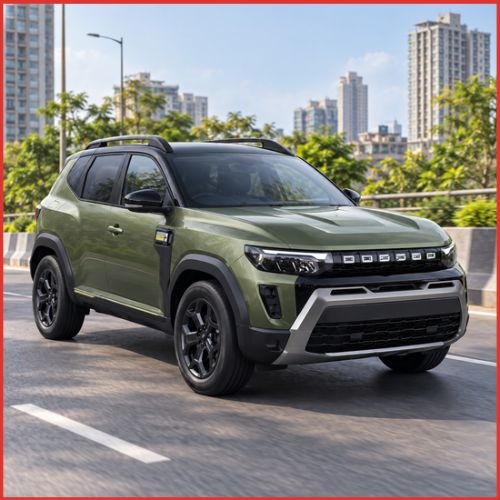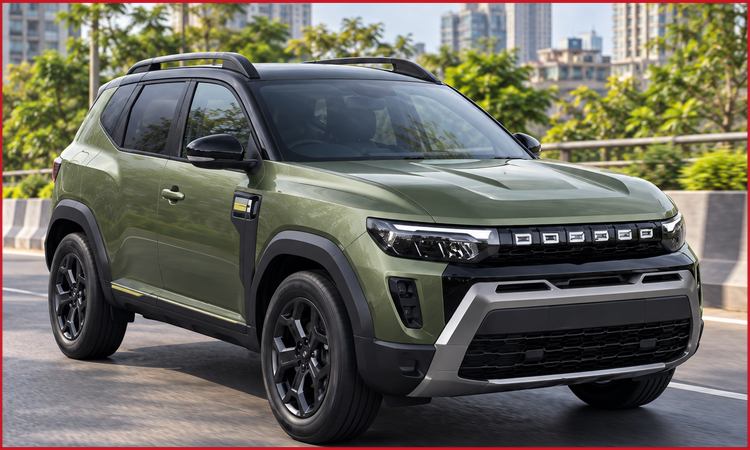
Renault has revealed the headline number it hopes will make buyers pay attention to the upcoming Duster Strong Hybrid: 29 km per litre.
That is the ARAI-certified fuel-efficiency figure for the new Renault Duster Strong Hybrid E-Tech 160, which pairs a 1.8-litre petrol engine with two electric motors and a small self-charging battery.
Bookings opened on October 9 for ₹21,000, while the complete India reveal is scheduled for October 17.
Renault has not announced the final price yet. Still, the mileage figure gives buyers an early idea of where the hybrid Duster is trying to fit. This is being pitched as an SUV for people who want diesel-like running efficiency without actually buying a diesel.
The Hybrid System Produces 160 PS
The Duster’s E-Tech system is more complicated than adding one electric motor to an ordinary petrol engine.
Renault combines a 1.8-litre petrol motor with two electric motors and a 1.4kWh battery.
Together, the system produces 160 PS.
An intelligent multi-mode transmission decides how those components work depending on speed, battery state and driving conditions.
At one moment the vehicle can move using electric power. At another, the petrol engine takes over or works alongside the electric system.
The driver does not need to manually decide which mode should be used.
That automatic switching is central to the Renault E-Tech hybrid concept.
There Is No Charging Plug
The Duster is a strong hybrid, not a plug-in hybrid.
That means there is no requirement to connect the vehicle to a charger at home or at a public charging station.
The 1.4kWh battery replenishes itself while the SUV is being driven.
Energy that would normally be lost during braking and deceleration can be recovered and used to charge the battery.
The petrol engine can support charging as well.
For Indian buyers who are interested in electrification but do not want to think about charging infrastructure, that makes the ownership experience much closer to a regular petrol vehicle.
You fill the tank and drive.
The electrical side works in the background.
Renault Says City Driving Can Be Mostly Electric
One of the more interesting claims around the system concerns low-speed driving.
Renault says the Duster can operate in electric mode for up to 80% of city driving time under suitable conditions.
That does not mean 80% of every journey will be electric regardless of traffic, temperature or driving style.
The figure describes what the system can achieve under relevant operating conditions.
Still, city traffic is exactly where a strong hybrid tends to make the most sense.
Repeated braking creates opportunities for energy recovery, while electric motors can handle a large portion of low-speed movement without keeping the petrol engine running continuously.
That is a major reason the Duster hybrid mileage reaches a certified 29 km/l.
The 29 km/l Figure Is ARAI-Certified
Mileage figures need context, particularly with hybrids.
Renault’s 29 km/l claim is certified by the testing agency under Indian regulatory procedures.
That makes it a standardised benchmark for comparing one vehicle with another.
It is not a promise that every owner will see exactly 29 km/l on the dashboard.
Real-world fuel economy changes with traffic, air-conditioning use, road conditions, load, tyre pressure and driving behaviour.
A hybrid that spends most of its time crawling through urban traffic may behave very differently from the same vehicle driven at sustained highway speeds.
Still, the certified number is eye-catching for an SUV delivering 160 PS.
Renault Is Clearly Targeting Former Diesel Buyers
The positioning is deliberate.
Diesel SUVs built a loyal following in India because they combined torque with comparatively low fuel consumption, particularly for people covering long distances.
Stricter emissions requirements and changing manufacturer strategies have reduced the number of diesel options in several segments.
Strong hybrids are beginning to fill some of that space.
Renault itself has described the Duster E-Tech 160 as an alternative for buyers considering diesel.
It gives customers a petrol-based powertrain but uses electric assistance to bring fuel efficiency much closer to what economy-focused SUV buyers expect.
Whether customers accept the higher purchase price that hybrid technology usually brings will be the next question.
The Full Price Is Still Missing
This is the biggest piece of information Renault has not revealed yet.
Bookings have opened for ₹21,000, but buyers do not yet know the final ex-showroom price of the hybrid variant.
That matters because fuel savings only tell half the ownership story.
If a hybrid costs significantly more than an equivalent petrol model, the owner may need to drive a substantial distance before lower fuel consumption recovers the upfront difference.
Renault’s October 17 reveal should therefore be more important than the mileage announcement alone.
The final price, variants, equipment list and warranty terms will determine whether the efficiency advantage also makes financial sense.
The Duster Already Has Petrol Alternatives
The hybrid is joining an existing Duster range rather than launching by itself.
That gives potential customers an interesting internal comparison.
A buyer can choose a conventional petrol powertrain with a lower initial cost or pay more for the strong-hybrid version in exchange for better certified efficiency and more electric-assisted city driving.
The decision will depend heavily on usage.
Someone driving only a few thousand kilometres each year may struggle to recover a large hybrid premium through fuel savings.
A high-mileage city user could reach that point much sooner.
This is where the 29 km/l Renault Duster mileage becomes useful as part of a calculation rather than simply a marketing number.
E-Tech Is Making Its India Debut
The Duster will also be Renault’s first E-Tech strong-hybrid model in India.
That gives the launch wider importance for the company.
Renault has used E-Tech technology in international markets for years, but the Indian market has different pricing pressures and customer expectations.
Bringing the system here signals that Renault sees enough demand for hybrids to justify adding a more technically complex powertrain.
It also gives the brand another way to compete without entering a straight horsepower battle with every other midsize SUV.
Efficiency becomes part of the performance story.
The Mileage Number Has Done Its Job
Before the price is known, 29 km/l is the specification Renault wants people to remember.
It sounds impressive for a midsize SUV. The 160 PS output makes it even easier to market because Renault does not have to frame the hybrid as a slow economy-focused version.
But certified efficiency is only the first part of the judgement.
Buyers still need to know what the Renault Duster Strong Hybrid costs, how its equipment compares with the petrol variants, what hybrid-system warranty Renault offers and what real-world mileage looks like once owners begin using it.
Those answers arrive after the full October 17 reveal.
For now, Renault has at least made the hybrid Duster difficult to ignore.