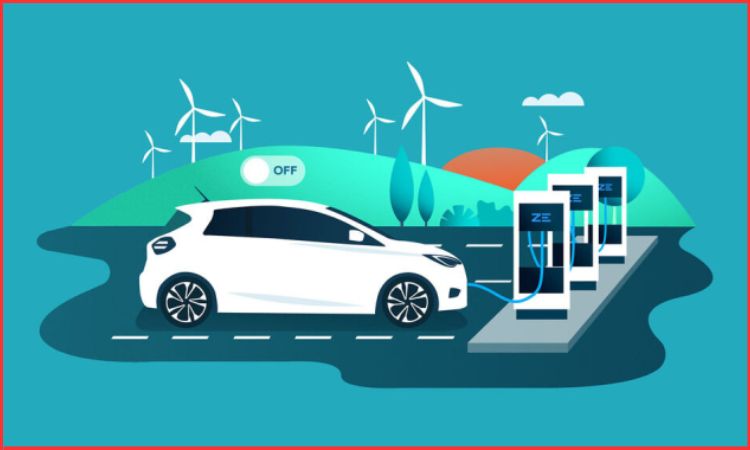
Can India, the world’s third-largest automobile market, truly scale up its adoption of electric vehicles? The Electric Vehicle Market in India shows promising growth, supported by strong government initiatives and growing consumer interest. The focus extends beyond passenger cars to include buses, two- and three-wheelers, and charging infrastructure. Yet, several challenges continue to slow down this electrifying shift. This article explores the current landscape of India’s EV market, highlighting both opportunities and obstacles that define the country’s journey toward cleaner mobility.
Current Landscape of the Electric Vehicle Market in India
Source: Currency Transfer
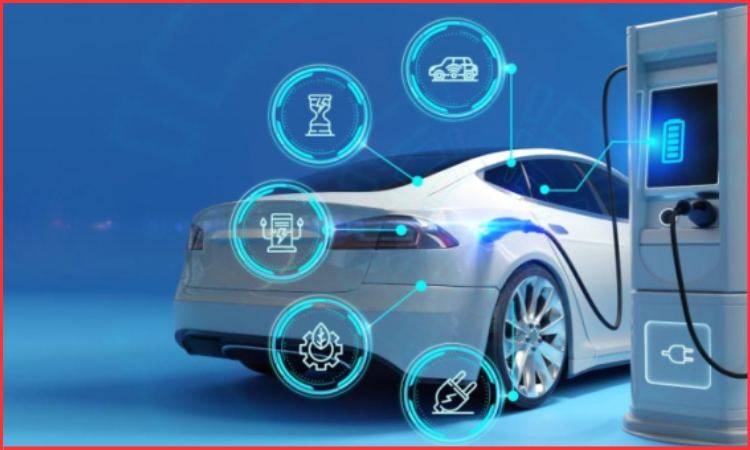
According to IBEF, India’s EV market is expected to grow at a CAGR of 28.52%, reaching $18.3 billion by 2029, up from $5.22 billion in 2024. Sales have been climbing steadily, EV registrations rose 49.25% in 2023, reaching 1.52 million units. In FY24, sales grew by 16.9% to 1.97 million units, compared to 1.75 million units in FY23. Much of this growth has been driven by two- and three-wheelers, which dominate India’s EV segment.
Government Policies and Incentives
Source: Zingbus
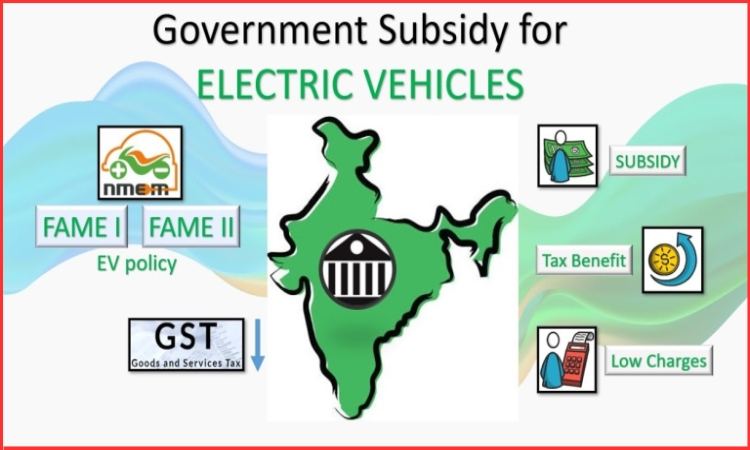
The government has taken the following measures to provide an initial boost in the market:
- FAME [Faster Adoption and Manufacturing of Hybrid and Electric Vehicles] Scheme
The first phase of this scheme, FAME 1, was aimed at electric two-wheelers, three-wheelers, cars, and buses. The government offered demand incentives worth ₹895 crore, focused on creating early adoption. The second phase, FAME 2, had an outlay of ₹10,000 crore to support 7,000 e-buses, 5 lakh e-three-wheelers, 55,000 e-four-wheeler passenger cars, and 10 lakh e-two-wheelers. It also provided direct subsidies based on battery capacity. For the next phase, FAME 3, the government is focusing on charging infrastructure, domestic manufacturing, and integration with renewable energy. - State-level EV Policies
Tamil Nadu and Karnataka have become India’s EV manufacturing hubs with special investment zones, tax rebates, and land allocation for EV manufacturers like Ola Electric, Ather, and BYD. Delhi framed an EV policy in 2020, which offers incentives up to ₹30,000 for two-wheelers and ₹1.5 lakh for cars. It also offered a waiver on road tax and registration fees. Maharashtra offers subsidies of up to ₹1 lakh per EV. The policy targets 10% of all new vehicle registrations to be EVs by 2025. - GST Reduction, Tax Incentives, and Regulatory Support
GST on EVs has been reduced to 5%, compared to 28% for petrol and diesel cars, and 12-18% for hybrids. Even EV chargers and charging stations also charge 5% GST. Additionally, buyers are eligible for a claim on an income tax deduction of up to ₹1.5 lakh on interest paid on loans used to purchase EVs under Section 80EEB of the Income Tax Act. EVs are exempt from permit requirements [for commercial use], making them attractive for logistics and ride-hailing businesses. The government has issued green license plates to make them easily identifiable for policy benefits. - Production-linked Incentive [PLI] Scheme
The government has introduced PLI for the Advanced Chemistry Cell Batteries with an outlay of ₹18,100 crore. This scheme supports local production of high-efficiency batteries. On the other side, PLI for Automobile and Auto Components with an outlay of ₹25,938 crore is also allocated by the government to encourage domestic manufacturing of EVs and related parts. - Charging Infrastructure Push
The Indian government has set a target of installing over 22,000 public charging stations by 2026. Incentives under FAME II have supported charging equipment procurement, with up to 70% capital subsidy for setting up charging stations in cities.
Opportunities in the Electric Vehicle Market in India
- Rising Fuel Prices and Cost Savings
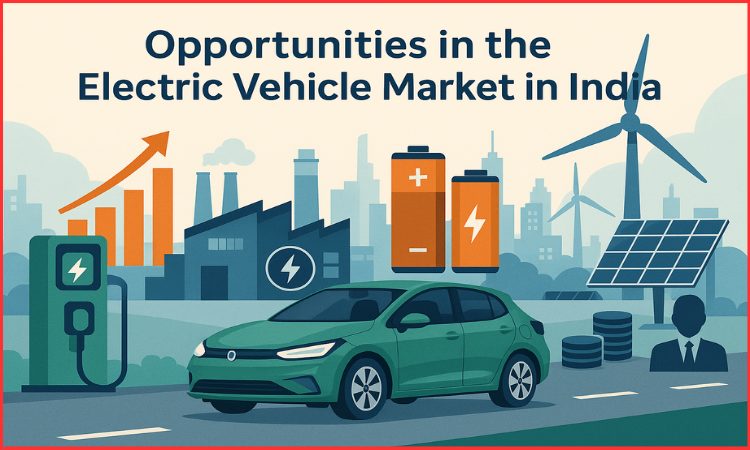
In most cities, petrol and diesel prices have crossed ₹100 per litre. For daily commuters in urban areas, fuel costs hold a major part of monthly expenses. Hence, EVs with their lower running cost of ₹1-2 per km compared to ₹6-8 per km for petrol vehicles, offer significant long-term savings.
- Global Manufacturing Hub
Currently, the Indian government is strongly promoting the manufacturing of two-wheeler and three-wheeler electric vehicles with the availability of a larger skilled workforce. With affordable EVs, India is focusing on dominating the domestic market along with international markets, including Southeast Asia, Africa, and Latin America, and thus, becoming a global manufacturing hub. - Battery Production & Recycling
Through the PLI scheme, the Indian government is promoting domestic cell manufacturing, because batteries account for 30-40% of the EV’s cost. With recent discoveries of lithium reserves, India could reduce import dependency and even control costs. Parallely, battery recycling startups like Lohum and Attero are exploring a multi-billion-dollar market for battery reuse and raw material recovery. - Emergence of Renewable Energy
Charging infrastructure powered by renewable energy, such as solar and wind power, will help India reduce both oil imports and carbon emissions. Companies like Tata Power and ReNew are already experimenting with solar-powered EV charging stations. - Urban Mobility Transformation
Cities with high population density and pollution, such as Delhi, Mumbai, and Bengaluru, will experience the most benefits. Ola, Uber, Zomato, Swiggy, and Amazon are switching fleets to electric, to accelerate at scale and normalise EVs for the mass market. - Investment Opportunities and Startup Ecosystem
Ola Electric is building a ₹10,000 crore gigafactory. Ather Energy has also attracted several global investors by expanding across 100+ cities. Venture capital firms are betting heavily on EV financing and charging networks. Thus, this ecosystem, while offering job opportunities, is creating business models like EV leasing, subscription services, and fleet electrification.
Challenges in India’s EV Market
Source: Bannari Amman Institute of Technology
- Insufficient Charging Infrastructure:
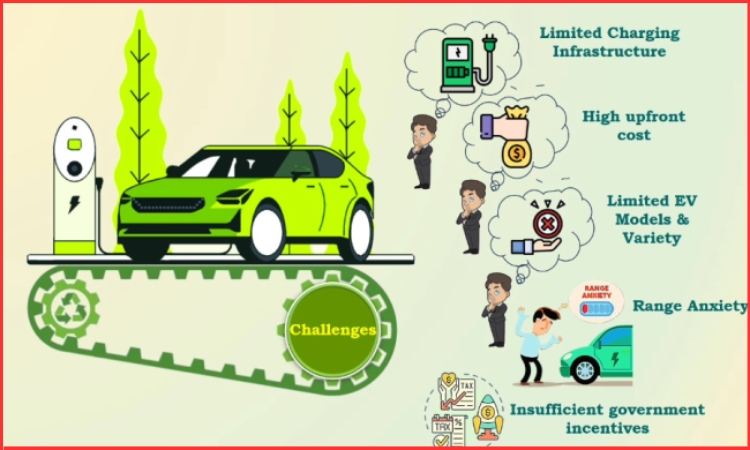
India has only 12,000 public charging stations, far short of the 2 million required by 2030. Many stations lack fast charging and are absent in smaller towns and on highways. - High Upfront Costs:
Despite subsidies, EVs remain expensive. A Tata Nexon EV costs ₹14–18 lakh, while its petrol variant costs ₹8–12 lakh, which is significant in a price-sensitive market. - Consumer Awareness and Trust Issues:
Concerns about battery life, resale value, and performance persist, particularly in areas where word-of-mouth heavily influences purchasing decisions. - Lack of Standardisation:
Varying battery-swapping protocols, incentives, and charging connectors across states complicate adoption for businesses and consumers. - Power Grid and Renewable Integration:
Heavy reliance on coal power risks shifting pollution from cars to power plants. Grid upgrades and renewable integration are critical to ensure real emissions reductions.
Future of the Electric Vehicle Adoption in India
By 2030, India aims to achieve 30% of all new vehicles sold to be electric. To achieve this goal, an ecosystem supporting the same is required. Currently, the focus is on creating a dense charging network across highways, cities, and smaller towns. At the same time, India is also reducing its dependence on importing batteries by setting up domestic gigafactories and exploring lithium reserves. The government is also working on new financing models to bring EVs’ costs closer to petrol vehicles.
Standardising charging protocols and training a workforce of EV technicians will build consumer confidence. Thus, by 2030, costs will fall, and trust will rise, bringing a growth-heavy transformation of EV adoption in India. In addition, job opportunities will expand, and new industries will emerge in battery manufacturing, charging infrastructure, and shared mobility services.
Final Thoughts
The Electric Vehicle Market in India stands at a critical turning point. Government policies, industry investments, and rising consumer interest provide a strong foundation. Yet, challenges such as infrastructure gaps, cost barriers, and energy grid limitations require urgent attention. If public and private sectors collaborate effectively, India could become a global leader in electric mobility by 2030.
FAQs
Q1. Which states are leading in EV adoption?
Delhi, Maharashtra, Karnataka, and Tamil Nadu currently lead in EV adoption.
Q2. Are EVs cheaper in the long run?
Yes, EVs significantly reduce fuel and maintenance expenses over time.
Q3. What is the biggest challenge for EV adoption in India?
Insufficient charging infrastructure and dependence on imported batteries remain the biggest hurdles.