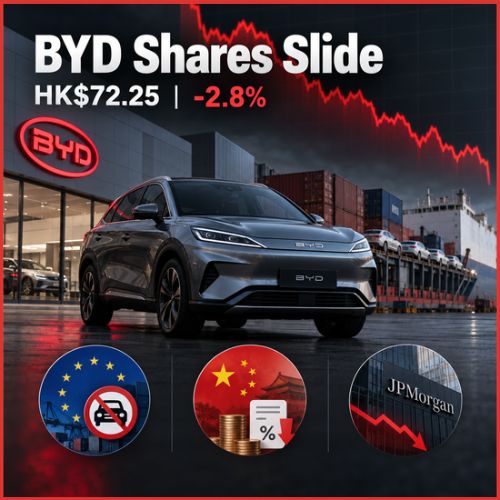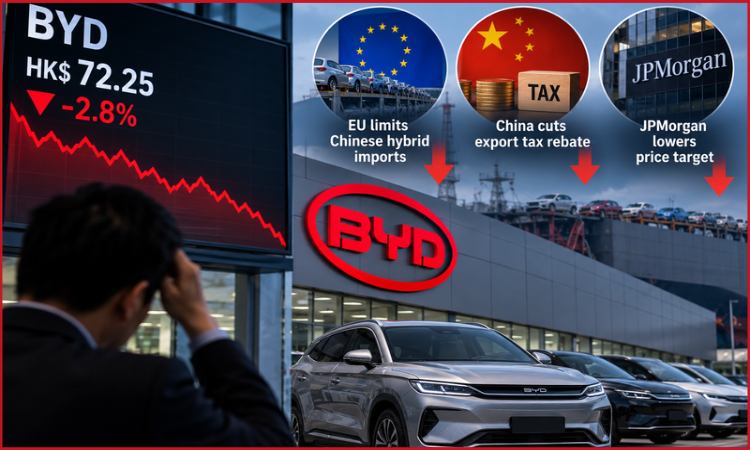
BYD shares fell again on Tuesday as investors weighed three problems at once: tighter limits on Chinese hybrid exports to Europe, a reduction in China’s tax support for new-energy vehicle exports and a much less optimistic price target from JPMorgan.
The Hong Kong-listed stock dropped as much as 2.8% to HK$72.25 during the session.
Any one of those developments would have given investors something to think about. Together, they hit two parts of BYD’s growth story that have become increasingly important: overseas expansion and the profit earned on every car shipped outside China.
The latest decline leaves BYD stock close to the lower end of its 52-week range after months of weakness.
Europe Is Putting a Limit on Chinese Hybrid Imports
The most immediate pressure comes from Europe.
China and the European Union have agreed on a new framework that will limit the number of Chinese hybrid vehicles entering the bloc.
The initial annual quota is expected to be around 350,000 vehicles, with the permitted amount increasing by about 6% each year.
Without restrictions, Chinese hybrid shipments to the region had been expected to reach far higher levels.
That creates a problem for companies including BYD because Europe has become an important outlet at a time when the Chinese domestic car market is much tougher.
The restrictions cover an area Chinese automakers had increasingly relied on after the EU imposed additional duties on Chinese-made battery electric vehicles.
Plug-In Hybrids Had Become a Useful Route Into Europe
Chinese manufacturers adapted quickly to Europe’s EV tariffs.
Instead of depending entirely on battery-electric models, they increased shipments of plug-in hybrids, which were not subject to the same additional duties.
The change was dramatic.
Chinese hybrid exports to the European Union reached about $7.5 billion during the first half of 2026, roughly three times the level recorded a year earlier.
BYD, Chery and SAIC became important players in that trade.
The new quota makes that strategy harder to scale.
For BYD European sales, the risk is not necessarily that demand disappears. It is that the company may no longer be able to meet all of that demand through exports from China.
The alternative is to make more cars inside Europe.
BYD Is Already Building Locally
BYD has been preparing for that possibility.
The company is expanding manufacturing in Europe, including operations in Hungary, and has broader plans to build a much larger regional workforce.
Local production matters because vehicles assembled inside the European Union would not face the same import restrictions as cars shipped from China.
That could soften the long-term effect of the quota.
It does not remove the near-term cost.
Building factories, localising suppliers and hiring thousands of workers requires money and takes time. Exporting finished vehicles from existing Chinese plants can be far quicker.
The EU agreement therefore adds another reason for BYD to accelerate European production even if doing so initially puts pressure on capital spending.
China Is Also Cutting an Export Tax Benefit
A second issue emerged from Beijing.
China plans to reduce the value-added-tax rebate available on exports of new-energy vehicles from 13% to 9%.
The change takes effect on April 1, 2027.
Export tax rebates allow manufacturers to recover part of the taxes associated with products sold overseas. Reducing that refund effectively raises the cost of exporting.
The change applies to battery electric cars, plug-in hybrids and several other new-energy vehicle categories.
For Chinese EV makers, the timing is important because overseas markets have become more valuable just as domestic competition has intensified.
The Impact on BYD Could Be Meaningful
Analysts are already trying to estimate the cost.
Deutsche Bank calculated that the lower export rebate could reduce BYD’s net profit by roughly 5,000 yuan, or about $740, for each exported vehicle, all else being equal.
That does not mean BYD will simply accept the entire hit.
The company can respond through pricing, cost reductions, local production or changes in the models it sends overseas.
But each option involves a trade-off.
Higher prices can hurt demand. Cost reductions take time. Building cars outside China requires investment.
The policy therefore creates another source of margin uncertainty around a business investors had expected to become an increasingly important profit driver.
Overseas Growth Has Been Offsetting a Weak Home Market
BYD’s international expansion matters even more because conditions at home remain difficult.
China’s car industry has been dealing with intense price competition and softer domestic demand.
BYD’s global sales have still been supported by exports, which have grown much faster than sales inside China.
That mix helped the company keep delivering higher overall volumes even as domestic sales came under pressure.
If overseas shipments become more expensive at the same time that Europe limits imports, the company’s growth path becomes less straightforward.
This is one reason the BYD share price has reacted so sharply to policy developments around exports.
JPMorgan Has Become More Cautious
The third pressure point comes from Wall Street.
JPMorgan recently downgraded BYD to Neutral from Overweight and cut its Hong Kong price target to HK88fromHK124.
That is a sizeable reduction.
The brokerage pointed to weak Chinese auto demand, rising input costs, policy uncertainty and both tariff and non-tariff barriers affecting international expansion.
JPMorgan does not expect those issues to disappear quickly.
Its broader concern is that structural pressure could continue into 2027, limiting how much investors are prepared to pay for Chinese auto stocks even if vehicle sales remain high.
The bank also became more cautious on several of BYD’s peers.
Why BYD Stock Is Falling Now
The latest BYD stock decline is therefore not being driven by one disappointing sales number.
Investors are reassessing how profitable the company’s international growth will be.
The EU is putting limits on a fast-growing hybrid export route. China is reducing the tax rebate attached to overseas NEV shipments. JPMorgan has cut its expectations for the stock as competition and policy risk continue to build.
BYD still has advantages few Chinese automakers can match: enormous scale, battery expertise, strong exports and the financial capacity to manufacture closer to customers.
The question is what that expansion costs.
For several years, investors focused on how many vehicles BYD could sell outside China.
The next stage of the story may be less about volume and more about how much money the company can keep from every overseas vehicle once subsidies, quotas and localisation costs begin to change the maths.