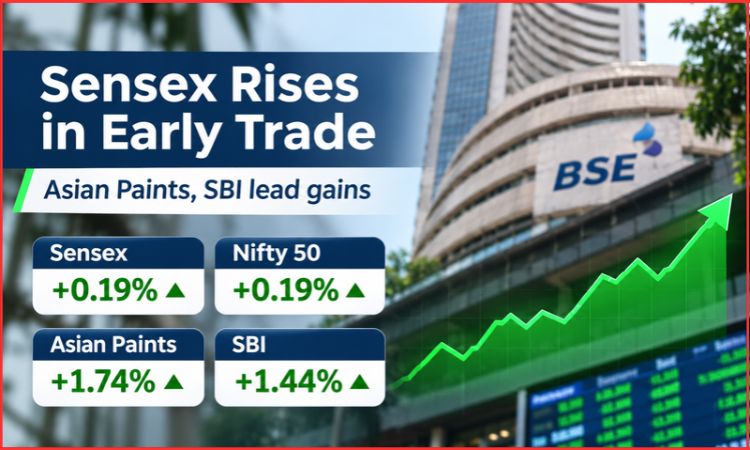
Indian shares traded higher on November 17, with Asian Paints and State Bank of India among the prominent gainers as easing crude oil prices helped domestic sentiment withstand weakness elsewhere in Asia.
The Sensex and Nifty built on the previous session’s advance, although the opening period showed some hesitation. Different morning snapshots captured the benchmarks moving between modest gains and a firmer footing.
At 9:42am, the Sensex was up 0.19% at 82,261.31, while the Nifty 50 gained 0.19% to 25,338.70, according to Reuters.
The early advance followed Monday’s stronger close. Investors were balancing support from lower oil prices and overseas fund flows against pressure on global technology shares.
These figures describe morning trading, rather than the session’s final result.
Asian Paints And SBI Feature Among The Gainers
Asian Paints shares were among the strongest performers in the Sensex pack. A 9:56am market update showed the stock gaining 1.74%, while SBI advanced 1.44%.
The buying extended beyond those two companies. TCS, IndiGo, Mahindra & Mahindra, Axis Bank and Maruti Suzuki also featured among the early gainers.
That spread gave the advance support from several businesses rather than one isolated stock. However, a list of rising heavyweight companies does not establish that every part of the market was participating equally.
Benchmark indices reflect the performance and weight of their constituent stocks. A gain in a heavily weighted company can influence the headline number more than a similar percentage move elsewhere.
For readers following the session, the useful distinction is between the index direction and the experience of individual shares. Both matter, and they do not always move together.
Lower Crude Prices Provide Support
Easing oil prices were an important part of the morning’s market backdrop.
Reuters reported Brent crude near $91.70 a barrel, with expectations of a supply surplus contributing to the decline.
For an oil-importing economy such as India, lower crude prices can offer relief through several channels. They can reduce pressure on the import bill and ease costs for businesses exposed to petroleum-linked inputs.
Paint companies were among the beneficiaries of that interpretation. Reuters reported gains of roughly 1.4% to 2.5% across Asian Paints, Berger Paints and Kansai Nerolac.
The relationship is not automatic. A change in crude prices does not flow immediately or completely into a company’s profit.
Purchase contracts, inventories, selling prices and other expenses all affect the eventual result. Still, a softer oil market can improve expectations before those effects appear in reported earnings.
That helps explain why paint stocks drew attention during the session.
Monday’s Advance Set A Positive Starting Point
The previous session had already strengthened domestic sentiment.
On November 16, the Sensex rose 512.34 points, or 0.63%, to close at 82,104.79. The Nifty gained 146.80 points, or 0.58%, to settle at 25,291.10.
Financial, FMCG and oil-and-gas shares supported that move.
Tuesday’s early gains therefore represented an extension of an existing recovery, rather than a sudden reversal after a weak session.
That context changes how a small opening rise should be read. After a substantial advance, investors may become more selective about adding exposure, particularly when global signals are mixed.
A higher index level can coexist with caution. Some participants may continue buying, while others use the improvement to reduce positions or wait for company-specific information.
The morning’s movement reflected that balance rather than an uninterrupted rush into equities.
Foreign Fund Flows Remain In Focus
Foreign investor activity has also helped shape expectations for the Indian stock market.
Recent coverage has highlighted renewed overseas interest following a period of withdrawals. Sustained buying can support demand for large listed companies and help domestic shares absorb an unfavourable global session.
But flows should be interpreted alongside earnings and valuations.
A strong period of inflows does not remove differences between companies. It also does not guarantee that buying continues at the same pace.
For businesses attracting investor attention, subsequent financial results still need to support expectations about revenue, margins and cash generation.
The practical question is whether the market’s advance rests on improving operating performance across enough companies. Fund flows can reinforce that process, but they cannot establish it by themselves.
Global Technology Weakness Creates A Counterweight
Other Asian markets were weaker as investors responded to an overnight decline on Wall Street and fresh restrictions affecting China’s access to advanced AI chips.
That produced a different backdrop from India’s oil-related relief.
The contrast illustrates why global markets do not always move uniformly. Countries and indices have different sector exposures, import requirements and company weightings.
A development that pressures technology-heavy markets can coexist with support for businesses benefiting from lower input costs.
For Indian investors, the global sell-off remained relevant even though the local benchmarks traded higher. Continued weakness abroad could affect risk appetite, while domestic earnings and commodity costs could provide a partial offset.
The session therefore required attention to several influences rather than one decisive explanation.
SBI’s Rise Adds A Financial-Sector Dimension
The advance in SBI shares brought a major banking stock into the list of early leaders.
Bank shares often attract attention because their performance connects with expectations about credit demand, funding costs and the wider economy.
However, a single morning’s price movement does not establish that any of those factors changed materially overnight.
The stronger conclusion is narrower: investors were willing to buy SBI alongside consumer, industrial and technology names during the reported period.
That participation helped broaden the character of the early advance. Whether it continued through the session would determine how much support the financial sector ultimately provided.
The Morning Gain Still Needed To Hold
The immediate picture was positive: domestic benchmarks were higher, several major stocks participated and falling crude offered a useful tailwind.
The remaining test was whether buying would persist as the session developed.
An opening gain can weaken, strengthen or shift between sectors before the closing bell. Morning prices should therefore remain attached to their timestamps.
For now, Asian Paints and SBI stood out within an advance supported by domestic factors, even as global technology concerns kept the wider market backdrop unsettled.