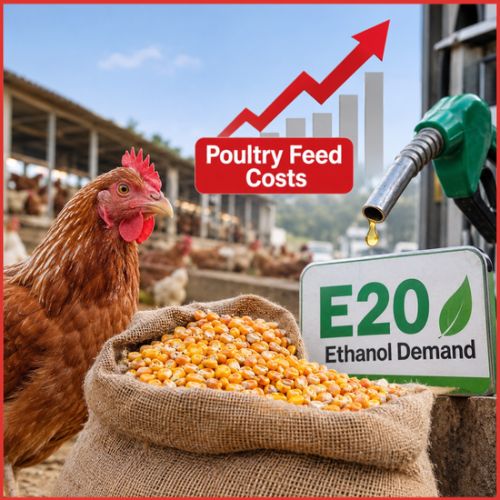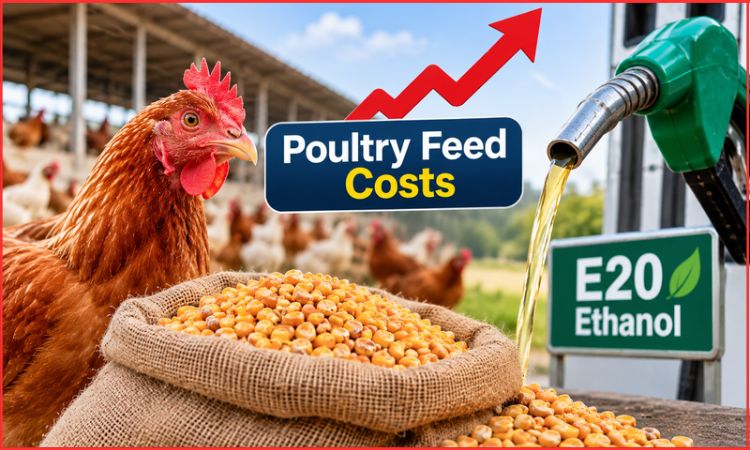
India’s ethanol programme is creating a difficult purchasing environment for poultry producers as fuel manufacturers and feed businesses compete for maize.
The concern centres on a crop that serves several markets. Maize supplies energy in animal feed, provides raw material for industrial processing and can also be converted into ethanol for petrol blending.
As E20 ethanol demand expands the fuel market for grain, poultry farmers face the possibility of higher feed bills without an equivalent increase in the prices they receive for eggs and chicken.
Industry representatives have raised concerns about that imbalance in recent months. Weather-related uncertainty and the availability of alternative ethanol feedstocks add further complications.
The issue is therefore broader than a simple contest between food and fuel. It concerns how grain supply, purchasing power and production costs are distributed across connected industries.
Maize Demand Now Comes From Several Directions
E20 refers to petrol containing 20% ethanol.
India’s blending programme aims to reduce dependence on imported petroleum while creating demand for domestically produced fuel ingredients. Ethanol can be made from different feedstocks, including eligible sugar-industry materials and grains.
For maize growers, additional buyers can create a larger market. For businesses that already depend on the crop, those buyers introduce more competition.
Poultry feed manufacturers must secure grain of suitable quality at a price that works within their production costs. Ethanol producers make their purchasing decisions according to a different set of economics.
The two industries can therefore place different values on the same available supply.
When production and stocks are sufficient, competing uses may be accommodated more easily. When availability tightens, the pressure becomes more visible through prices, procurement difficulties or both.
That is the immediate concern for poultry producers buying feed regularly.
Farmers Have Already Reported A Cost Squeeze
The pressure is not entirely new.
A September report from Namakkal cited poultry-industry representatives describing maize prices rising from around ₹22 per kilogram to as much as ₹30 over the preceding year.
Those were reported local figures at that time, rather than a single nationwide November price.
The same coverage described smaller poultry businesses struggling to absorb the increase, while financially stronger participants had greater scope to hold grain stocks.
That distinction remains important. A farm purchasing smaller quantities as needed may face a different cost from a large business able to negotiate bulk supplies.
For a poultry producer, rising maize prices affect repeated expenditure. Birds need feed throughout the production cycle, so the business cannot simply suspend purchases until the market becomes more favourable.
The financial pressure accumulates while the farmer waits to sell the output.
Higher Feed Bills Do Not Translate Automatically Into Higher Selling Prices
A producer facing a more expensive input has limited choices.
It can absorb the increase, attempt to improve efficiency, change purchasing arrangements or seek a higher selling price.
The final option depends on market conditions. Egg and chicken prices also reflect demand, available supply and the bargaining position of buyers.
A farmer cannot assume that every additional rupee spent on feed will be recovered immediately.
That gap is the source of the margin squeeze. Production continues at a higher cost, while the selling price may respond slowly or unevenly.
Consumers may eventually encounter some of the increase, but the timing and scale are not predetermined. Part of the burden can remain with farmers, processors or traders.
This makes it misleading to treat a rise in maize prices as an immediate, identical rise in retail poultry prices.
Grain Availability Matters Alongside Fuel Policy
The intensity of competition depends on how much grain reaches the market.
Crop output, storage losses, transport and the timing of arrivals can all influence the supply available to feed mills and distilleries.
Weather uncertainty makes that calculation harder. Buyers may become more cautious about future availability, while producers need to plan procurement before the final harvest picture is clear.
Industry concerns about ethanol demand therefore need to be assessed alongside agricultural conditions.
A larger fuel market can increase demand, but its price effect will depend on the crop available to meet it.
The distinction matters for policy responses. Increasing production addresses one part of the problem; improving drying, storage and distribution addresses another.
Neither offers an instant solution to a poultry farmer facing a higher feed invoice this week.
Ethanol Production Also Returns A Feed Ingredient
There is another side to the relationship.
Grain-based ethanol production creates distillers dried grains with solubles, commonly called DDGS. This material can be used in animal feed.
The government has previously identified the coproduct as a protein source for cattle and poultry feed. Recent industry reporting also describes its growing use as an alternative to some soybean-meal requirements.
That means grain entering a distillery does not disappear entirely from the feed system.
However, DDGS should not be treated as an identical replacement for the original grain. Feed formulation depends on nutritional composition, quality and the requirements of the animals being raised.
Its availability may help with some ingredient costs without eliminating pressure on maize procurement.
The balance is therefore more complicated than measuring only the grain purchased by ethanol producers.
Smaller Farms Have Less Room To Wait
Industry representatives have highlighted smaller livestock producers as particularly exposed to volatile ingredient prices.
Larger businesses may have more purchasing options, working capital or storage capacity. A small farm may need to buy at the prevailing rate because its immediate priority is keeping production running.
That makes access to affordable working capital and dependable supplies relevant alongside the headline crop price.
There is also a planning problem. A farmer needs to estimate the cost of completing a production cycle before knowing exactly what the output will fetch.
Persistent poultry feed cost inflation makes those estimates less reliable. A business can begin a cycle expecting one margin and finish with a much narrower result.
Supply Improvements Will Determine How The Pressure Develops
The longer-term challenge is to expand grain availability without allowing essential users to become financially vulnerable during the transition.
Industry proposals include better crop productivity, improved storage, clearer allocation information and flexibility when supplies tighten.
Each addresses a different part of the chain. More production helps only if grain can be stored safely and moved to buyers at a workable cost.
For poultry farmers, the immediate measure of progress will be simpler: whether suitable feed remains available at a price their sales can support.
E20 creates a substantial market opportunity for grain producers and ethanol businesses. Managing its effect on existing users will be essential if that opportunity is to coexist with affordable poultry production.