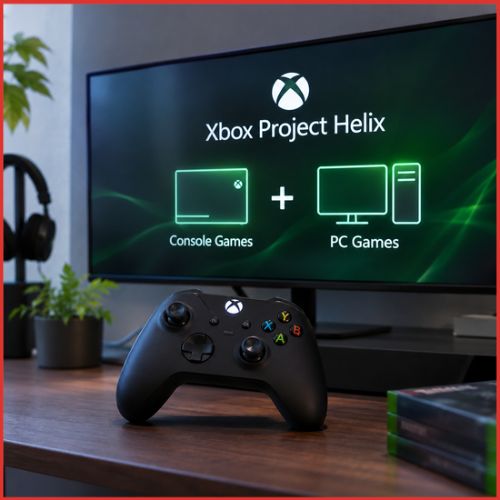
Microsoft’s next Xbox is taking shape around a promise that reaches beyond better graphics: a console designed to play both Xbox console games and PC games.
Known as Xbox Project Helix, the hardware remains in development. Microsoft outlined its direction earlier this year, confirming a custom AMD processor and plans to begin shipping alpha hardware to developers in 2027.
That timetable concerns development equipment, rather than a confirmed retail launch. The official announcements reviewed do not establish a consumer release date or selling price.
For players, the larger question is how this combination will work. Bringing PC games into a console experience could widen the available library, but the details of compatibility, purchasing and everyday use will determine its value.
Project Helix Starts With A Broader Library Ambition
Microsoft has described Helix as its next-generation first-party console, designed to accommodate Xbox and PC games.
That ambition addresses a familiar divide. Players often build libraries across different devices, while access to those purchases depends on the platform, store and version involved.
A console capable of playing PC games could make some of those boundaries less restrictive. However, Microsoft’s broad description should not be treated as confirmation that every Windows game or storefront will work without qualification.
The practical questions remain specific. Which games will be supported? How will players access them? Will features behave consistently across different versions?
Those answers matter more to an existing customer than the general promise of a larger library. Someone considering new hardware will want to know whether the particular games they own are included.
The next-generation Xbox console therefore has two jobs: delivering more capable hardware and making the available software straightforward to understand.
AMD Partnership Supports The Hardware Design
Microsoft has confirmed that Project Helix uses a custom AMD system-on-chip, developed alongside the next generation of DirectX and AMD’s FSR technology.
The company has also claimed an order-of-magnitude improvement in ray-tracing performance and capability.
That is a substantial technical claim, but it does not mean every game will run ten times faster. Ray tracing represents one part of the work involved in producing an image, and its effect varies between games.
A finished title must balance graphics, simulation, responsiveness and the demands of its particular design. Developers decide how to use the resources available.
For players, the useful evidence will eventually come from running games: how consistently they perform, what visual improvements are visible and which compromises remain.
At this stage, the custom AMD processor establishes the hardware partnership and direction. It does not provide a complete specification sheet or substitute for independent testing.
Developer Hardware Is Planned For 2027
Microsoft’s plan to send alpha hardware to developers beginning in 2027 is an important milestone.
Studios need access to a platform before they can properly assess how their games behave on it. That work involves much more than confirming that a title starts.
Developers must examine performance, memory use, controls, installation and the features that connect a game to the wider platform.
Early hardware also provides a way to discover problems while there is still time to address them. The process can influence both software development and the platform itself.
For customers, the distinction between developer equipment and a retail product is worth preserving. An alpha shipment date does not establish when a finished console will appear in shops.
Likewise, a game demonstrated during development may not represent its final performance. Hardware, tools and software can all change before release.
Play Anywhere Shows How Shared Ownership Can Work
Microsoft already operates a more limited connection between console and PC through Xbox Play Anywhere.
For participating digital games, one qualifying purchase allows play across supported Xbox consoles, Windows PCs and gaming handhelds without an additional purchase. Progress, achievements and supported add-ons can move with the player.
The key word is participating. Play Anywhere applies to eligible titles and purchases; it is not a blanket entitlement covering every game available on PC.
That existing programme offers a useful reference for understanding Microsoft’s wider direction. The company has experience connecting purchases and progress across devices.
Helix could make the relationship more significant, but its eventual compatibility rules still need to be explained on their own terms.
Players should not have to infer support from an architectural promise. Clear store listings, library information and account requirements will be essential when the hardware reaches customers.
Older Games Remain Part Of The Discussion
Microsoft has also stated its commitment to keeping games from four Xbox generations playable for years to come.
That commitment matters because a console purchase often sits on top of years of spending. Players bring established libraries, saved progress and preferences to a new system.
For those customers, improvements to new releases are only part of the decision. Continued access to older favourites can be equally important.
However, a general preservation commitment does not confirm universal compatibility. Title-level information remains necessary, particularly where different editions or purchase formats are involved.
The Xbox backward compatibility story will therefore need practical detail alongside the hardware announcement.
A clear account of supported games would help customers assess Helix against the equipment they already own, rather than making a decision based entirely on future releases.
Price And Everyday Simplicity Will Shape Its Appeal
A more capable console still has to justify its place in the home.
Buyers will consider price, available games, storage and the experience of using the device. A broader library could be attractive, but complicated access rules could weaken that advantage.
The interface will be especially important if console and PC games appear together. Players need to understand what they own, what they can install and what requires a separate purchase.
Microsoft has presented Helix as part of its effort to make gaming more connected across devices. Whether that feels convenient will depend on ordinary actions working smoothly, from launching a game to returning to saved progress.
Project Helix has a defined direction and a developer milestone ahead. The next decisive information will concern the finished product: its price, release timing, supported library and performance in actual games.