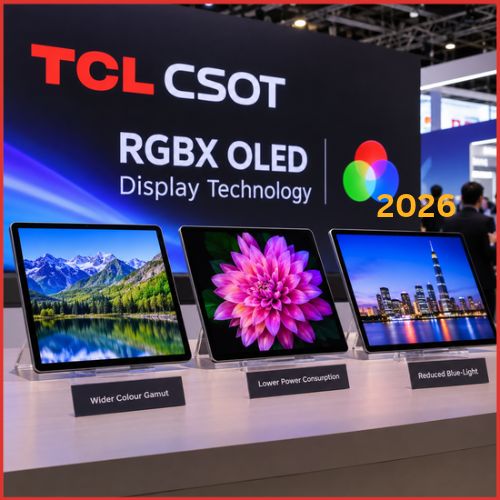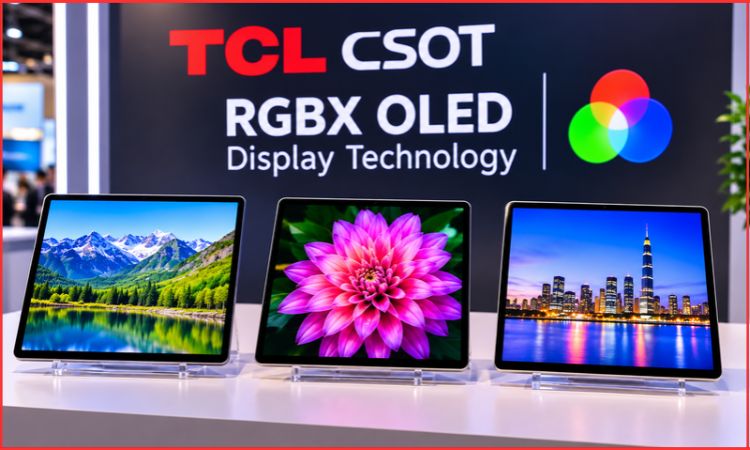
TCL CSOT has demonstrated three 10.95-inch OLED tablet displays built around RGBX display technology, using an additional colour component to pursue different improvements in picture quality, power consumption and blue-light characteristics.
The panels appeared at the company’s DTC 2026 display conference. They share a common underlying approach, but each demonstration has a separate purpose.
One focuses on expanding colour reproduction. Another targets lower power consumption. The third changes the blue-light characteristics of the display.
These are panel demonstrations rather than an announcement of three finished tablets. Pricing, retail availability and the devices that might eventually use the screens remain important unanswered questions.
Even so, the presentation offers a look at how TCL CSOT wants to develop tablet OLEDs beyond the familiar competition over brightness, resolution and refresh rate.
What The Extra X Changes
Conventional RGB displays reproduce colours through red, green and blue components. TCL CSOT’s RGBX OLED architecture adds a fourth component, with its role changing according to the intended application.
The “X” therefore does not describe one fixed material used identically across all three panels. It represents an additional element that TCL CSOT can select to address a particular display characteristic.
That distinction matters when reading the announcement. The colour-gamut figures, power-saving claim and blue-light measurement belong to different demonstrations. They should not be combined into a specification sheet for one commercially available screen.
The approach gives panel designers another variable to work with. Instead of pursuing every improvement through the same three components, the architecture introduces another way to influence the output.
For tablet manufacturers, the eventual attraction would depend on which trade-offs fit a product. A device designed for entertainment may have different priorities from one intended primarily for reading or long working sessions.
One Panel Targets A Wider Colour Range
The colour-focused demonstration incorporates a deep-red component alongside a narrow-spectrum green emitter. TCL CSOT says the panel can switch between modes covering 89% and 95% of the BT.2020 colour gamut.
Those percentages describe the range of colours the display can reproduce against that reference space. They are not scores for overall picture quality.
A wider gamut can provide more room for reproducing richly coloured material. Whether the result looks accurate depends on how the display handles the content it receives.
That makes colour management part of the story. A screen capable of reproducing a broad range still needs suitable calibration and software behaviour to present ordinary photographs, websites and video correctly.
For someone editing images, consistency may matter more than an especially vivid demonstration. For someone watching films, the relationship between the content and the selected picture mode will matter.
The dual-mode design is therefore interesting because of the flexibility it suggests. Independent testing would be needed to establish how well that flexibility works in a finished device.
The Efficiency Version Claims Lower Panel Power
A second 10.95-inch OLED tablet display concentrates on energy efficiency. TCL CSOT reports a 20% reduction in power consumption using an approach involving phosphor-sensitised fluorescence technology associated with the blue component.
The company also describes high- and low-power display modes.
The headline figure needs to remain attached to its subject: panel power consumption. It does not establish that a tablet using the screen would last 20% longer between charges.
A tablet also powers its processor, wireless connections, memory and other components. The share consumed by the display changes with the task and settings.
Nevertheless, a more efficient panel could give a manufacturer useful choices. It might help extend runtime, support a different battery design or reduce the energy required during screen-intensive use.
The practical benefit would need to be measured under comparable conditions. Brightness, displayed material and operating mode would all be relevant when assessing the claimed improvement.
A Third Version Changes Blue-Light Output
The remaining demonstration uses a light-blue electroluminescent material and supports switching between a normal mode and an eye-care mode.
TCL CSOT quotes a 0.5% blue-light-hazard metric for this version. That is a manufacturer-reported measurement, rather than a clinical finding about how a tablet affects a user.
It should not be interpreted as a guarantee that the screen prevents eye strain or makes unlimited viewing comfortable.
For buyers, the useful questions would include how the mode changes the image and whether it remains suitable for their work. A setting intended for reading may be less appropriate when judging colours in a photograph.
The announcement is best understood as a change to the panel’s light-emission characteristics. Broader conclusions about comfort require more information than a single percentage.
Three Demonstrations Leave Room For Different Products
The decision to show three versions is arguably as significant as any individual number.
Tablet screens serve several purposes, often within the same day. Reading documents, watching video and working with images place different demands on the display.
TCL CSOT’s presentation suggests an attempt to give device manufacturers more ways to choose their priorities.
It also leaves questions that cannot be settled at a conference demonstration. Manufacturers would need to consider production consistency, component availability, integration and cost alongside the advertised benefits.
A promising panel does not automatically become a widely available tablet. The surrounding product still has to make sense.
The Next Milestone Is A Finished Device
For now, the TCL CSOT OLED panels show three directions for the same architectural idea: a broader colour range, lower display power and modified blue-light output.
The next meaningful step would be an announced device with confirmed specifications and availability.
That would allow the technology to be judged as people actually use it, including how modes behave, how long the battery lasts and whether picture quality remains consistent.
The demonstration supplies an interesting engineering proposal. A finished tablet, followed by independent measurements, will establish how much of that proposal reaches the buyer.