Ask ten people about Snapdeal and most will remember the orange app and the sale banners. Far fewer know what the people behind it did next. The Kunal Bahl Business Empire today is three things at once: an operating marketplace, a listed software company and one of the busiest seed-stage investors in the country. Each piece grew out of the one before it, and that order is what makes the story worth telling.
This article follows the Snapdeal founder from a rejected work visa to a portfolio of 300+ companies. Every figure below carries a named source and a year. It covers Kunal Bahl Snapdeal, Titan Capital, Kunal Bahl investments, Kunal Bahl startups and the wider Indian startup ecosystem those bets sit inside.
| Quick Glance | Detail |
| Best known as | Co-founder of Snapdeal and Titan Capital |
| Business group | AceVector (Snapdeal, Unicommerce, Stellaro Brands) |
| Snapdeal launched | 2010, as a daily-deals platform |
| Titan Capital portfolio | 300+ startups (ET Now GBS, 2026) |
| Notable exits | Ola, Urban Company, Mamaearth, Credgenics |
| Winners Fund | Rs 333 crore final close, 2024 (YourStory) |
| Unicommerce listing | August 2024 |
Who Is Kunal Bahl?
Kunal Bahl is an Indian entrepreneur and investor, and the Snapdeal founder people usually mean when they use the name. He studied engineering and business at the University of Pennsylvania through the Jerome Fisher Program in Management and Technology, and later picked up an executive marketing certificate from Kellogg. Snapdeal’s own team page says he worked briefly at Microsoft in the US, then returned to India after his H1B visa was rejected in 2007.
That rejection matters more than it sounds. It sent a Wharton-trained graduate back home to build something while the Indian internet was still small. He teamed up with Rohit Bansal, and the two have worked side by side ever since, on Snapdeal, on Titan Capital and across the wider group.
Kunal Bahl Snapdeal: Where the Business Empire Began
From Daily Deals to a Full Marketplace
Snapdeal went live in 2010 as a daily-deals site. Coupons for spas, restaurants, weekend breaks. It was a cheap way to get people comfortable with paying online, which in 2010 was not a given. The Snapdeal founder duo soon saw that deals were only a small door into a much larger room, and rebuilt the site as a marketplace where sellers listed products themselves.
Investors noticed. Business Standard (2024) notes that Snapdeal was once valued at $6.5 billion. The Kunal Bahl Snapdeal story is really about timing as much as product: phones were getting cheaper, first-time shoppers were coming online, and nobody had yet locked up the market.
The Flipkart Merger That Never Happened
The years after the peak were harder. Amazon and Flipkart spent heavily on logistics and discounts, and Snapdeal could not match them rupee for rupee. A merger with Flipkart was explored and collapsed, as Business Standard (2024) records.
What came next was a smaller, sharper Snapdeal. It stopped chasing everyone and went after value-conscious shoppers, mostly outside the big metros, with fashion, lifestyle and home products at low price points. The company says it has served over 10 crore online shoppers across 16 years. For the Snapdeal founder, this second phase was quieter than the first, but it kept the business standing.
AceVector: The Group Sitting Behind Snapdeal
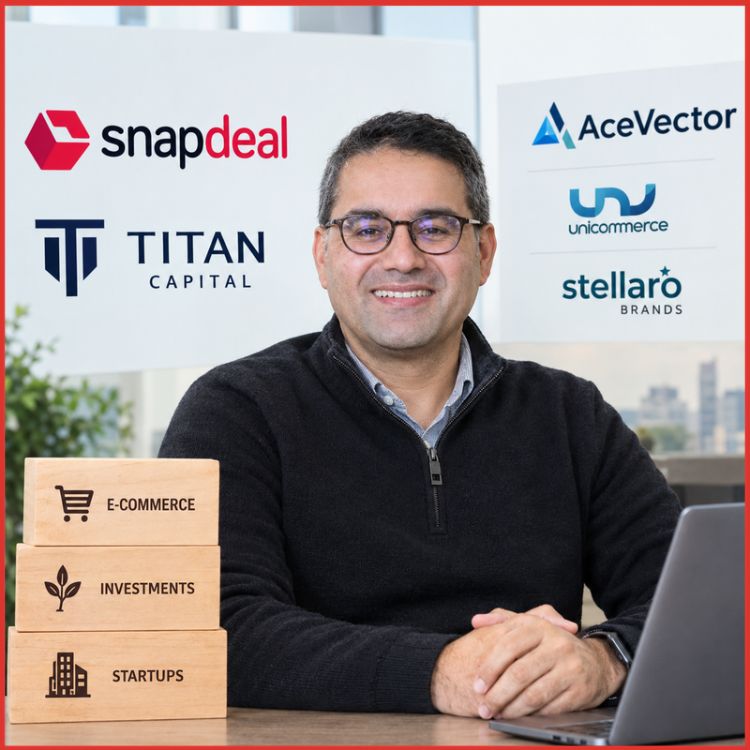
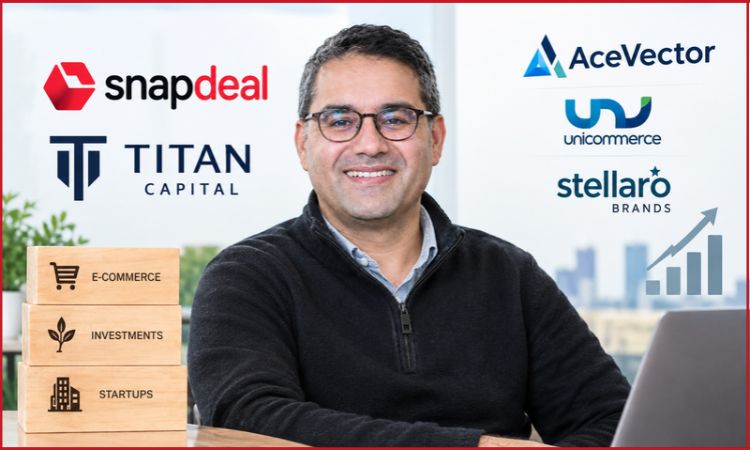
Snapdeal today sits inside AceVector, the group identity its parent company took on in 2022. AceVector also holds Unicommerce and Stellaro Brands, and Bahl is its promoter and joint managing director.
Unicommerce is the piece most casual readers miss. Snapdeal acquired the e-commerce software firm in 2015, and it listed on the stock exchanges in August 2024, according to FounderVox (2026). It sells order, inventory and fulfilment tools to other online sellers. That gives the Kunal Bahl Business Empire something Snapdeal alone never could: a listed technology company that earns from the growth of e-commerce without selling a single kurta itself.
Titan Capital: Where Kunal Bahl Investments Took Shape
Titan Capital is the second engine. Bahl and Bansal began writing small cheques to founders around 2011, well before Titan looked like a fund. Forbes India (2023) quotes Bahl saying they started investing mainly to help founders, and that many of the early ones simply turned up. His favourite example is Bhavish Aggarwal, who walked up to him at a travel conference with an early version of the Ola app.
Titan Capital now lists 300+ startups across consumer tech, health tech, fintech, SaaS, consumer brands and B2B platforms, per the ET Now Global Business Summit (2026) speaker profile. Business Insider (2025) named Bahl among the world’s top 100 early-stage investors. Titan writes cheques of roughly $300,000 to $500,000, according to its OpenVC profile, and says it is usually the first outside money in.
How Titan Capital Picks Founders
Team first. Titan’s own profile calls the founding team its number one criterion and describes the firm as sector-agnostic, with a valuation cap of around $6 million at entry. Kunal Bahl investments are rarely about a market map. They are about whether the person in the room looks likely to keep going when things get ugly.
The Returns That Made Titan Capital Famous
- Ola – Titan Capital put in about $60,000 in 2011 and exited fully in late 2021, around the time Ola reached a peak valuation of $7.3 billion, as reported by Entrackr (2023).
- Urban Company – Entrackr (2024) reported that Titan invested Rs 57 lakh in the early rounds and fully exited with Rs 111 crore, roughly a 200X return. That figure includes a partial exit in 2021.
- Mamaearth and Credgenics – When Mamaearth listed in November 2023, Entrackr (2023) estimated that Bahl and Bansal’s outlay of about Rs 38.30 lakh turned into roughly Rs 38.66 crore through the IPO. The same report says Titan booked a 100-fold return from a partial exit in Credgenics, the debt-recovery and legal-automation platform, in August 2023.
Kunal Bahl Startups: A Portfolio With No Single Theme
Kunal Bahl startups do not share a sector, and that looks deliberate. Razorpay handles payments. OfBusiness runs B2B procurement. Shadowfax does hyperlocal delivery. Credgenics works on debt recovery, Giva sells jewellery and Mamaearth sells personal care.
The habit has not slowed. PitchBook (2026) lists a March 2026 investment by Bahl in Laani, a personal products company. Small cheque, early stage, same pattern as before.
Most of these bets will not work, which is how seed investing goes. What Titan Capital gets from 300+ of them is volume: a wide enough spread that a handful of Olas and Urban Companies can carry the rest.
The Winners Fund and the Rs 333 Crore Follow-On Bet
Seed cheques are one thing. Doubling down on the ones that work is another, and Titan built a vehicle for it. The Titan Capital Winners Fund, a SEBI-registered Category II AIF, crossed its Rs 200 crore target in August 2024 with Bahl and Bansal as anchor investors, per Startup Story (2024). It reached a final close of Rs 333 crore that October, and YourStory (2024) says it will back about 20 portfolio companies with an average ticket of Rs 15 crore, exclusively in follow-on rounds.
The move says something about how Kunal Bahl investments have matured. The early phase was about spotting founders. The current one is about holding on to the winners as they grow.
Snapdeal vs Titan Capital: Two Very Different Businesses
The two share founders and very little else. One sells products to shoppers; the other buys stakes in companies.
| Factor | Snapdeal | Titan Capital |
| What it does | Value-focused online marketplace | Early-stage startup investing |
| Started | 2010 | Investing from around 2011 |
| Who it serves | Shoppers and sellers | Founders |
| How it earns | Marketplace and seller services | Exits and investment returns |
| Sector exposure | E-commerce | Consumer, fintech, SaaS, health tech, B2B |
| Bahl’s role | Co-founder; joint MD of parent AceVector | Co-founder, investor |
What the Kunal Bahl Business Empire Means for the Indian Startup Ecosystem
Bahl does not stop at writing cheques. He chairs the CII Startup Committee, sits on India’s National Startup Advisory Council and has appeared as a panellist on Shark Tank India for Seasons 4 and 5, according to the Snapdeal team page.
His own view on money is worth noting. In a YourStory (2024) interview he said that about 85% of the capital behind Indian startups still comes from abroad, which leaves the Indian startup ecosystem hanging on the mood of global markets. He wants more domestic investors to take part. Titan Capital, funded in large part by its founders’ own wealth, is one example of that argument in practice.
It is also part of a pattern. Founders who cash out or scale up put money and advice back into the next batch, and the Snapdeal founder is a clear case of that cycle. One caution, though: Snapdeal itself never became the giant it once looked set to be. The empire is wider than it was, but its most famous name is no longer its biggest earner of respect or returns.
Key Takeaways
- The Kunal Bahl Business Empire has three parts: Snapdeal, the Unicommerce software business and Titan Capital, with AceVector as the parent group.
- Kunal Bahl Snapdeal began in 2010 as a daily-deals site and was later rebuilt around value shopping.
- Titan Capital lists 300+ startups and writes cheques of about $300,000 to $500,000 at the seed stage.
- Reported exits include Ola (about $60,000 in, exited late 2021), Urban Company (Rs 57 lakh in, Rs 111 crore out) and Mamaearth.
- The Rs 333 crore Winners Fund exists to back top portfolio companies in follow-on rounds.
Conclusion
Snapdeal gave Kunal Bahl a name. Titan Capital gave him reach. Between them sits AceVector, holding a marketplace, a listed software firm and a consumer brands arm, while the investing side keeps adding companies year after year. The Kunal Bahl Business Empire is easy to describe but hard to copy, because the pieces fed each other: what Snapdeal taught, Titan applied; what Titan earned, the founders could reinvest. For anyone studying the Indian startup ecosystem, the Snapdeal founder is worth watching less for his hits than for how he keeps the machine running.
FAQs
1. Who is Kunal Bahl?
Kunal Bahl is an Indian entrepreneur and investor, co-founder of Snapdeal and Titan Capital, and promoter and joint managing director of AceVector.
2. What is Titan Capital?
Titan Capital is the early-stage investment platform of Kunal Bahl and Rohit Bansal. It backs startups across sectors and lists 300+ portfolio companies.
3. Which Kunal Bahl startups has Titan Capital backed?
Ola, Urban Company, Razorpay, Mamaearth, OfBusiness, Shadowfax, Credgenics and Giva are among the names, according to the ET Now Global Business Summit (2026) profile.
4. What is AceVector?
AceVector is the parent group of Snapdeal, Unicommerce and Stellaro Brands. Bahl is its promoter and joint managing director.
5. Is Kunal Bahl still involved with Snapdeal?
Yes. He remains a co-founder and board member at Snapdeal and leads its parent group AceVector alongside his work at Titan Capital.