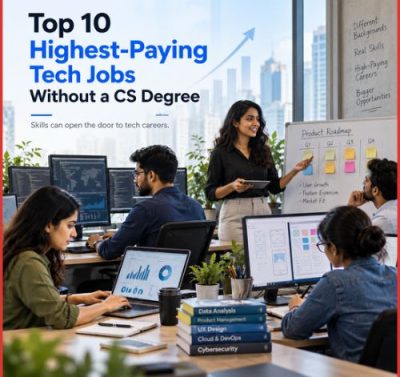
Looking for the highest-paying tech jobs without a computer science degree? One does not necessarily need a B.Tech in Computer Science or a four-year CS degree to build a high-paying career in technology.
A degree can get you your first job easily. But it is not the only way to prove your skills.
Nowadays, companies also look at what one can build, the tools he knows, the problems he can solve.
Even how updated you are with the latest AI tools.
This is especially relevant in India. While large IT services companies still use strict degree filters, many startups, product companies and Global Capability Centres (GCCs) focus more on practical skills, portfolios and relevant experience.
This creates opportunities for graduates from non-technical backgrounds like commerce, arts, management, design and other backgrounds who are willing to learn technical skills.
Data analysis, product management, cloud computing, cybersecurity and tech sales, here are 10 high-paying tech careers you can pursue without a traditional computer science degree.
10 Highest-Paying Tech Jobs Without a CS Degree
| Rank | Job | Typical US Salary | Typical India Salary |
|---|---|---|---|
| 1 | Data Analyst | $75,000–$115,000 | ₹7 lakh–₹16 lakh |
| 2 | Product Manager | $115,000–$170,000 | ₹15 lakh–₹35 lakh |
| 3 | UX/UI Designer | $85,000–$135,000 | ₹8 lakh–₹22 lakh |
| 4 | Cloud Architect/Engineer | $125,000–$180,000 | ₹15 lakh–₹38 lakh |
| 5 | Cybersecurity Analyst | $95,000–$145,000 | ₹10 lakh–₹25 lakh |
| 6 | Technical Writer | $80,000–$130,000 | ₹8 lakh–₹20 lakh |
| 7 | Tech Sales/Solutions Engineer | $110,000–$220,000+ | ₹12 lakh–₹45 lakh+ |
| 8 | Scrum Master/Agile Coach | $95,000–$140,000 | ₹14 lakh–₹28 lakh |
| 9 | DevOps Engineer | $120,000–$175,000 | ₹16 lakh–₹32 lakh |
| 10 | Front-End Developer | $80,000–$135,000 | ₹6 lakh–₹20 lakh |
Note: Salary ranges are broad market estimates. Actual pay varies by location, experience, company, skills and role level.
1. Data Analyst
A Data analysts turn raw business data into useful information that companies can use to make decisions.
You may work with sales figures, customer behaviour, marketing data, financial records or operational data.
Modern analysts who can use AI tools to speed up repetitive work such as data cleaning, SQL queries and initial analysis are in demand.
Note:- Human judgement is still needed to understand what the numbers actually mean.
Why you don’t need a CS degree
Data analysis is less about advanced computer science theory and more about:
- Logical thinking
- SQL
- Excel or spreadsheets
- Data visualisation
- Basic Python
- Business understanding
- Communication
How to get started
Start by learning SQL, Excel, Python and a visualisation tool such as Tableau or Power BI.
Build 3–5 projects using real or publicly available datasets. Show the problem, explain your analysis and the business insight you found.
You can also consider the Google Data Analytics Professional Certificate as a structured starting point.
Salary range
- India: ₹7 lakh–₹16 lakh
- US: $75,000–$115,000
- Singapore: S$50,000–S$85,000
2. Product Manager
Product managers decide what the company should build, for whom and which problems it should solve.
Product managers work closely with developers, designers, marketers and business teams.
You don’t usually write the code yourself. Instead, you need to understand enough technology to work effectively with engineers.
Why you don’t need a CS degree
Product management depends heavily on:
- Customer understanding
- Communication
- Business strategy
- Market research
- Problem-solving
- Prioritisation
- Leadership
People from business, marketing, sales and other non-technical backgrounds can transition into product management.
How to get started
Start by learning product fundamentals and Agile methods.
Then create evidence of your product thinking:
- Write product teardowns
- Analyse popular apps
- Identify user problems
- Suggest product improvements
- Build a small no-code product
- Document your decisions
An internal move from marketing, operations, sales or customer success can also be an effective route into product management.
Salary range
- India: ₹15 lakh–₹35 lakh
- US: $115,000–$170,000
- Singapore: S$80,000–S$130,000
3. UX/UI Designer
UX/UI designers make websites and apps easier and more enjoyable to use.
UX focuses on the user experience, while UI focuses more on the visual interface.
Why you don’t need a CS degree
This career is built around design, user behaviour and problem-solving rather than computer science.
Useful skills include:
- User research
- Wireframing
- Prototyping
- Visual design
- Usability testing
- Design systems
- Figma
How to get started
Learn Figma and basic UX principles.
Then build a strong portfolio. You can redesign an existing app or create a complete mobile app concept. Explain:
Problem → Research → Design decision → Prototype → Result
That makes your portfolio much more convincing.
Salary range
- US: $85,000–$135,000
- Singapore: S$60,000–S$95,000
- India: ₹8 lakh–₹22 lakh
4. Cloud Architect or Cloud Engineer
Cloud professionals build and manage the infrastructure that runs modern applications.
Common platforms include:
- Amazon Web Services (AWS)
- Microsoft Azure
- Google Cloud
Cloud engineers may work on infrastructure, networking, security, deployment and application performance.
Why you don’t need a CS degree
This job is one of the most technical jobs in the list, and therefore, the lack of a CS major does not make it easy.
However, certification, projects and experience can be used by companies to gauge practical cloud skills.
How to get started
Start with cloud fundamentals and Linux.
Then learn networking, security and infrastructure basics.
Useful certifications include:
- AWS Certified Solutions Architect
- Microsoft Azure certifications
- Google Cloud certifications
Don’t stop at certification. Deploy applications, configure cloud services and document your architecture. Practical projects make the certification more valuable.
Salary range
- US: $125,000–$180,000
- Singapore: S$90,000–S$140,000
- India: ₹15 lakh–₹38 lakh
5. Cybersecurity Analyst
The main responsibility of cybersecurity specialists is to safeguard networks, systems, and information from potential threats.
Depending on your position, you might be responsible for monitoring alert messages, conducting investigations, discovering weaknesses, or helping companies to enhance their cybersecurity controls.
Why you don’t need a CS degree
Cybersecurity is concerned with hands-on abilities and problem solving.
Knowledge of systems is necessary, but you can learn most of that information without being in an academic computer science program.
Important skills include:
- Networking
- Linux
- Security fundamentals
- Threat detection
- Incident response
- Vulnerability assessment
How to get started
Start with the basics in networking and operating systems.
Then look at certification like CompTIA Security+.
Gain experience in legal environments by using websites such as TryHackMe and HackTheBox.
You can have a portfolio in cybersecurity with labs and problems solved in security assessments.
Salary range
- Singapore: S$65,000–S$110,000
- India: ₹10 lakh–₹25 lakh
- US: $95,000–$145,000
6. Technical Writer
Technical writers are responsible to rewrite complicated technical information into documentation that users and developers can understand.
They may write:
- API documentation
- Product guides
- Developer documentation
- Tutorials
- Knowledge-base articles
- Technical explanations
There have been changes due to AI in this domain too. As writers use AI programs in researching, arranging and enhancing documentation, but human writers continue to bear responsibility for accuracy, clarity, and context.
Why you don’t need a CS degree
Good writing and communication skills can outweigh a formal education in computer science.
However, you will need to have some technical expertise, which you can acquire at the same time, when you learn to communicate about technology.
How to get started
Learn basic programming and API concepts.
Then create a portfolio containing:
- API documentation
- Developer tutorials
- Product guides
- Technical explainers
Contributing documentation to open-source projects can also give you real examples of your work.
Salary range
- Singapore: S$55,000–S$90,000
- India: ₹8 lakh–₹20 lakh
- US: $80,000–$130,000
What about prompt engineering?
Prompt engineering is useful as a skill, but it is risky to treat it as a standalone career category. Many companies now expect AI and prompt skills to be part of broader roles such as product, data, engineering, marketing and technical writing.
7. Tech Sales or Solutions Engineer
Technical sales people sell software and technology products to organizations.
Solution engineers have a more technical profile. They demonstrate products, understand the customer needs and explain how technology solutions will integrate in the existing environment.
Why you don’t need a CS degree
Tech sales mainly need communication and other sales skills along with some technical knowledge to give demonstrations. You are there to sell the to build one.
Important skills include:
- Communication
- Negotiation
- Presentation
- Customer research
- Product knowledge
- Business understanding
You need enough technical knowledge to understand the product and explain its value. You don’t necessarily need to build the product yourself.
How to get started
People with B2B sales, marketing or customer-facing experience can have an advantage.
Start by Learning:
- APIs
- Cloud basics
- SaaS business models
- CRM tools
- Enterprise technology
For solutions engineering, add stronger technical skills in areas such as networking, cloud and software integrations.
Salary range
- India: ₹12 lakh–₹45 lakh+
- Singapore: S$80,000–S$160,000+
- US: $110,000–$220,000+
Tech sales compensation can include substantial commissions, so total earnings can vary significantly.
8. Scrum Master or Agile Coach
Scrum masters assist development teams in becoming more productive through Agile methodologies.
They can conduct meetings, remove any obstacles, and streamline the process for the team.
Why you don’t need a CS degree
The job is primarily about people, communication and processes.
Useful skills include:
- Communication
- Facilitation
- Conflict resolution
- Project coordination
- Team management
- Agile methodologies
How to get started
Learn Scrum and Agile fundamentals.
You can pursue certifications such as:
- Certified ScrumMaster (CSM)
- Professional Scrum Master (PSM)
Experience in project management, operations, business analysis or team coordination can provide a useful foundation.
Salary range
- India: ₹14 lakh–₹28 lakh
- Singapore: S$70,000–S$115,000
- US: $95,000–$140,000
9. DevOps Engineer
DevOps Engineers are involved in developing and deploying software in an efficient manner.
They deal with areas like automation, infrastructure, deployment, and monitoring.
Important tools to learn include:
- Docker
- Kubernetes
- Jenkins
- Terraform
- Git
- Linux
- Cloud platforms
Why you don’t need a CS degree
DevOps is a very technical field, but you can demonstrate practical skills in projects and experience in the field.
You would need to understand operating systems, networking, scripting, and infrastructure well.
How to get started
Learn Linux and Git first. Then learn and practice these:-
Linux → Networking → Git → CI/CD → Docker → Cloud → Kubernetes → Infrastructure as Code
Make automatic pipelines for deploying your own projects.
Certifications by cloud providers or any organizations like Red Hat may complement your hands-on work experience.
Salary range
- Singapore: S$85,000–S$135,000
- US: $120,000–$175,000
- India: ₹16 lakh–₹32 lakh
10. Front-End Web Developer
Front-end developers build the parts of websites and web applications that users interact with.
The core technologies include:
- HTML
- CSS
- JavaScript
- React
- Vue
- Modern web development tools
Why you don’t need a CS degree
Front-end web development has one key benefit for those who have taught themselves the skill: your work is easily shown.
All the recruiter needs to do is visit your website, and there it is.
This is why a portfolio is especially important.
How to get started
Begin with the basics – HTML, CSS, and JavaScript. Learn a modern framework like React.
Create at least three complex applications rather than 10 simple tutorial projects. For example:
- An e-commerce interface
- A dashboard with real data
- A full-featured web application
AI coding assistants can speed up development, but don’t depend on them without understanding the code.
Salary range
- Singapore: S$50,000–S$90,000
- US: $80,000–$135,000
- India: ₹6 lakh–₹20 lakh
How to Get a High-Paying Tech Job Without a CS Degree
Understanding which careers are available is only the beginning of this journey.
If you don’t have a traditional technical degree, your biggest challenge is proving that you can do the work.
Use this four-part strategy.
1. Choose One Specialisation
Don’t try to learn everything at once.
Choose something specific:
“I want to become a data analyst specialising in supply-chain analytics.”
Or:
“I want to become a cloud engineer working with AWS.”
A focused skill set makes your learning plan, portfolio and job search much clearer.
2. Build Proof of Your Skills
The certificate indicates that your employer sees you have completed the course. A project highlights your capability. Completing a project is particularly relevant if you do not have any CS certification.
Depending on your target career, build:
- Data: dashboards, SQL projects and analysis reports
- UX: case studies and prototypes
- Development: live web applications
- Cloud: deployed applications and architecture diagrams
- Cybersecurity: documented labs and security assessments
- Product: product teardowns and product case studies
- Technical writing: documentation and tutorials
Your portfolio is evidence of your capabilities.
3. Learn to Work With AI
AI is becoming a part of day-to-day technical activities. There is no need to be an AI scientist to take advantage of it.
The data analyst will find AI useful in generating and reviewing SQL queries. The developer will benefit from AI coding assistants in debugging and creating boilerplate code.
The product manager will leverage AI in synthesizing and documenting research. The technical writer will benefit from using AI in organizing complex information.
The key is knowing when to apply AI, how to validate its output and when human judgment is still needed.
4. Use Networking and Real Projects
Applying to hundreds of jobs on various portals may not be the ideal way for an unconventional applicant.
Instead, build up contacts within your targeted industry. You can:
- Connect with recruiters
- Talk to professionals on LinkedIn
- Attend industry events
- Join technical communities
- Contribute to open-source projects
- Take freelance assignments
- Apply for internships
- Look for internal transfers
Even a small real-world project can become valuable experience if you can clearly explain your contribution and results.
Frequently Asked Questions
1. Can I get a high-paying IT job without a CS degree?
Yes. Most IT positions do not require a Computer Science degree. Positions related to data analysis, cybersecurity, cloud computing, software development, DevOps, and UX design are positions one can pursue without a Computer Science degree. However, some organizations require that you have a Computer Science degree, therefore always check the position’s requirements.
2. What are the highest paying IT jobs without a CS degree?
Some of the best-paid careers in the field of Information Technology without having a Computer Science degree include Cloud Engineering, DevOps, Cybersecurity, Software Development, Data Analytics, AI-related jobs, and UX design.
Nevertheless, better-paid jobs always have more to do with specialization and experience than with certification or courses.
3. Can I become a software engineer without a Computer Science degree?
Yes. A degree in computer science is useful for learning the basics of programming and passing some filtering tests by a recruiter, but it is certainly not the only option. You can gain experience in programming yourself, by taking free online classes, joining coding bootcamps, contributing to open source and getting actual project experience.
4. What skills do I need to get an IT job without a CS degree?
Your skill requirements will be based on what kind of career path you take. For instance, a data analyst is supposed to have skills in Excel, SQL, Power BI, and basic Python.
A cloud professional will need knowledge in networking, Linux, and even cloud computing platforms like AWS and Azure. Cybersecurity will require security and networking basics, while developers will need programming and database skills.
5. Can I get an IT job without a degree or previous experience?
Yes, but it can be harder to get hired without both a degree and experience. Entry-level roles such as IT support, software testing, junior web development, and data analytics can be good starting points. Build practical projects, earn relevant entry-level certifications, create a portfolio, and target employers that focus on skills rather than academic qualifications alone.
Final Takeaway
Getting a computer science degree is a great choice, but it’s certainly not the only path into tech.
The best non-traditional candidates use other signals to substitute for the degree signal:
Skills + projects + experience + a good portfolio + networking
And you don’t have to know all the technologies on the market. Choose one career path, figure out which skills are actually in demand, create projects showcasing those skills and apply before you’re 100% ready.
For an Indian candidate who doesn’t have anything yet, the fields of data analysis, UX/UI design, front-end development and technology sales provide an easy entry point. More technical options like cloud, cybersecurity and DevOps provide higher salaries but also take more time to learn.
The degree might be the thing that gets you noticed. The ability to do the job is what keeps you in the room.