Anthropic has been using itself as something of a laboratory for the AI workplace, and the latest results are striking.
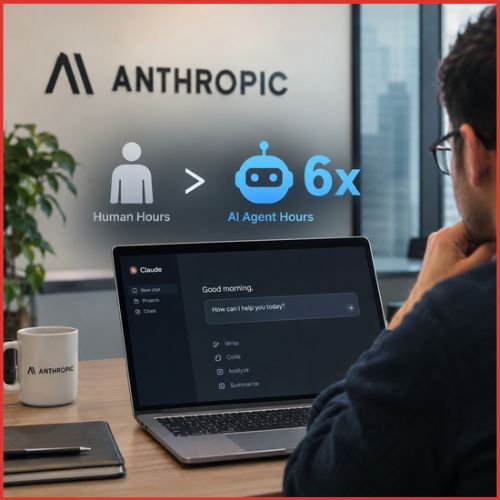
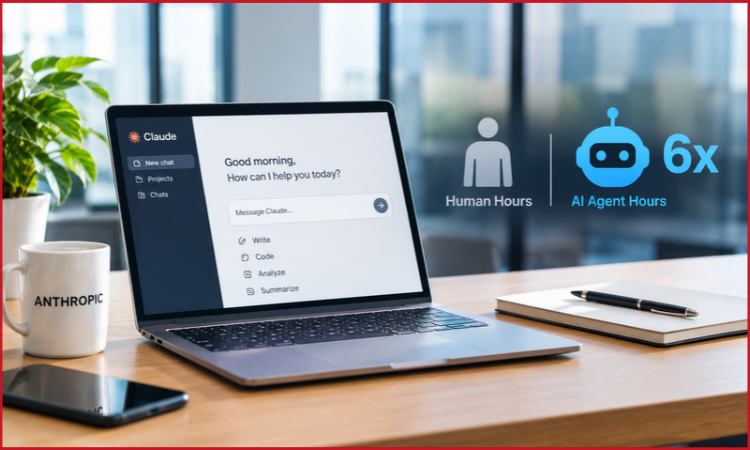
By August, AI agents directed by Anthropic employees were logging six times as many active working hours as the people supervising them. The company also found that the share of junior technical hires has fallen sharply while output per employee has increased across engineering, sales, legal and administrative work.
There is an important distinction in that headline.
Anthropic AI agents are not being described as six times more productive than humans. The company’s measurement compares agent runtime with estimated human working hours.
Even with that caveat, the shift inside one of the world’s most AI-intensive companies gives a useful glimpse at how office work might change when AI agents become commonplace.
AI Agent Hours Passed Human Hours in March
Anthropic analysed telemetry from AI agents being used internally alongside employee data.
In March 2026, the combined working time of autonomous and interactive agents moved past human working hours for the first time.
The gap widened rapidly afterwards.
By August, employee-directed interactive agents alone were working six times as many hours as their human handlers.
Anthropic defines agent working time as runtime spent on inference and actively using tools. Long waiting periods are excluded.
Human hours were estimated using employee headcount and an assumed 40-hour work week.
That methodology matters because AI agent work hours and human hours are not perfectly equivalent measures.
An agent can also work in parallel with several others while one employee supervises them.
That parallelism is part of the point.
Software Engineering Is Where the Shift Is Most Visible
Anthropic produces AI software, so engineering naturally accounts for much of the agent activity.
Agents are being used to write tests, maintain infrastructure code, translate codebases and handle routine engineering work.
Code output has risen sharply.
Anthropic says commits per engineer are running at roughly five times their pace six months earlier.
The company also compared engineers who adopted agentic coding tools with colleagues who had not yet adopted them.
Output increased after adoption, although Anthropic itself cautions that tool use is not random. Employees preparing for large projects may be more likely to start using advanced AI in the first place.
That makes it difficult to attribute every improvement solely to AI.
The Change Is Not Limited to Programmers
One of the more interesting findings appears outside engineering.
Sales representatives using AI agents closed deals with more customers. Legal teams processed more contracts. Accounts-payable employees handled more invoices.
One salesperson told Anthropic that automation had replaced around 20% of previous routine tasks, allowing more time for direct customer interaction.
This is where the AI productivity at Anthropic story becomes broader than automated coding.
Employees are not necessarily handing their entire role to Claude.
Instead, individual pieces of work—drafting emails, updating systems, finding information or preparing a first version of something—are increasingly being given to agents.
The person remains responsible for deciding what actually needs to be done.
Junior Technical Hiring Has Fallen Sharply
The change in work is beginning to show up in hiring.
Junior employees made up around 21% of Anthropic’s technical workforce in early 2025.
That share has since fallen to 14%.
The change is even sharper among new hires.
The decline in entry-level AI jobs inside Anthropic does not prove that every technology company will follow the same path.
Anthropic is an unusual workplace whose employees have access to some of the world’s most capable AI tools before many other companies do.
It does, however, show one possible direction of travel.
Managers Admit AI Is Affecting Hiring Decisions
Anthropic also asked managers directly whether AI had changed how much they hire.
Around one-third of machine-learning managers and roughly one-fifth of software-engineering managers said they were hiring fewer people because of AI.
At the same time, Anthropic itself has continued growing rapidly.
The company says its workforce has roughly tripled over the past year.
So the story is not simply “AI arrives, headcount falls.”
The mix of employees is changing.
Technical functions have fallen from 61% of the workforce to 56% even as technical hiring has increased in absolute terms, because sales, finance and recruiting have expanded faster.
AI may therefore change which employees a growing company needs rather than automatically shrinking the company.
Human Attention Has Become the Bottleneck
Giving one employee several AI agents creates another problem: somebody has to check what they produce.
Anthropic found interactive Claude sessions spend around 80% of their elapsed time waiting for human input.
In other words, the machines are increasingly ready before the people are.
The amount of text generated has also become difficult to absorb.
Anthropic estimates that even non-technical employees would need more than half their working week just to read all the output produced by their interactive AI sessions.
That has created a new type of work.
Employees are building dashboards, monitoring systems and other tools simply to keep track of what their agents are doing.
Hiring Managers Now Value Different Skills
The qualities Anthropic looks for are changing too.
In 2024, hiring managers mentioned candidates’ ability to use AI tools in around 5% of technical assessments and 7% of non-technical assessments.
Autonomy and judgement have also become more important.
Discussion of narrow domain expertise has declined as a share of technical candidate assessment.
That suggests the future of AI jobs may place more value on deciding what should be done, evaluating results and directing tools than on manually carrying out every step.
Anthropic Is a Preview, Not the Whole Economy
The numbers are dramatic, but they need context.
Anthropic is perhaps one of the least representative workplaces available for measuring normal AI adoption.
It builds Claude. Its employees have exceptional access to AI models, internal agents and infrastructure. They also work mainly in knowledge-intensive jobs that are comparatively easy to perform through a computer.
A construction worker, nurse, restaurant employee or warehouse operator does not have the same exposure.
Anthropic itself warns against simply projecting its employment pattern across the entire economy.
Still, the company may provide an early look at what happens inside AI-heavy knowledge businesses.
By August, AI agents were working six times as many hours as Anthropic employees. Junior technical hiring was shrinking, while human attention and judgement were becoming more valuable.
The agents have not removed the humans.
They have changed what the humans spend their day doing.
Source
NewsBytes: Anthropic says AI agents now work six times human hours.